All text, no meet: How to spot a pen pal situation

By Sandra · Updated on 29 September 2026 · ✓ Reviewed by the editorial team

All text, no meet: How to spot a pen pal situation

You've been messaging for weeks. The messages are warm, personal, sometimes even deep. But when you ask to meet up, things get vague. "Soon, definitely." "I'll be more relaxed next week." "Let's just keep messaging for a bit longer."

Welcome to the world of the digital pen pal – the modern dating phenomenon where your thumbs are on fire, but your coffee cup stays empty.

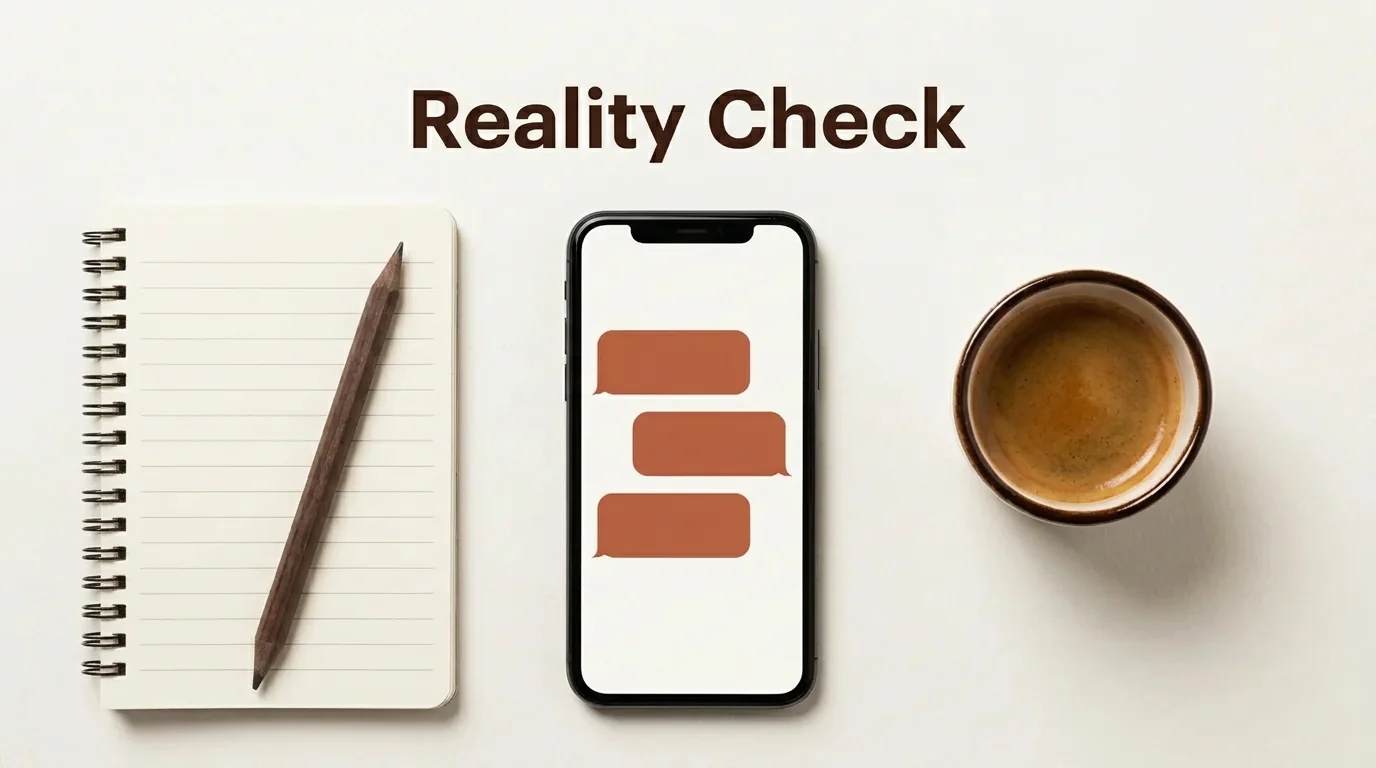
A smartphone showing lots of chat messages next to a lonely coffee cup on a light background, symbolising a purely text-based acquaintance. Chatting or getting to know someone? When digital communication replaces real-life encounters, it's time for an honest reality check of your current dating situation.

In a nutshell

You can spot a purely text-based acquaintance on dating apps and sites when the other person hasn't suggested a concrete plan to meet after two weeks. Often, these singles are just looking for validation or a distraction, not a real date.

  • After two weeks with no concrete plan, it's usually just a text-based acquaintance with no real intention of meeting.
  • Many people use dating apps for validation or to cure boredom, without ever planning to meet up.
  • A clear message with a specific timeframe brings clarity – anyone who still dodges the question isn't truly invested.
  • Ending a text-only acquaintance is self-care, not failure.
  • Dating sites like Match.com, EliteSingles or Ourtime tend to attract singles with serious intentions more than swipe-based apps.

1. Why do we message so much if it never leads to a real meeting?

Digital communication creates a deceptive sense of closeness. Shared thoughts, inside jokes, details from your day – your brain interprets this exchange as a real connection. But in reality, texting lacks facial expressions, body language and the chemistry you can only feel in person. Real intimacy only develops through face-to-face contact.

Avoidance plays a key role. The fear of real-life rejection keeps many people in their digital comfort zone. When you're messaging, you can overthink every reply and perfect every sentence. A meeting involves risk: What if the chemistry isn't there? What if the person is a disappointment in real life?

Then there's the sunk cost fallacy. After three weeks of intense conversation and hundreds of messages, it's hard to admit: this is going nowhere. The time and emotional energy you've already invested make it harder to end the contact.

Finally, some people use dating apps as a form of entertainment. The exchange gives them validation, attention and the feeling of being desirable – without any intention of ever leaving the digital realm. People used to write to each other because they couldn't see each other. Today, they write even though they could meet – but one person doesn't want to.

2. What are the signs I'm in a digital pen pal situation?

Purely text-based acquaintances follow recurring patterns. These seven warning signs are particularly common:

A clear red flag: if the time spent on digital messages is completely out of proportion to actual in-person meetings, you might be heading for a pen pal situation.

The seven warning signs

You're the only one initiating plans. You're the only person who asks to meet up. The other person never suggests a date themselves, but they react warmly to your suggestions – without ever committing to a specific plan.

Systematic excuses for every suggestion. Work, stress, illness, family commitments, home renovations. There's always a plausible reason why now isn't a good time. The excuses sound convincing but are just variations on a theme.

The postponement tactic becomes the norm. "Next week for sure" turns into "the week after next," which becomes "after my holiday." Concrete dates are never mentioned. Instead, you get vague timeframes that are constantly pushed back.

Emotional depth with no practical follow-through. You talk about your childhoods, dreams, fears, and personal values – but when it comes to "coffee at 3 p.m. on Saturday," the conversation suddenly becomes non-committal. The emotional investment is completely out of sync with the willingness to meet.

Focus on compliments instead of genuine connection. Lots of charm, plenty of nice words, but no real curiosity about you as a person with a real life. The conversations remain superficially flattering, never reaching the depth required to truly get to know someone.

A vague identity and avoidance of video calls. No recent photos, evasive answers to specific questions about their life, a flat-out refusal to have a video call. This could also be a sign of catfishing – where the person is pretending to be someone they're not.

Conversations that don't evolve. After weeks of chatting, you don't know any more about each other than you did in the first week. The topics repeat themselves, and you never reach new levels of conversation. A real connection shows progress; a digital pen pal situation just goes round in circles.

3. Could endless texting be a tactic like breadcrumbing or benching?

Not every text-only acquaintance is down to insecurity. Sometimes, there's a deliberate strategy behind it.

Breadcrumbing means giving someone just enough attention to keep them on the hook. Little breadcrumbs: a sweet compliment here, a deep question there, an "I miss our chats" – but never enough to truly invest. The goal is to keep their options open, get validation, and feel good without committing.

Benching goes a step further. The person is keeping you on the substitute's bench while they date other people. They're keeping you warm in case things don't work out with their other options. That's why you get the vague promises, the stalling, the "soon." You're the backup plan, not the first choice.

The ego boost is another pattern. People use dating apps as a free self-esteem boost. Messaging gives them validation, attention, and the feeling of being desirable. A real-life meeting would end the game and shatter the illusion.

Finally, the hidden relationship: some people aren't even single. They're looking for a digital thrill on the side of their existing relationship. A meeting would be too risky and would make the situation real. Warning signs include only being available at certain times, refusing video calls, and being vague about their personal life.

The bottom line is: someone who's genuinely interested makes time. Someone who has time makes a plan. Everything else is an excuse.

4. How long should you message online before asking for a date?

The answer is simpler than many people think: not long.

The sweet spot is about three to seven days of active conversation, or around ten to twenty messages. That's enough to get an initial feel for each other and identify some common ground. At the same time, it's short enough to avoid drifting into a digital fantasy world.

Experiences from singles over 40 or 50 show a clear preference for meeting sooner rather than messaging for weeks. After a long marriage or relationship, they know that chemistry can't be tested over text. Life is too short to waste on illusions. Many prefer a quick phone call before the first date – ten minutes is enough to hear their voice and get a better sense of the person.

A person sitting in a bright room, focused on writing a clarifying message on their smartphone to test a text-based acquaintance. Take action instead of waiting around: use direct communication and the 48-hour test to quickly find out if the other person is genuinely interested in meeting.

The 48-hour test for clarity

The 48-hour test provides clarity by asking a direct question with two specific options:

"I'm really enjoying our chats. Let's continue this over a coffee – would Thursday afternoon or Saturday morning work for you?"

Now, watch how they respond within 48 hours:

  • Genuine interest: They agree to one of the times or suggest a concrete alternative ("I can't do Thursday, but how about Friday at 5 p.m.?").
  • Politeness without intent: Vague replies like "Sounds good, I'll let you know" without offering a counter-suggestion. The person remains friendly but non-committal.
  • No intention: Excuses, silence, or another attempt to postpone indefinitely ("I'll check my calendar and get back to you").

More than two weeks without a concrete plan almost always means you're just digital pen pals. Someone who really wants to meet will find the time. And someone who finds the time will make a plan.

5. How can I politely end a text-only acquaintance?

Ending a text-only acquaintance is self-care, not failure. Yet many people find it difficult to draw the line.

The 'investment check' for a final clarification

The 'investment check' is your final clarifying message. Before you end things, give the person one fair chance to show their true colours:

"I've noticed we've been messaging for three weeks without meeting up. I'm enjoying our chats, but I'm looking for something real. Are you interested in a date – yes or no?"

Their answer will tell you whether it's worth investing any more of your time. A clear yes or a concrete suggestion for a date means there's genuine interest. Anything else is a no.

Three templates for a clean break

If the reply is vague, or you already know it's going nowhere, here are three templates:

Polite and appreciative: "I've really enjoyed our chats, but I've realised I'm looking to meet people in person. I wish you all the best."

Firm and clear: "Since a meeting isn't happening, I'm going to end this contact here. I'd rather focus on people who are ready to get to know each other in real life."

After repeated breadcrumbing: "I need clarity and commitment, and I'm not seeing either of those here. I wish you the best."

Why a clean break is better than ghosting: Ghosting leaves the other person in limbo and comes across as disrespectful. A short, honest message provides closure. You don't owe anyone a lengthy explanation, but a clear ending is fair – to yourself and to them.

After that: delete the contact and move on. Your time is your most valuable resource in dating. Anyone who doesn't respect it doesn't deserve it.

6. Are there dating sites for singles who genuinely want a serious relationship?

Not all dating platforms attract the same type of user. The structure of the site often influences the seriousness of its members' intentions.

Swipe-based apps like Tinder or Bumble are designed for quick decisions. This often attracts people who are just browsing rather than seriously searching. Many use them for entertainment, an ego boost, or casual connections. The low barrier to entry makes it easy to be on there without any real intent.

If you're looking for a real relationship, you're more likely to find suitable matches on dating sites with psychological matching and detailed profiles:

  • Match.com is aimed specifically at singles looking for a committed partnership. The platform is well-established and focuses on compatibility, filtering out people who are just there to pass the time.
  • EliteSingles caters to professionals and discerning singles who are thinking long-term. Members invest time in their profiles, which increases the level of seriousness.
  • Ourtime is designed specifically for singles over 50 who are looking for a mature, honest relationship. This age group often has a clearer idea of what they want.

The difference lies in the effort required. Anyone who fills out a detailed profile and completes a personality test is investing time. This naturally filters out people who are only looking for a distraction.

Quality over quantity

Quality over quantity also means taking time with your own profile. Use recent photos, write honestly about yourself, and show who you are. A well-thought-out profile attracts people who are searching with similar sincerity.

Tools like the Profile Check from AskAlva can help you optimise your profile and spot time-wasters early on. A second pair of eyes on your photos and bio can be the difference between being ignored and getting genuine replies.

If you're not sure whether a chat contact is genuine or just playing games, the Scam Check from AskAlva can analyse profiles and messages for fraudulent patterns, giving you clarity before you become emotionally invested.

A card with the words 'Time for me' on it, symbolising self-worth and ending unfulfilling text-based acquaintances. Self-worth over wasted time: ending a purely text-based acquaintance is an act of self-care that makes space for people who truly want to be present.

7. Conclusion: Time is your most valuable resource in dating

A digital pen pal in a dating context isn't a compliment. It's a sign that someone isn't ready or interested in getting to know you for real.

You deserve more than warm words and vague promises. You deserve someone who makes time, who shows up, and who is willing to take the risk of a real-life encounter.

Ending a text-only acquaintance isn't a failure. It's a yes to yourself. It creates space for people who truly want to be present.

If you're unsure how to reply to a message, whether a profile is real, or how to improve your own profile, AskAlva is here to guide you through those moments. With chat coaching, a profile check and a scam check – discreet, honest, and with no games.

Dating shouldn't be a waste of time. It should be the start of something real.

Frequently Asked Questions

Why do they message every day but not ask to meet up?

Someone messaging every day but not asking to meet is often enjoying the validation and attention without having to commit. Many singles use chats to combat boredom or loneliness, with no real intention of meeting you. If there's no concrete plan for a date after two weeks, it's highly likely they aren't planning to meet at all.

How long should you message before meeting?

Ideally, you should message for between three and seven days, or for about ten to twenty messages, before meeting. This timeframe is enough to get an initial feel for each other. Waiting longer increases the risk of slipping into a pen pal situation, which is why many singles prefer to meet sooner, often after a quick phone call.

How do I politely say I don't want to message anymore?

The most polite way to say you don't want to message anymore is with a clear and respectful message, which is always better than ghosting. For example: "I've enjoyed our chats, but I've realised I'm looking to meet people in person. I wish you all the best." You don't owe anyone a long explanation, but a clean break is fair.

Is it breadcrumbing if they always say "we'll meet soon"?

If someone always just says "we'll meet soon," it's a classic pattern of breadcrumbing. They are giving you just enough hope to keep you interested without ever actually investing in a meeting. Test it by being specific: "How about Thursday or Saturday?" If the answer is still just "soon," you have your answer.

Which dating sites are better for serious relationships?

For serious relationships, dating sites with detailed profiles and psychological matching, like Match.com, EliteSingles or Ourtime, are generally more suitable. These platforms tend to attract singles who are looking for a committed partnership, whereas swipe-based apps are often more superficial and attract more people who just want to chat.

How can I tell if someone is genuinely single?

You can spot whether someone is genuinely single by looking for certain red flags in their behaviour. Pay attention if the person avoids video calls, is only available at certain times, is vague about their personal life, or won't connect on social media. Constant excuses for why you can't meet are also a strong indicator.

What is the 48-hour test?

The 48-hour test is a method where you ask a direct question about meeting up, offering two specific time slots ("How about Thursday or Saturday?"), and then observe the response within 48 hours. Genuine interest is shown by an acceptance or a concrete counter-proposal, while vague answers or silence indicate a lack of real interest in meeting.

Can AskAlva help me spot time-wasters?

Yes, AskAlva can help you spot time-wasters by providing various analyses. The Chat Check analyses conversations and shows you whether the other person is truly invested or just being polite. Additionally, the Scam Check examines profiles for fraudulent patterns, and the Profile Check helps you create an attractive profile. Your screenshots are never saved.


💬 Chat coach by Alva

In a conversation where you’re stuck? Upload a screenshot — Alva suggests three replies.

Try it free →

Screenshots are never stored.

More from “Chatting & writing”