How to Spot Someone Who's Emotionally Unavailable: Dating Red Flags

By Sandra · Updated on 29 September 2026 · ✓ Reviewed by the editorial team

How to Spot Someone Who's Emotionally Unavailable: Dating Red Flags

You've been chatting for weeks with someone who sends you a 'good morning' text every day, showers you with compliments and raves about your future together. But whenever things get real – a meet-up, a video call, genuine closeness – something always comes up.

Your gut is telling you something's off. But you talk yourself out of it. After all, everything seems so real, so loving. And that's the trap: emotional unavailability often disguises itself as true love.

In a nutshell

You can spot emotionally unavailable people by subtle patterns, like inconsistent contact or a rehearsed vulnerability. They react to your boundaries with withdrawal or anger instead of understanding.

  • Emotional unavailability reveals itself through subtle patterns: using their availability as a reward, rehearsed vulnerability, and underlying tension
  • The difference from classic romance scams: it's not about money, but about securing an emotional connection without any real commitment
  • Typical mechanisms like intermittent reinforcement (the 'slot machine effect') and trauma bonding keep you stuck in the dynamic
  • Setting boundaries is the best litmus test: emotionally available people react with understanding, while unavailable ones react with withdrawal or anger
  • The 'three-strikes rule' helps you spot patterns before you become too invested

1. When your gut feeling sounds the alarm: The search for a real connection

The getting-to-know-you stage is exciting. You've finally found someone who seems to get you, who shares similar values, who talks about a future together.

Especially when you're starting over after a long relationship or a loss, this connection can feel like a gift.

But then something strange happens: your gut feeling starts to kick in. Quietly, almost shyly. Something isn't right, even if you can't put your finger on what it is.

Maybe it's the excuses for why you can't meet up. Or the way they suddenly disappear and then reappear as if nothing happened.

Those rose-tinted glasses are powerful. They make us overlook red flags, accept excuses and justify behaviour we'd immediately question in a friend.

What's particularly deceptive is that emotional unavailability often comes disguised as true love. It uses the same tools as genuine affection – compliments, attention, plans for the future. The only thing missing is the real intention behind them.

You're not going crazy for sensing this mismatch. Your gut feeling isn't a glitch; it's an early warning system. It registers what your mind is still trying to rationalise: that their words and actions don't line up, that the emotional availability you're being promised never actually materialises.

In fact, relationship counsellors report that most clients say in hindsight, "I felt it from the very beginning." Your gut often picks up on it weeks before your head does.

2. Drawing the line: Financial scam or emotional wall?

When we talk about scams on dating sites, most of us immediately think of romance scams: the widowed army doctor working on an oil rig who desperately needs money for a plane ticket.

These classic scammers have a clear goal – your money or your data.

Emotional unavailability works differently. It's not about financial gain, but about securing an emotional connection without any real commitment. The person invests just enough to keep you interested, but never enough to build a real relationship.

The common ground: Love bombing

Both dynamics often start with intense love bombing. You're showered with attention, compliments and grand declarations of feelings.

"I've never felt this way about anyone before," "You're my soulmate," "Fate brought us together" – phrases that make your heart beat faster.

The crucial difference

The crucial difference lies in what happens next:

  • Romance scammers escalate to asking for money (an emergency, a plane ticket, a frozen bank account).
  • Emotionally unavailable people escalate to a pattern of closeness and distance that keeps you trapped on an emotional roller coaster.

Why is the latter often more painful? Because it feels real. The person actually exists, the feelings seem genuine, the connection feels deep.

You're not just investing your time; you're opening your heart – only to realise there's a wall on the other side that you'll never be able to break through.

If you're looking for a serious connection, dating sites like eharmony or Match.com can help. They're geared towards long-term relationships and attract singles who know what they want.

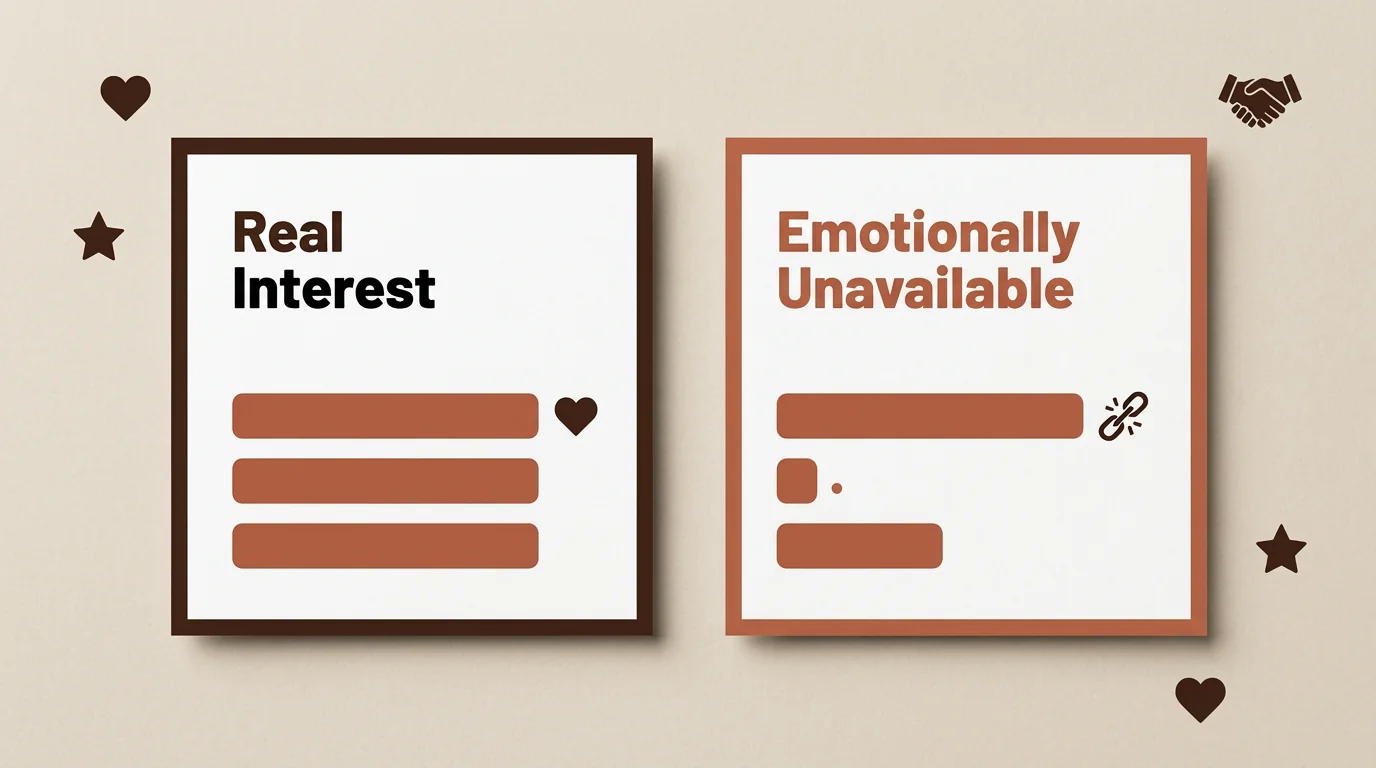
A comparison chart showing the difference between genuine interest and emotional unavailability, using bar graphs in brand colours of rust red and dark brown. This comparison helps you distinguish between a healthy getting-to-know-you phase and the inconsistent patterns of emotional unavailability.

3. 7 subtle red flags for emotional unavailability

Flag 1: Calculated Unavailability – Using contact as a reward

One minute they're super present, the next they've vanished for days. No explanation, no apology. If you ask, you get vague excuses ("stressful week," "a lot on my plate").

Then, suddenly, a loving message appears, as if nothing ever happened.

This pattern is no accident. Their availability becomes a reward system: you get attention when you wait "patiently," don't push for answers, and don't complain. Your need for reliability is conditioned until you feel grateful for the bare minimum.

In reality, people who are genuinely interested explain delays proactively. They'll say, "This week is chaotic, but I'll get in touch at the weekend." They give you a heads-up instead of leaving you in the dark.

Flag 2: Performance Vulnerability – Rehearsed sob stories

They share "deep" stories about past hurts, a difficult childhood, or the ex who ruined everything. It feels intimate, like they're truly opening up.

But on closer inspection, you notice these stories always come up at the same moments – whenever you ask for more closeness or express doubts.

Real vulnerability grows over time and is mutual. Performance vulnerability is a tool to deflect criticism ("I told you about my difficult past – and now you're putting pressure on me?") and push you into the role of a rescuer.

What's telling is that the stories remain superficial, despite the dramatic words. Specific details are missing. The narrative isn't about genuine sharing; it's a defence mechanism.

Flag 3: Forced Teaming – A premature 'we'

"We're so alike," "We understand each other without words," "It's us against the world" – an intense feeling of "we" emerges after just a few conversations.

It feels like destiny, as if you've finally found someone who truly gets you.

But this "we" has no real foundation. You barely know each other, have no shared experiences, and haven't navigated any real conflicts together.

Forced teaming is a way to simulate emotional intimacy quickly and get you hooked before you have time to think critically.

A good rule of thumb is that real connection takes time. If someone is talking about being "soulmates" after three conversations, it's a red flag, not a compliment.

Flag 4: Weaponized Therapy Speak – Psychology as a weapon

"You're just triggered right now," "That's your projection," "I'm setting a boundary" – they use psychological terms to shut down any criticism. Instead of engaging with your feelings, you're pathologised.

True emotional intelligence shows up as empathy and a willingness to reflect on one's own behaviour. Weaponized therapy speak turns the tables: suddenly, you're the problem for being "too needy," "too insecure," or "not ready for a relationship."

Therapists report that clients who experience this dynamic begin to seriously doubt their own perception. They ask themselves, "Am I really being too demanding?" The answer is almost always no. You're having a normal reaction to abnormal behaviour.

Flag 5: Ambient Abuse – A constant underlying tension

There are no big fights, no open aggression. But you constantly feel on edge, like you're walking on eggshells.

One wrong word, and the mood shifts. They withdraw, become cold, and make you feel you've done something wrong – without ever saying it directly.

Ambient abuse is a subtle form of control through atmosphere. You learn to adapt, to put your own needs aside to keep the peace. But this peace is an illusion – it only exists as long as you play your part.

In practice, this means that after talking to this person, you feel drained, not uplifted. You find yourself analysing every word, every pause. That's not a sign of a deep connection; it's a sign of emotional manipulation.

Flag 6: Stashing – Keeping you a secret

You've been texting for weeks, maybe you've even met up. But you're never made a part of their real life.

No invitation to meet friends, no mention to family, no photos together on social media. You're a secret, not a real relationship.

Stashing sends a clear signal: this person wants the benefits of a relationship (attention, validation, maybe intimacy) without the responsibility. You're kept hidden because real integration would mean commitment.

A common benchmark is that after 2-3 months of regular contact, some level of integration into their daily life should happen. If this is actively avoided, it's a clear sign.

Flag 7: Moving the Goalposts – An ever-shifting standard

You make an effort, meet their requests, adapt to their needs. But it's never enough. First, it was "too soon to meet," then "too much stress at work," then "I still need time to open up."

The requirements are constantly changing, so you can never be "enough."

This pattern keeps you in a position of constantly having to prove yourself. You're chasing a goal that keeps moving further away. A real partner has clear, fair expectations – and appreciates your efforts.

Experience shows that people in this dynamic invest more and more, while the other person gives less and less. The imbalance grows until you're completely exhausted.


4. The psychological traps: Why it's so hard to let go

You spot the patterns, you see the red flags – and yet you stay. Why?

Because emotional unavailability uses powerful psychological mechanisms that keep you trapped in the dynamic.

Intermittent reinforcement: The slot machine effect in love

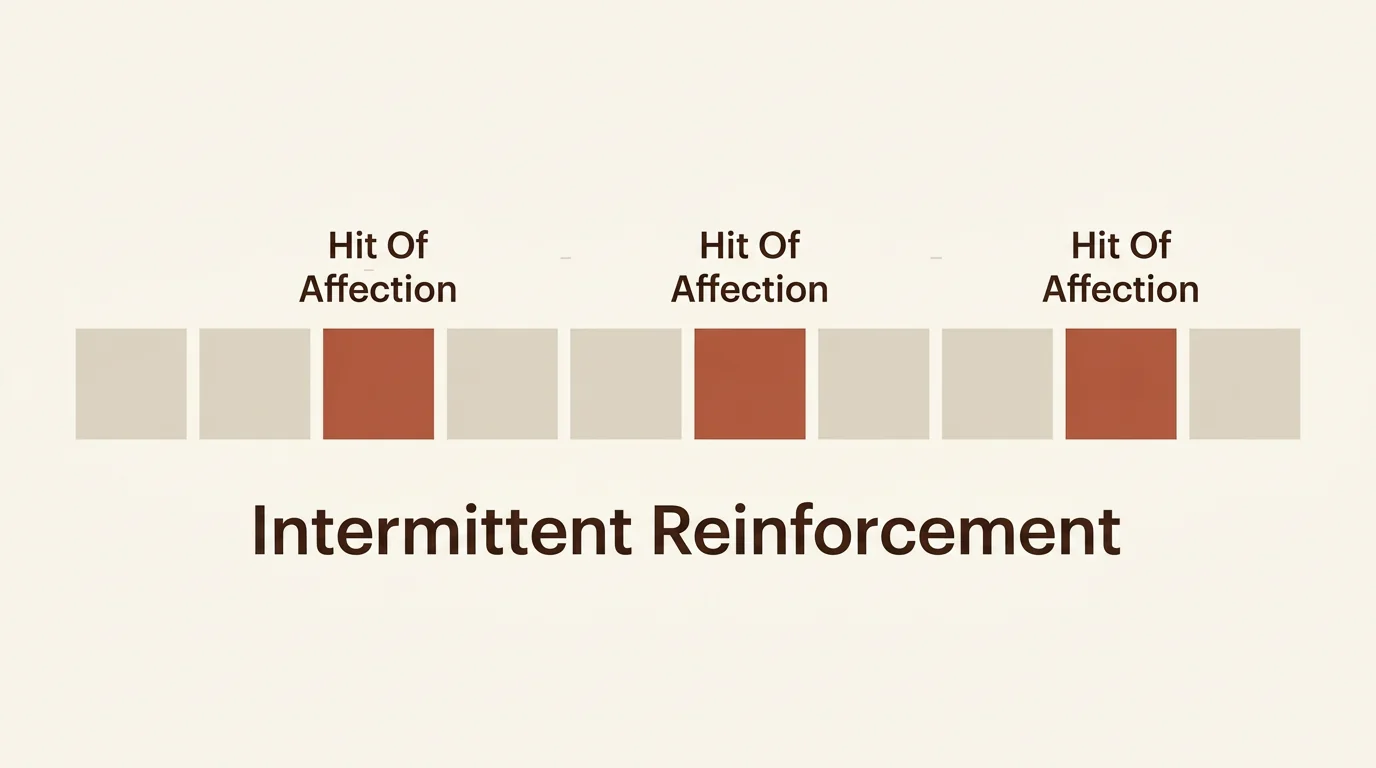
Imagine a slot machine: sometimes you win, mostly you lose, but the hope of the next payout keeps you pulling the lever. That's exactly how emotional unavailability works.

The person gives you sporadic affection – a loving message after days of silence, an intense conversation after weeks of distance.

These irregular "wins" activate the reward centre in your brain more powerfully than consistent affection does. You learn that if you just hang in there, another good moment will come.

From a neurological perspective, unpredictable rewards release more dopamine than predictable ones. Your brain gets addicted to the next "hit" – not to the person themselves, but to the feeling of relief when they return.

Trauma bonding: When pain and affection become blurred

Trauma bonding happens when periods of emotional neglect or criticism alternate with intense moments of reconciliation.

The pain of their withdrawal makes the relief of their return feel that much more intense. Your nervous system gets used to this roller coaster – a state of calm suddenly feels boring.

Singles are particularly vulnerable to this dynamic after a long relationship or a loss. The longing for companionship, for someone to share life with, makes you susceptible to future faking – big promises with no intention of keeping them.

A visualisation of the slot machine effect, showing how irregular bursts of affection create a psychological dependency in toxic dynamics. The principle of intermittent reinforcement explains why we hold on to people who only sporadically give us the attention we need.

The hope that they'll change

"If I'm just more patient," "When the stress at work eases up," "When enough time has passed" – the hope that the person will change is the biggest obstacle to walking away.

You keep investing because you feel you have to justify your investment. Economists call this the "sunk cost fallacy" – the time you've already put in feels like a reason to continue, rather than a reason to leave.

The truth is, past investments are gone no matter what you decide now. The only relevant question is: is it worth investing more based on their current behaviour?

5. Checklist: Fear of commitment or just not interested?

Not every bit of uncertainty points to emotional unavailability. Some people have a genuine fear of commitment – they want closeness but are afraid of it. Others are simply not that interested.

How can you tell the difference?

Reaction to boundaries

Type Reaction to your boundaries
Emotionally available Respects your boundaries, apologises for mistakes, shows a willingness to change
Fear of commitment Pulls away, needs space, but comes back and reflects on their behaviour
Not interested Ignores your needs, shows no willingness to work on the connection

Consistency of words and actions

Type Consistency
Emotionally available Says "I'll call you" and actually does. Plans are kept
Fear of commitment Fluctuates between closeness and distance, but their effort is visible
Not interested Lots of words, no action. Plans are constantly postponed or forgotten

The litmus test: Communicating your needs

State clearly what you need: "It's important to me that we meet in person soon," or "I need more reliable communication to feel secure."

Type Reaction to your needs
Emotionally available Takes your needs seriously, looks for solutions together
Fear of commitment Feels overwhelmed, pulls away, but is able to talk about it
Not interested Reacts defensively, makes you the problem, or disappears

Dating sites like EliteSingles or Ourtime are aimed specifically at people with serious intentions who don't want to waste time on games. The profiles are more detailed, and the matching algorithms focus on compatibility rather than just looks.

Setting boundaries is the ultimate litmus test: an emotionally available partner will respect them, while an unavailable one will react defensively.

6. The AskAlva check: Protecting your heart

Sometimes you can't see the wood for the trees. You're emotionally invested, your heart wants to believe, but your head has doubts.

In moments like these, an objective outside perspective can help.

AskAlva is your AI dating coach, designed for exactly these situations. Simply upload a screenshot of your chat history or the person's profile – Alva analyses the communication for patterns you might be missing.

What Alva does for you

  • Chat Coaching: Alva reads along and shows you whether the communication is mutual, if the other person is signalling genuine interest, or if there are typical patterns of emotional unavailability
  • Profile Check: Sometimes the profile reveals more than the chat. Vague descriptions, contradictory information, photos that are too perfect – Alva helps you spot the red flags
  • Scam Check: If you're worried it might not just be emotional unavailability but a classic romance scam, Alva checks photos and texts for known fraud patterns

Screenshots are never saved. Your privacy is protected, while you get the clarity you need. You can find more information at askalva.ai.

7. Conclusion: Your path to a fulfilling relationship

Emotional unavailability is painful because it feels so real. The person exists, the moments of connection are real – but the willingness to build something lasting is missing.

Trust your gut. If something feels off, if words and actions don't match up, if you constantly have to justify yourself or prove your worth – you're not imagining it. Those are signals your self-preservation instincts are sending you.

The three-strikes rule

When a pattern repeats three times (cancellations, withdrawals, excuses), it's no longer a coincidence. It's a behaviour pattern. You don't have to be harsh – but you are allowed to stand up for yourself.

Setting boundaries is the best test: an emotionally available person will react with understanding and a willingness to work on the connection. An unavailable person will react with withdrawal, anger, or by making you the problem.

You deserve a love that feels safe and available. A companion who exists not just in words, but in actions, reliability and genuine interest.

Starting over after a break-up, a loss, or many years in a relationship is a brave thing to do. Don't let that courage be stolen by people who aren't ready to give you what you deserve.

You're not too demanding. You're not too old. You are not the problem. You're looking for something real – and that's your right.

Frequently Asked Questions (FAQ)

How does an emotionally unavailable person behave?

An emotionally unavailable person often behaves in a contradictory pattern of closeness and distance, where intense periods of attention are followed by sudden withdrawal without explanation. Such singles talk about future plans but never take concrete steps to make them happen. They react to criticism or requests for more closeness with defensiveness, excuses, or by making you the problem. Vague phrases like "sometime" or "we'll see" are common instead of firm commitments, and communication remains superficial even after a long time.

How can I tell if someone is serious about me?

You can tell a single is serious about you primarily through the consistency between their words and actions: plans are kept and your needs are respected. The person integrates you into their life, introduces you to friends or family, and shows a willingness to work on the connection when things get tough. Your boundaries are seen as information, not as an attack. For example, if they say they'll get in touch at the weekend, they do, and arranged meetings aren't cancelled at the last minute. They ask about your day, remember details, and show genuine interest in your life.

What's the difference between a fear of commitment and a lack of interest?

The difference between a fear of commitment and a lack of interest lies in the person's internal conflict. A fear of commitment manifests as a constant push-and-pull, where the person wants closeness but pulls back out of fear, and they often reflect on their behaviour. A lack of interest, on the other hand, is consistently distant – the person invests minimally, postpones meetings, and shows no real effort to deepen the connection. The crucial point is that singles with a fear of commitment often suffer because of their behaviour and try to work on it, whereas uninterested people see no problem and make you the problem if you want more.

Why do I stay even though I see the red flags?

Staying even when you see the red flags is often due to something called intermittent reinforcement, where irregular rewards activate your brain's reward system more strongly than consistent affection. Your brain learns that holding on is worth it because the next good moment is bound to come. Additionally, trauma bonding can occur, where the roller coaster of pain and reconciliation creates an emotional dependency. The hope that they'll change and the "sunk cost fallacy" also play a role: the time you've already invested feels like a reason to keep going because your brain wants to justify the investment.

How can I set boundaries without losing the person?

You can set boundaries without losing the person by framing them not as an ultimatum, but as clear information about your needs. For example: "It's important to me that we meet in person soon," or "I need more reliable communication." An emotionally available person will respect this and work with you to find solutions. If, however, the person reacts with withdrawal or anger, it reveals their inability to meet your needs – which is not your fault. If you "lose" someone by setting healthy boundaries, you never really had them in the first place, because a real connection grows through honesty, not just accommodation.

Are people more vulnerable to emotionally unavailable partners after a long relationship?

Yes, singles are often more vulnerable to emotionally unavailable partners after a long relationship, divorce, or loss, as the longing for companionship can make them more susceptible to future faking and love bombing. At the same time, with more life experience, you often have a sharper gut instinct. The key is to trust that feeling and not let a fear of loneliness rush you into a connection. Those starting over after a long time are often more grateful for attention and can more easily overlook warning signs that would have stood out to them before.

Which dating sites are good for finding a serious relationship?

For finding a serious relationship, dating sites like eharmony, Match.com, or EliteSingles are suitable as they are specifically aimed at singles looking for a long-term partnership. Their more detailed profiles and matching algorithms help you find people with similar intentions and reduce the likelihood of encountering emotionally unavailable people who are just looking for a distraction. When choosing, look for platforms with verification processes and in-depth personality tests, as these hurdles tend to deter singles who aren't serious.

How can I protect myself from romance scams?

You can protect yourself from romance scams by watching out for classic red flags, such as overly fast love bombing, avoiding video calls, or pushing to switch to WhatsApp or Telegram. Be especially wary of stories about working abroad (military, oil rig) and any requests for money or investment opportunities. Use tools like the AskAlva Scam Check, which analyses photos and chats for known fraud patterns, and meet in person before you become too emotionally invested. The most important rule is: no genuine person will ask you for money before you've met in person – no exceptions, no "emergencies," and no "one-off situations."

🛡️ Scam check by Alva

Not sure about a contact? Upload a screenshot — Alva checks it for fraud patterns in under a minute.

Try it free →

Screenshots are never stored.

More from “Safety & scam protection”