How to Spot a Fake Dating Profile

By Sandra · Updated on 13 November 2026 · ✓ Reviewed by the editorial team

How to Spot a Fake Dating Profile

That nagging feeling, your gut instinct… you just know something’s not quite right. The photos seem a little too perfect, the messages feel generic, and there’s always an excuse when you suggest a video call. Trusting that feeling is your first line of defence against fake profiles – and this guide will show you how to check them out, step by step.

In a nutshell

Here’s how to spot a fake profile on a dating app or site: check their photos using a reverse image search. Be wary if they want to switch to WhatsApp straight away, or if they suddenly ask for money – these are huge red flags.

  • A reverse image search is your best friend: Google Lens can reveal stolen photos in seconds
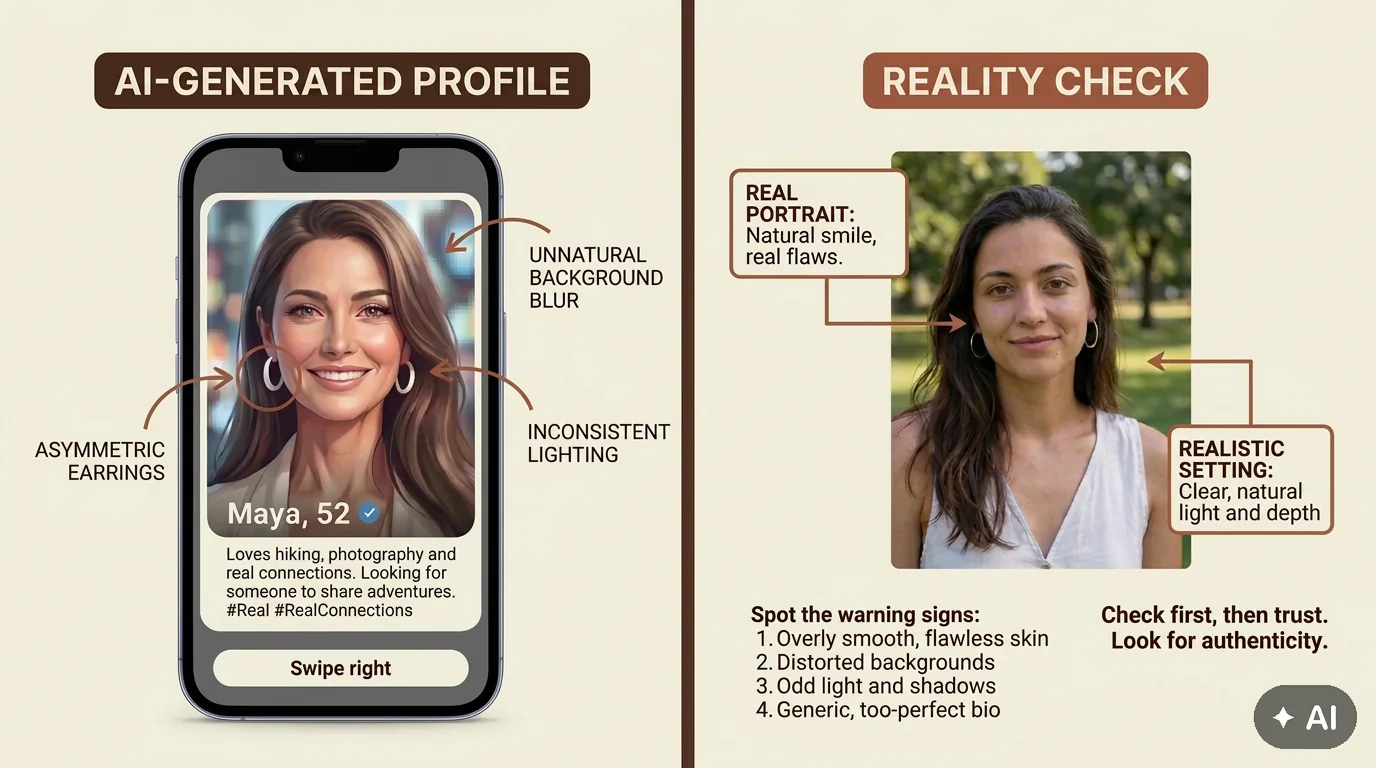
  • AI-generated faces have tell-tale giveaways: Look out for blurry ears, flawless skin and a lack of casual, everyday photos
  • Wanting to switch apps is a red flag: Anyone pushing to move the chat to WhatsApp or Telegram is likely trying to get around the dating site's security measures
  • Put them to the test: A quick, unannounced video call or asking for a selfie with a handwritten note can catch many scammers out
  • Any request for money is a deal-breaker: End the conversation immediately. No matter the sob story, it’s a scam
  • Keep a record for your own safety: Take screenshots of their profile and your chats, as you might need them as evidence if you decide to report them
Run these security checks now

1. The 7 biggest red flags: How to spot a fake profile

Fake profiles often follow a predictable pattern. These seven warning signs are common giveaways, and you'll often find them in combination.

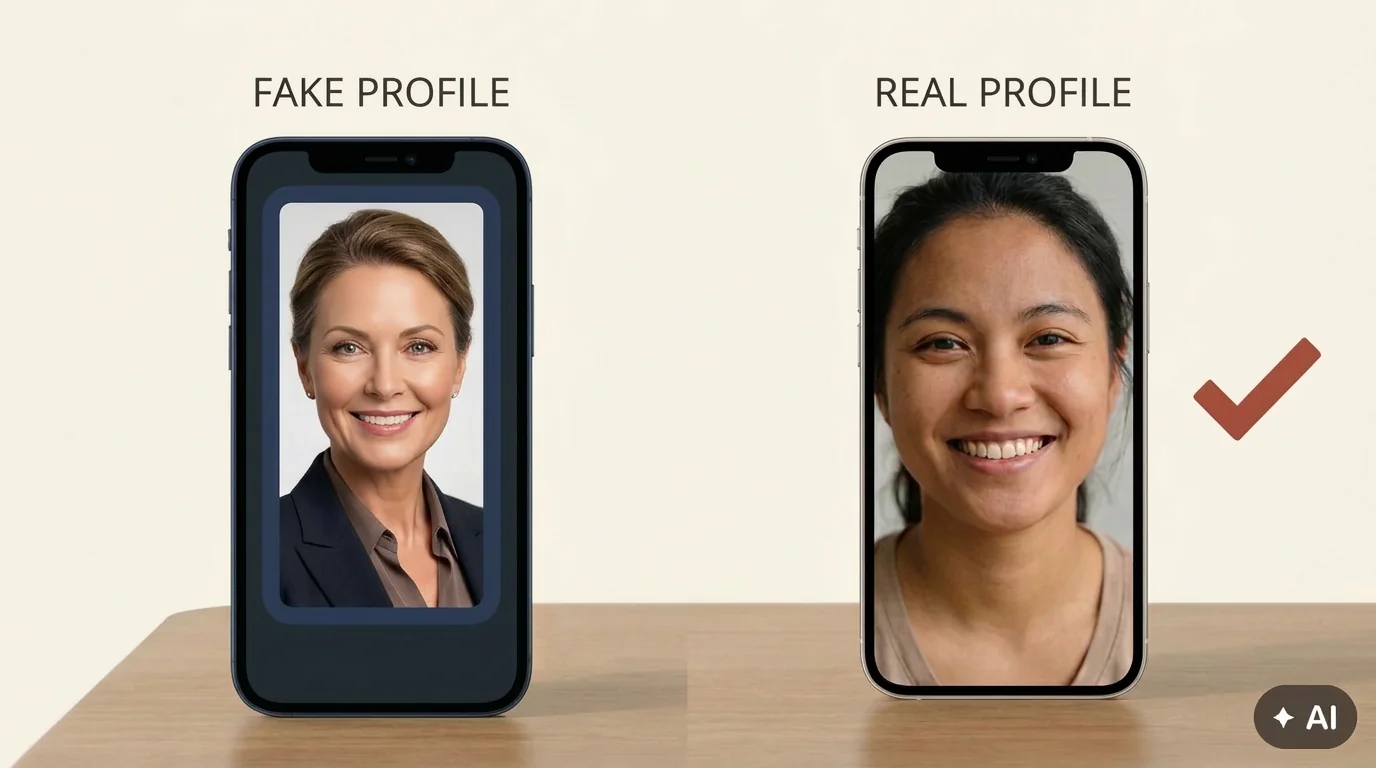
An example of a suspicious dating profile next to a genuine, verified one.

Love bombing: Too much, too soon

"You're my soulmate," "Fate brought us together" – after just three messages. Love bombing is a classic opening tactic used by romance scammers. Genuine connections develop over time. Anyone who talks about love after just a few hours is likely working from a script.

The intensity of the communication is another giveaway: long messages several times a day, over-the-top compliments and a constant emphasis on your "special connection." This strategy is designed to get you emotionally hooked before you have a chance to ask any probing questions.

The quick switch to WhatsApp or Telegram

"Let's chat on WhatsApp, I'm hardly ever on here" – you might see this after just the first message. Dating sites have security features that detect suspicious patterns. Scammers want to avoid being monitored, so they'll push to move you onto an external messaging app.

Our golden rule is to keep chatting on the dating site until you've met in person. A genuine single will understand you're being cautious. Anyone who pressures you to switch usually has a reason to get around the platform's security.

Common cover stories: The soldier, the oil-rig worker, the doctor abroad

Cover Story Why this story?
US soldier deployed overseas Explains poor communication and why they can't video call.
Engineer on an oil rig Explains their isolation and inability to video call.
Doctor with a humanitarian organisation Creates sympathy and explains why they're abroad.
International businessman on a construction project Explains why they're always moving around.
Widowed single parent Creates sympathy and explains their loneliness.

These backstories provide a convenient excuse for why the person can't meet up or have a video call, and they're designed to make you feel sympathetic. In reality, they're a smokescreen to bat away any requests for proof of identity.

Inconsistent details: The story keeps changing

One minute they have two children, the next it's three. First they work in Dubai, then in London. Scammers are often managing multiple victims at once and can't keep track of who they've told what.

It's worth making a note of key details to refer back to. Contradictions in basic information (like the number of children they have, where they live, or their job) are a clear red flag. A genuine person's life story will be consistent.

They always have an excuse for not video calling

"My camera's broken," "The internet on the base is awful," "Security rules forbid video calls" – or they cancel at the last minute. Someone who's genuinely interested will find a way. If they can't manage a video chat after several weeks, that's a huge red flag. With modern smartphones and Wi-Fi, video calls are possible from almost anywhere.

Awkward grammar and odd phrasing

Many romance scammers operate from countries where English isn't the first language. Look out for:

  • Stiff, unnatural-sounding sentences
  • Wording that clearly comes from a translation tool (often with classic mistakes)
  • Swinging between fluent and broken English
  • Using words or expressions that sound odd for a British person

Organised scammer groups often rely on translation software, which results in these strange language patterns.

Pressure and urgency

"I have to make a decision by tomorrow," "This investment opportunity expires today," "If you love me, you'll help me now" – this kind of manufactured urgency is a classic manipulation tactic.

The best thing to do is to take a step back and assess the situation calmly whenever you feel under pressure. A genuine crisis allows you time to think. Scammers try to create a panic so you don't have time to think straight or ask a friend for their opinion.

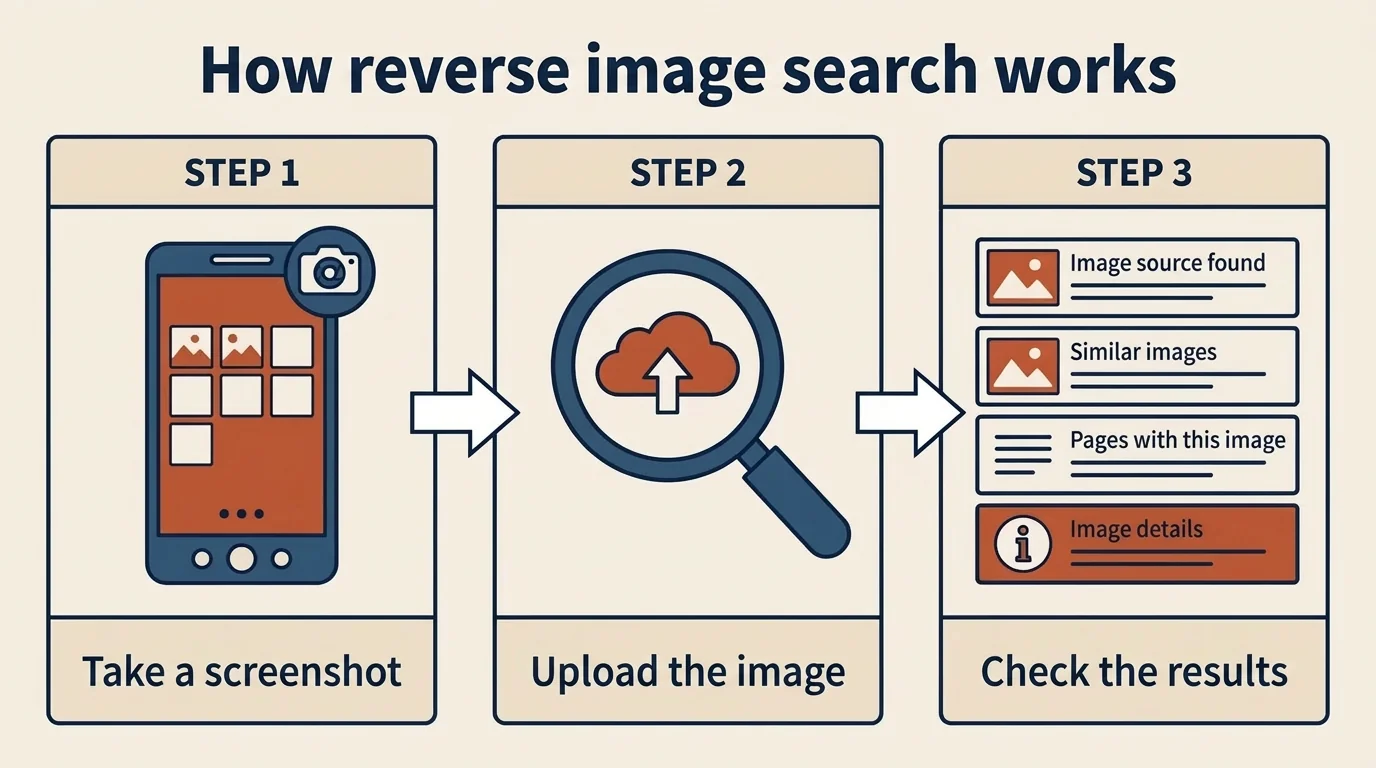
A step-by-step guide on how to do a reverse image search for suspicious dating profiles. A quick tech check: a reverse image search can reveal stolen photos and stock images in seconds.

2. Check their profile pictures: Spotting stolen photos and AI fakes

Running an image search is your most effective tool for spotting a fake profile. You can identify a stolen photo in seconds – if you know how.

Reverse image search: A powerful check

A reverse image search checks if a photo has appeared anywhere else on the internet. If their profile picture pops up on stock photo sites, under a different name, or in a completely different context, the profile is almost certainly a fake.

How to do a reverse image search on your phone

Step Instructions
1. Take a screenshot Take a screenshot of their profile photo
2. Open Google Lens In the Google app or Chrome
3. Select the photo Choose the screenshot from your gallery
4. Check the results Google will show you where else the image appears online

Alternative tools: TinEye and Yandex can often find the original source when Google can't. Yandex is particularly good for images from Eastern European sources. It's worth using all three services, as they each search different databases.

AI-generated faces: The new threat

A reverse image search won't work on AI-generated images – they're brand new, unique creations that don't exist anywhere else online. Scammers are increasingly using AI tools like Midjourney or Stable Diffusion to create faces that look convincingly real.

How to spot AI-generated profile pictures

Feature What to look for
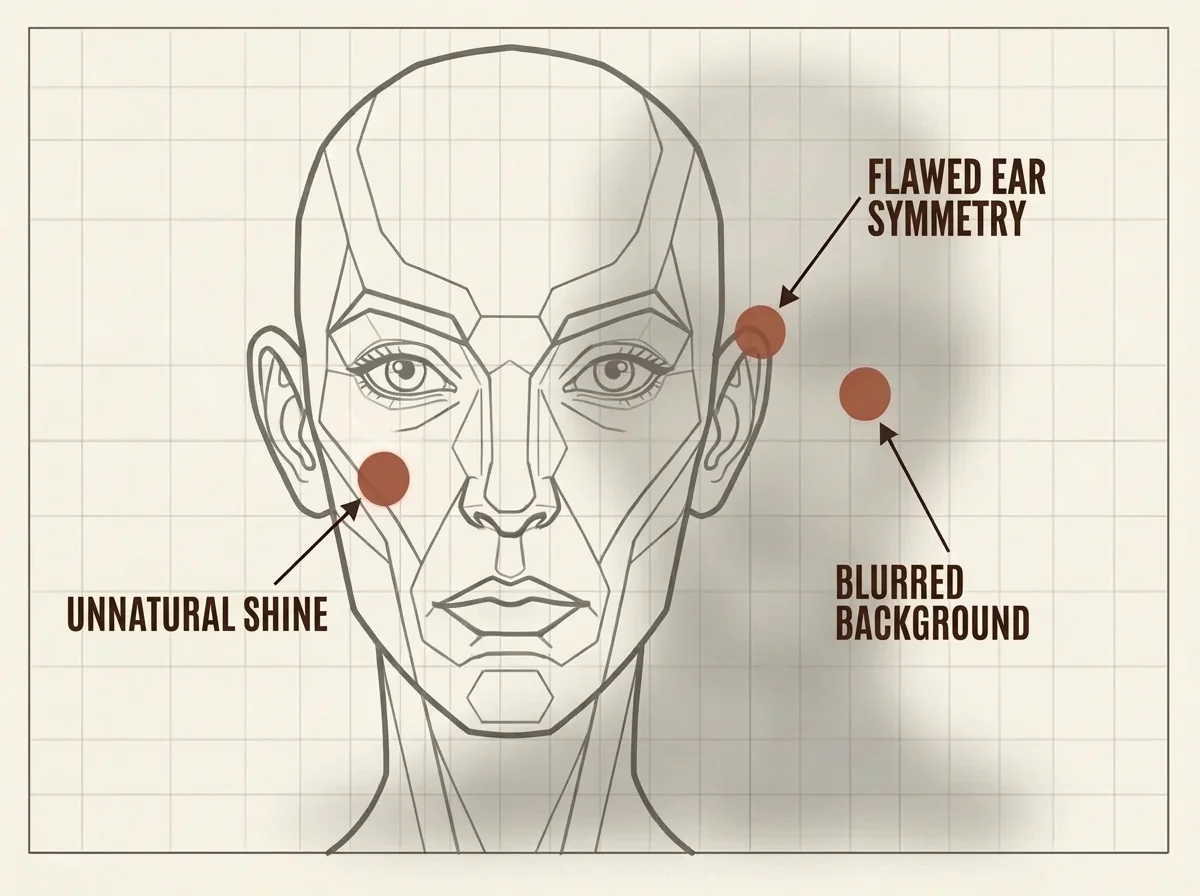
Ears and earrings Often asymmetrical or blurry
Hands The wrong number of fingers or odd positions
Background Text is unreadable; objects merge into one another
Skin Too smooth and poreless, almost plastic-like
Hair Strands of hair blend into the background
Photo variety Only flawless portraits, no candid snaps or everyday scenes

Profiles with AI-generated pictures usually just feature headshots against a neutral background. Real people have a variety of photos from different situations – playing sport, with friends, on holiday, or just going about their day.

The live test: A good indicator, but not foolproof

A good way to check if someone is real is to ask for a spontaneous photo with a handwritten note showing today's date and a word of your choice. Or, you could suggest an unannounced video call. A genuine person will usually be happy to oblige. Scammers will make excuses. However, this isn't foolproof, as AI can now fake these kinds of photos and even videos.

Deepfake video check: During a video call, ask them to wave a hand in front of their face or turn their head all the way to the left or right. AI overlays often flicker or distort with these kinds of movements. You can also catch out pre-recorded videos by asking spontaneous questions about details in their background.

Make the request without any warning, for example: "Can you quickly send me a photo now with a note that says 'banana'?" Someone who's genuine might find it a bit odd, but they'll do it. A faker will often suddenly have "technical problems".

A diagram showing the tell-tale signs of an AI-generated face, such as asymmetrical ears and unnaturally smooth skin. Spotting AI fakes: Pay close attention to details like the symmetry of the ears or an unnatural skin texture to tell if an image has been generated by AI.

3. The money trap: Crypto cons and 'pig butchering' scams

Getting your money is the end game for most fake profiles. Their methods are sophisticated and psychologically cunning.

Playing the long game: When they finally ask for money

Romance scammers are in it for the long haul. They’ll often chat with you for weeks, or even months, before they first ask for money. It’s this patience that makes their tactics so dangerous – by that point, you’ve likely developed genuine feelings for them.

The 7 phases of a 'pig butchering' scam

Phase What happens
1. Building trust Weeks of daily "good morning" messages, photos of home-cooked meals
2. The casual mention "I've made some good money with crypto"
3. The invitation "Let me show you how it works – for our future together"
4. The first withdrawal A small withdrawal goes through (a confidence trick)
5. The block A larger withdrawal is blocked: "You have to pay a fee first"
6. Escalation A never-ending stream of new fees, taxes, and demands for "proof of funds"
7. The disappearance The moment you can't pay any more

The term "pig butchering" comes from the scammers themselves: the victim is "fattened up" with false hopes and attention before being "slaughtered" – financially drained until there’s nothing left.

Other common excuses for needing money

Excuse Typical phrasing
Medical emergency "I'm in hospital and can't access my account"
Plane ticket "I need money to finally come and see you"
Customs "Your gift is stuck, I need to pay the fee"
Account crisis "My accounts are frozen, I urgently need to pay a fee"

These stories are designed to pull on your heartstrings and override your better judgement. The combination of urgency, your emotional attachment, and a crisis that seems easy to solve is a psychologically powerful one.

Payment methods as a red flag

The way they ask you to pay is often the biggest red flag. Genuine people simply don’t ask for gift cards or crypto transfers.

If they ask for these payment methods, it’s a scam

Payment method Why it's suspicious
Gift cards iTunes, Google Play, Amazon, Steam – untraceable
Crypto transfers Virtually irreversible and difficult to link to an individual
International bank transfers Hard to trace
Forwarding money "Accept money and pass it on" – makes you an unwitting accomplice in money laundering

The request to receive and forward money is particularly insidious. It makes you an unwitting accomplice in a money laundering scheme – with potential legal consequences.

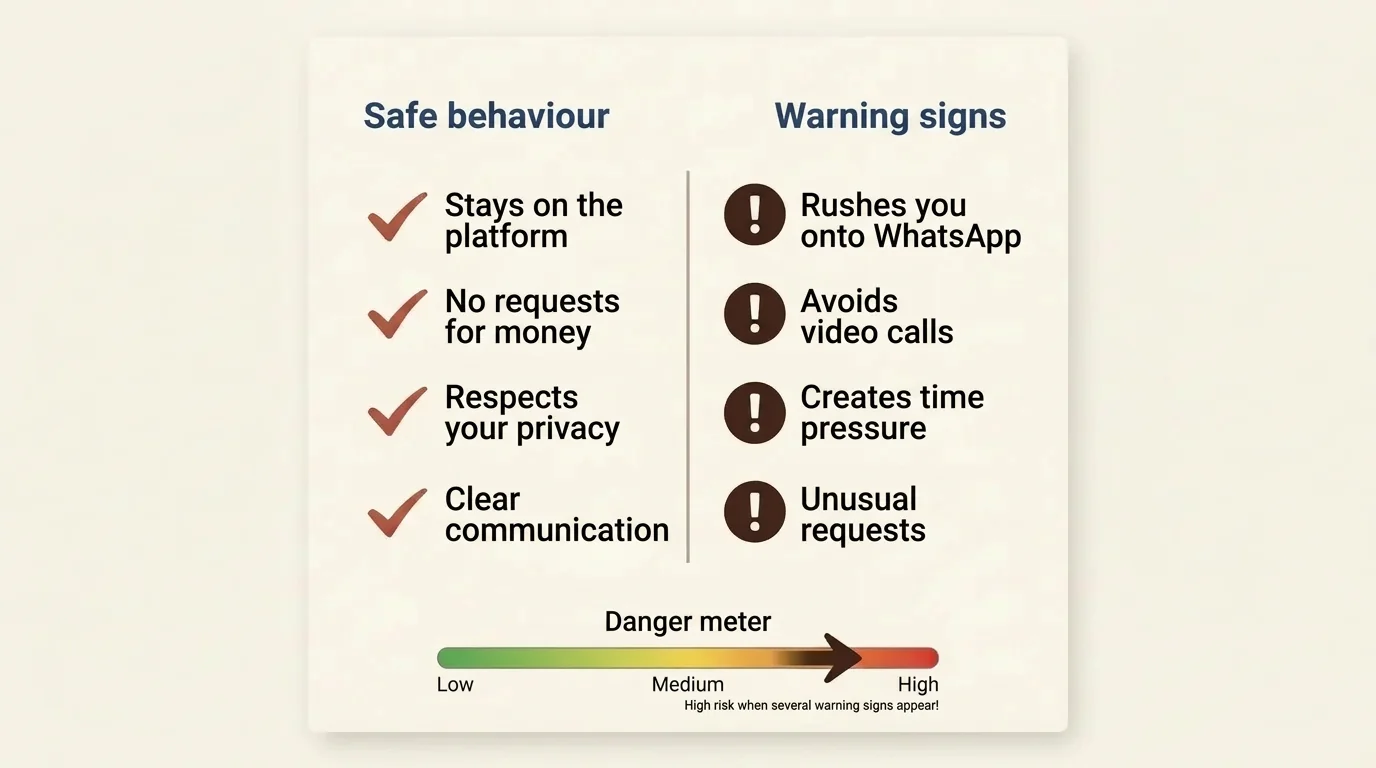
Checklist of warning signs and safe online dating habits to avoid romance scams. A quick reality check: These common patterns can help you get an objective sense of their true intentions early on.

The right way to react

If you suspect you’re being scammed, it’s vital to act quickly and keep a record of everything.

A 4-step plan if you suspect a scam

Step Action
1. Save screenshots Chat history, profile photos, and any requests for money. Save everything first, before you block them, otherwise the chat might disappear.
2. Report the profile Use the reporting function on the dating site or app.
3. Cut off contact No discussion, no explanation. Just block them.
4. Report to the police Report it to the police and to your country's national fraud reporting centre (in the UK, via the national fraud reporting service or, in Scotland, Police Scotland on 101). You can usually do this online or by phone.

Important: Don’t confront them. Scammers learn from being called out and just use it to refine their tactics for the next person. Instead: document, report, and cut all contact.

The more evidence you can provide, the easier it is for the authorities to spot patterns and help protect other people.

4. Staying safe from fake profiles: Your questions answered

Why do fake profiles even exist?

Fake profiles usually exist for one of three reasons. First, there's romance scamming, where fraudsters try to con you out of money or cryptocurrency, often working as part of organised networks. Second, some dating sites use paid staff to encourage singles to sign up for premium memberships; these people have no genuine romantic interest. And third, they're used for data theft, to gather your personal information.

How do I spot romance scammers on dating apps like Tinder and Bumble?

You can spot romance scammers on dating apps like Tinder and Bumble by looking for a few tell-tale signs. These include profiles with only a handful of flawless photos but no natural, candid snaps; generic messages that have nothing to do with your profile; and a push to move the chat to WhatsApp or Telegram very quickly. They often claim to have jobs abroad, such as in the military or on an oil rig, and will always have an excuse to get out of a video call. Before long, a story about a financial emergency or a dubious ‘investment opportunity’ usually follows.

What should I do if I've already sent money?

If you've already sent someone money, it's vital to act fast. Contact your bank or payment provider straight away, as it's sometimes possible to stop or reverse a payment if the transaction hasn't gone through yet. You should also report the crime to the police and your national fraud reporting centre, providing them with all your screenshots and proof of payment. Be sure to report the profile to the dating platform as well, to help protect other singles.

How can I check if someone on a dating app is genuine?

The best way to check if someone on a dating app is genuine is with a simple three-step process. First, check their photos by using a reverse image search to see if the pictures have been stolen from elsewhere online. Second, check their behaviour: pay attention to whether they answer your questions properly or if they seem evasive. Third, ask for live proof with a spontaneous video call or a recent photo of them making a specific gesture. Passing all three checks makes a scam much less likely, but it is no guarantee, so stay cautious, especially if money or personal data comes up.

How can I find out who is behind a fake account?

Finding out who is really behind a fake account is nearly impossible in most cases, as scammers often operate from abroad, using VPNs and stolen identities. Your goal, therefore, should be to protect yourself, not to unmask them. While you can use a reverse image search to check where the photos came from, or get clues about their time zone from their language and response times, you'll rarely be able to identify them fully. Never confront the person yourself; it's both dangerous and pointless.

Are blue ticks on dating apps a guarantee of safety?

Blue ticks on dating apps offer only limited protection, as they simply confirm that a real person submitted a live photo for verification. A tick doesn't mean the person is who they claim to be, that they have honest intentions, or that their profile photos are up to date. Even verified profiles can be used for scams. It's best to think of the blue tick as a small bonus, but never rely on it by itself.

Can I protect myself from AI-generated fake profiles?

Yes, you can protect yourself from AI-generated fake profiles by training your eye to spot the details. Ask for several photos in different situations and request a spontaneous photo or a short video. Look out for common AI flaws like strange backgrounds, unnaturally smooth skin or other odd details. The most effective method is a live interaction: a spontaneous video call with an unusual request (like waving or turning their head to the side) or meeting in a public place will catch out most AI-fakes. Be aware, though, that with real-time deepfake technology, even a video call isn't foolproof.

What's the difference between catfishing and romance scamming?

The main difference between catfishing and romance scamming is the motivation behind the deception. When someone is catfishing, they're pretending to be someone else for emotional reasons, such as insecurity or boredom, to get attention or form an emotional connection. Romance scamming, on the other hand, is professional fraud with a clear financial motive: the scammers want to get your money, cryptocurrency or gift cards. While catfishing can be incredibly hurtful emotionally, romance scamming is a criminal offence that often leads to devastating financial loss.

🛡️ Scam check by AskAlva

Not sure about a contact? Upload a screenshot. AskAlva checks it for fraud patterns in under a minute.

Try it free →

Screenshots are never stored.

More from “Safety & scam protection”