The Oil Rig Scam: Spotting the 'Engineer' Con

By Sandra · Updated on 4 November 2026 · ✓ Reviewed by the editorial team

The Oil Rig Scam: Spotting the 'Engineer' Con

You’ve found a match who seems too good to be true: a successful engineer working on an oil rig in the North Atlantic. His profile shows an attractive man with warm, smiling eyes, who’s full of plans for the future and showers you with compliments. The only catch? A video call is never possible – the connection on the rig is supposedly too poor.

If this story sounds familiar, it’s for a good reason. The ‘engineer on an oil rig’ tale is a carefully planned scam that specifically targets singles looking for a genuine connection. This oil rig scam follows a well-rehearsed psychological script used by criminal networks all over the world.

In a nutshell

With the oil rig scam, you're contacted on dating apps and dating sites by fraudsters posing as engineers on a drilling platform. After weeks or even months of building your trust, they use their supposed isolation as the perfect excuse to ask for money for fake emergencies.

  • The story of the engineer on an oil rig is a classic romance scam, following a carefully crafted psychological script.
  • Scammers use the rig’s remote location as the perfect excuse for avoiding video calls and never being able to meet in person.
  • Requests for money for spare parts, customs fees, medical emergencies or flight tickets are a huge red flag, and you should never pay them.
  • Legitimate companies do not expect their staff to ask members of the public for money.
  • If you have any suspicions, it’s vital to cut off all contact immediately and save copies of your conversations.
  • The Alva Scam Check can help you to assess profiles and chats for typical scam patterns.

1. Why the 'engineer on an oil rig' scam works so well

On the face of it, the profile of a successful engineer ticks a lot of boxes: he seems attractive, down-to-earth and well-off. A man with a respectable, well-paid job who’s also modest? It’s no wonder that appeals to many singles looking for a stable, long-term partner.

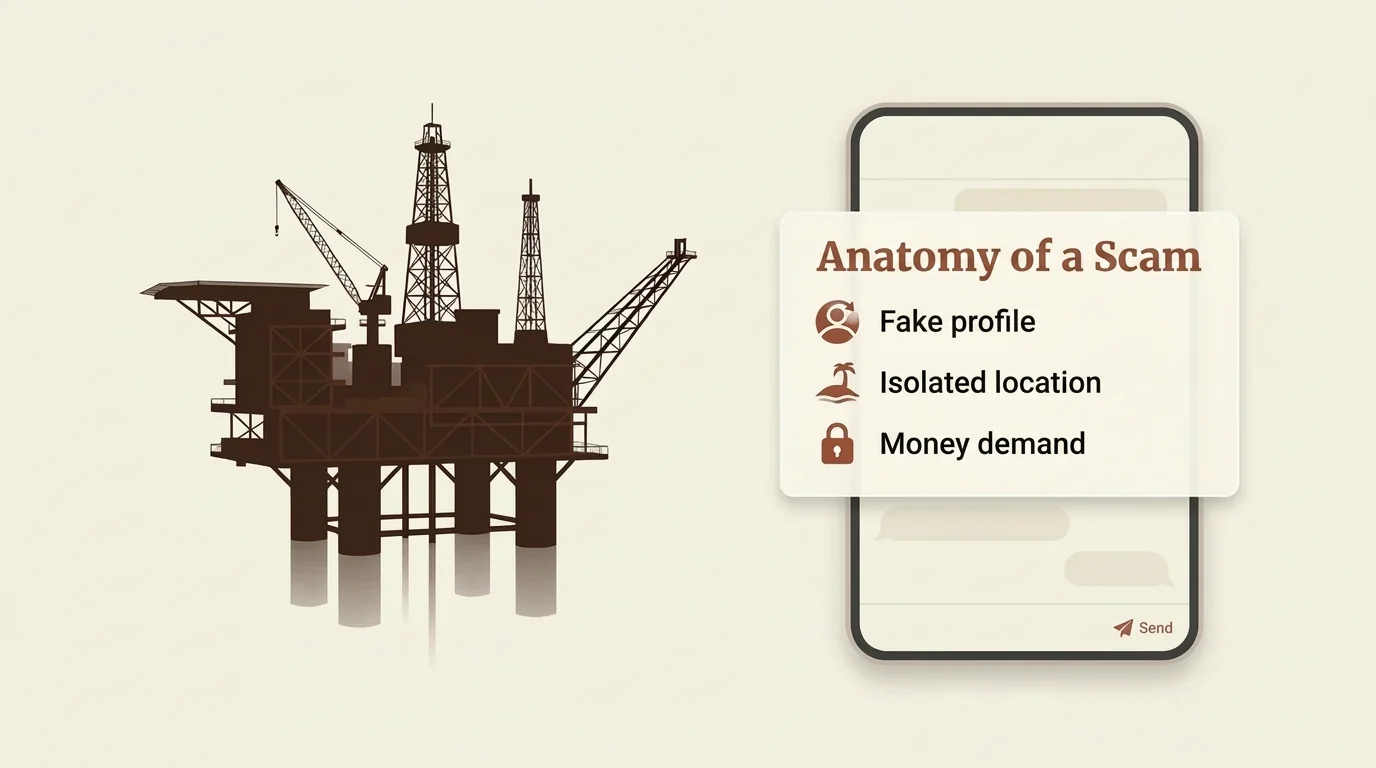
Illustration of an oil rig beside a chat window displaying three warning signs: a fake profile, an isolated location, and a request for money. The oil rig engineer scam follows a well-rehearsed psychological script. Find out how to spot the warning signs early on.

The oil rig is the perfect excuse for why they can't meet you in person. It’s far out at sea, isolated, and hard to get to, which makes it seem completely plausible that you can’t meet up straight away.

The story also creates a sense of drama and romance: he’s out there all alone, supposedly craving a connection.

Scammers deliberately prey on psychological triggers like loneliness and the need for security. They know that if you’ve recently been through a break-up or bereavement, you’re likely to be more open to their promises of affection and plans for the future.

Their supposed lack of communication options gives the scammer a perfect shield. Can’t video call? The connection’s too bad. Can’t ring you out of the blue? It’s against safety regulations.

These excuses sound believable because most of us imagine an oil rig as a very isolated place to work.

The truth is: while it's true that oil rigs have restrictions, like mobile phone bans in hazardous areas or limited bandwidth, most now provide internet for their staff. There are always breaks or downtime for a quick chat. Someone who’s genuinely interested in you will find a way to talk. If they keep making excuses for weeks on end, especially while asking for money, that should set alarm bells ringing.

2. The scammer's playbook: How the oil rig scam plays out

The oil rig scam follows a tried-and-tested script that plays out over weeks, or even months.

Phase 1: Love bombing – a whirlwind of compliments and plans for the future

The first messages are overwhelmingly positive. "You're different from everyone else on here." "God brought us together." "I've never felt this way about anyone before."

These declarations of love often arrive after just a few days, or sometimes even hours.

Scammers use pre-written scripts to create a false sense of intimacy. They’ll mirror your own hopes and dreams back at you, despite not really knowing you.

The speed is a dead giveaway: while real relationships take time to grow, scammers skip all the natural stages of getting to know someone.

Phase 2: Moving the conversation to WhatsApp or Telegram

As soon as they feel an emotional connection has been made, the scammer will push to move the conversation off the dating site. "I'm not on here much, it's better to message me on WhatsApp."

This might sound harmless, but there's a very clear reason for it: most dating apps have security measures in place and can block suspicious accounts. On WhatsApp or Telegram, the scammer is out of their reach.

Scammers also like to use several communication channels at once, making it harder for you to keep track.

Phase 3: The fabricated emergency – asking for money for spare parts, customs fees or medical crises

After weeks of intense communication, the actual scam begins. Suddenly, there’s an emergency: a vital piece of machinery on the rig has supposedly broken down, and he has to pay for the repairs himself or he’ll lose his job.

Or: he finally wants to visit you, but his bank account has been frozen and he needs money for the flight.

Or: he's had an accident and the clinic is demanding payment upfront.

They’ll often send forged documents or emails from so-called logistics companies as 'proof'. These can look incredibly realistic, but they’re complete fakes.

The sums start small and increase over time: first a few hundred pounds, then a thousand, then more. Once you've paid once, you can be sure that new demands will follow.

3. The 7 clearest red flags of an oil rig scam

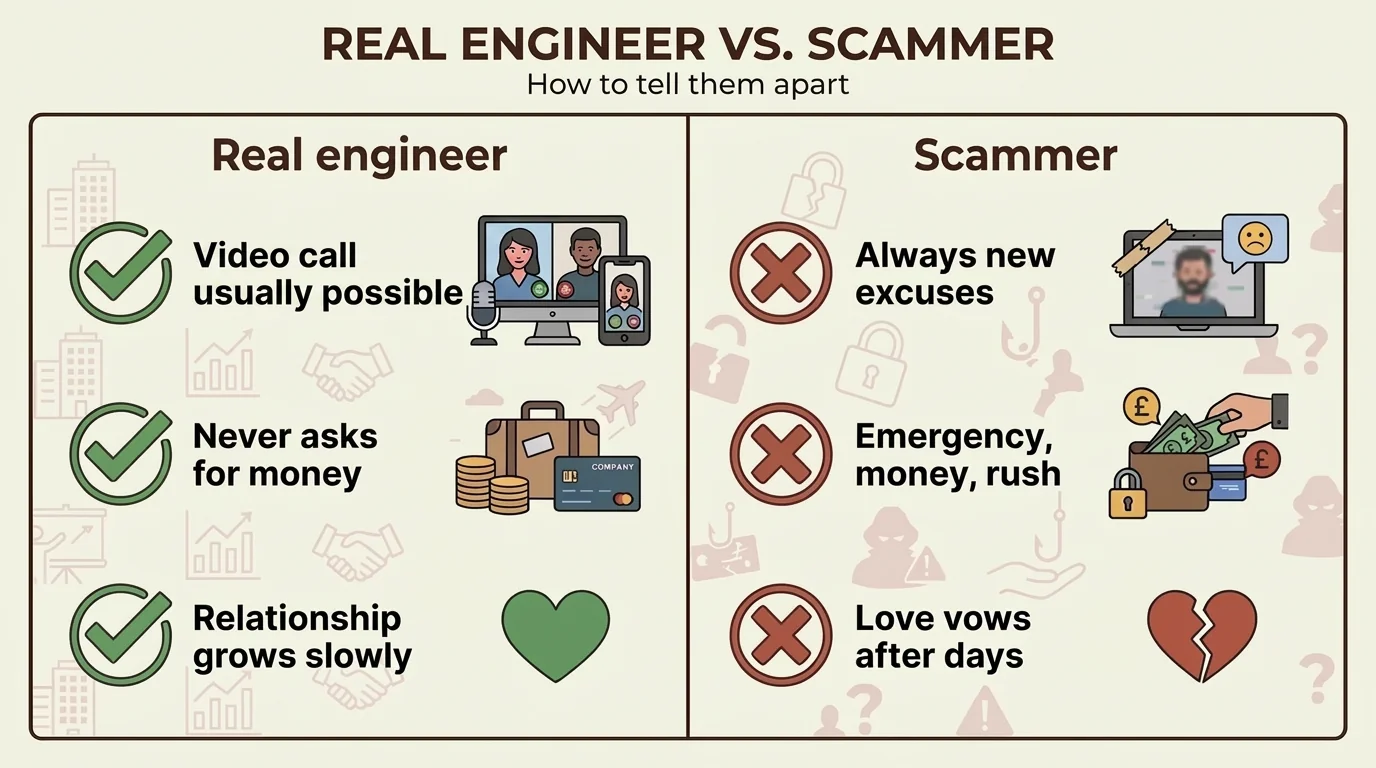
Real engineer vs. romance scammer: At a glance

Telltale sign Real engineer Romance scammer
Video calls Usually possible, although their availability and internet connection might be limited They'll refuse for weeks, with a constant stream of new excuses
Communication Works shifts, including nights, so they'll be offline at times Avoids video calls but is suddenly online the moment money is mentioned
Requests for money Will never ask you for money Asks for money for ‘emergencies’, repairs or flights
Photos A mix of work and personal photos Perfect, model-like photos, with no candid snaps
Time zone Matches their stated location Their online activity doesn't match their supposed time zone
Language Natural and consistent Awkward phrasing, translation mistakes or overly formal language
Emotional intensity Lets the relationship develop at a natural pace Love-bombs you after just a few days

Graphic comparing a real engineer and a romance scammer on three points: video calls, asking for money, and the pace of the relationship. Three key ways to tell a genuine match from a scammer. See if any of this sounds familiar.

1. They keep making excuses to avoid video calls

This is the biggest red flag. If someone keeps dodging your requests for a video call for weeks, or always cancels at the last minute, something isn't right.

Someone who's genuinely interested will find a way to have a quick video chat. An excuse like "bad internet" or "security rules" isn't proof of a scam on its own. But it becomes very suspicious when they avoid video calls for weeks while also bringing money into the conversation.

2. Their messages read like a bad translation

Many scammers are based abroad and use translation software. This can make their messages sound clunky, overly formal, or be full of odd grammatical mistakes and awkward turns of phrase.

Another giveaway is a switch between perfect English and sudden, basic mistakes. This is often a sign that different people are writing the messages, or that they’re switching between their own writing and a translation app.

3. They come on too strong, too soon

If they're talking about marriage, a future together and undying love after just three days, it’s not a whirlwind romance – it’s a red flag.

Real relationships take time to grow. A good rule of thumb is: the faster they say they love you, the higher the risk.

4. They ask for money via crypto, gift cards or an overseas transfer

A genuine person you've only met online will never ask you for money. Full stop.

Be especially wary of requests for payment with Apple or Amazon gift cards, Steam credit or cryptocurrency. It’s virtually impossible to get your money back if you pay this way.

5. Their photos look a little too perfect

If all their photos look like professional model shots, without a single casual selfie or candid snapshot in sight, that should raise a red flag.

Scammers often steal photos of real people or use AI-generated images. Many victims later discover the very same photos on other profiles or stock photo sites.

6. The time zone doesn't match their story

If someone claims to be working on an oil rig in the North Atlantic but is active during Asian office hours and wishes you "Good morning" in the middle of your night, something doesn't add up.

Many scammers are based abroad, and the time difference can give them away.

7. Their story keeps changing

One minute he has two children, the next it's three. Sometimes he's an engineer, other times a project manager.

These inconsistencies happen because scammers are often juggling several victims at once and get their stories mixed up.

4. Spotting an oil rig scammer: A step-by-step guide

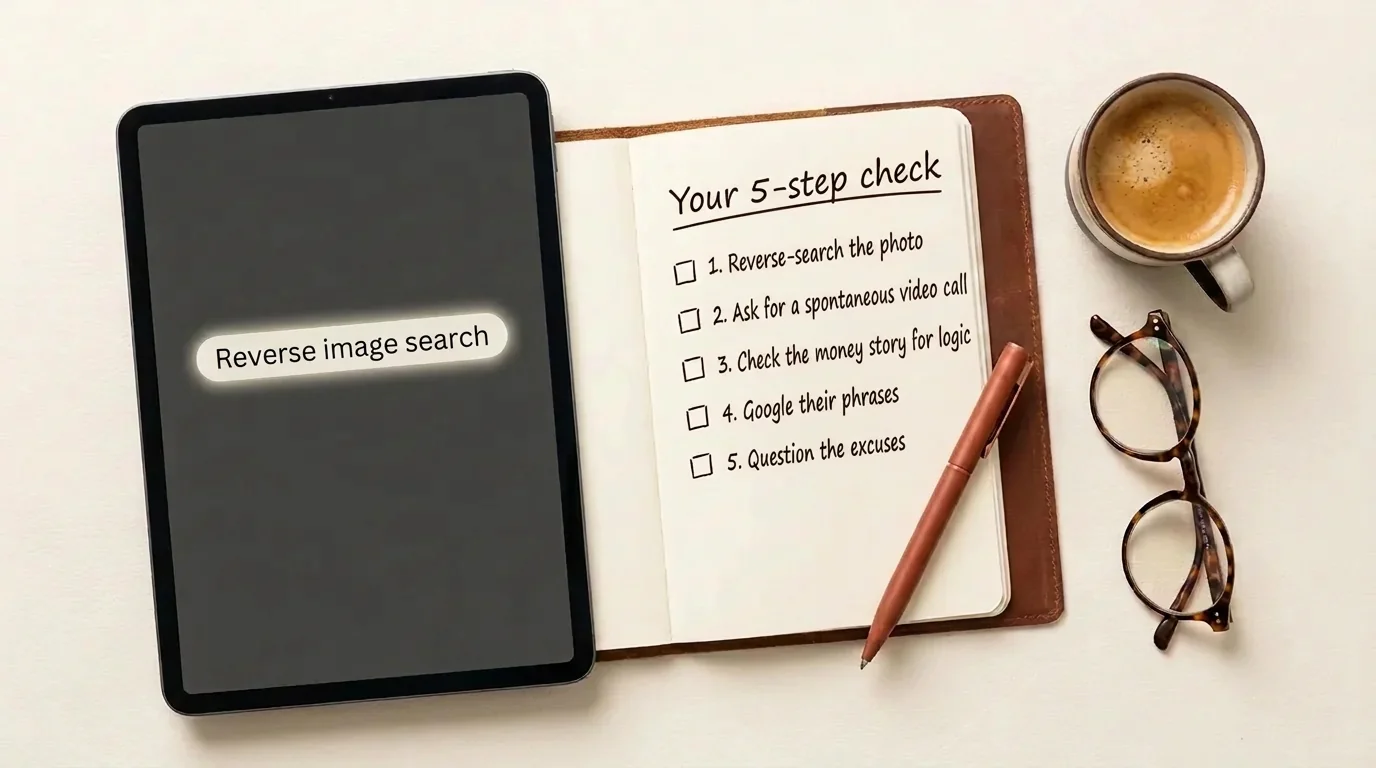
A desk with a tablet and a handwritten checklist for spotting fake profiles. Trust your gut, but always verify. These five steps will help you work out if you're talking to a genuine person.

Step 1: Do a reverse image search

Save one of their photos and search for it using Google Images or TinEye. If the picture appears on a modelling agency website, a stock photo site, or is linked to a completely different name, it’s a major red flag that the profile is fake.

A word of warning: AI-generated photos won't appear in a reverse image search because they’re completely new images. If you suspect this, look for other tell-tale signs like unnaturally smooth skin, distorted backgrounds or odd details.

Step 2: Suggest a spontaneous video call and ask for a specific gesture

During the video call, ask them to make a specific, spontaneous gesture – for example, to briefly hold their hand up to the camera or turn their head to one side. A genuine person can usually do this without any fuss, but a scammer will often dodge the request or come up with a string of excuses.

You could also ask for a custom photo, for instance: “Send me a quick photo of you holding a piece of paper with today's date and the word ‘sunshine’ on it.”

But be warned: this isn't foolproof. Thanks to AI tools and photo-editing software, these kinds of pictures can be faked in minutes. That’s why a spontaneous video call is a much better test. Even then, live deepfakes are a possibility, so the most crucial factor will always be their behaviour around the subject of money.

Step 3: Use some common sense – big companies cover their own costs

No reputable company would ever ask an employee to pay for equipment repairs or their flight home out of their own pocket – and they certainly wouldn’t expect them to borrow the money from someone they’ve just met online.

If someone tells you they need to pay upfront for their travel home or for a piece of broken machinery, it's almost certainly a scam. Major corporations handle these expenses through company accounts, insurance policies and internal departments, not by asking employees to get money from people they've met on a dating site.

Step 4: Google their name and any stock phrases

Copy and paste any distinctive-sounding sentences from their messages into Google. You’ll often find the exact same phrases popping up on scam warning lists or in forums like Reddit’s r/Scams.

The Alva Scam Check can also help you screen profiles and chat histories for common red flags.

Step 5: Be wary of the ‘no internet’ excuse

These days, most oil rigs have internet access, although the connection speed and usage rules can vary from one rig to another. It’s very rare for employees to be left completely out of contact.

A patchy connection on its own isn’t a red flag. But you should be on your guard if this excuse is combined with requests for money, pressure to act quickly, or intense declarations of love. That combination is a classic sign of a romance scam.

5. Dating safely: Great options for singles in their 40s and 50s

If you're looking for a serious connection, you're much better off on dating sites that cater to singles who are also hoping to find a committed relationship.

Dating sites like Ourtime or SilverSingles are designed specifically for singles over 50 who are looking for a long-term partner.

Sites like eHarmony or EliteSingles use detailed profiles and questionnaires. This might put some scammers off, but it's by no means a guarantee of safety.

Some sites check new profiles more thoroughly than others. That doesn't mean scammers can't slip through the net, so you still need to stay on your guard.

Whichever site you join, the Alva Scam Check can help you weigh up profiles and conversations before you get too emotionally involved.

6. First aid: What to do if you've already been in contact

Cut off all contact immediately, without explanation

You don't owe a scammer an explanation. First, take screenshots of all your messages, as the chat history can disappear once you block someone. Next, report their profile on the dating site or app, and then block their number on WhatsApp, Telegram and the dating app.

Do not reply to any new messages, even if they try to use emotional blackmail.

Save every chat, email and payment record as evidence

Take screenshots of all the messages, photos and documents they sent you. If you've already sent money, save any bank statements or transfer confirmations too.

You'll need this evidence for the police and your bank.

Report the fraud to the police and contact your bank

You should report what's happened through Report Fraud (reportfraud.police.uk) or, in Scotland, to Police Scotland on 101. Although the scammers are often based abroad and can be difficult to trace, every report helps the authorities to build a clearer picture of the problem and can prevent others from being conned.

If you have sent any money, let your bank know immediately. There's a chance they can still stop the payment, particularly with international transfers.

Get a first assessment with the Alva Scam Check

The Alva Scam Check uses AI to analyse your chat history and the person's profile, flagging up any typical red flags.

The result gives you guidance, it’s not a final verdict. Whether it’s actually fraud is for the police and your bank to decide.

Alva is no substitute for the police, but it's a great first step to help you get your thoughts in order before you decide what to do next.

7. Frequently asked questions about oil rig romance scams

Why do these 'engineers' always ask for money?

These so-called engineers always ask for money because they are scammers, plain and simple. The scam is designed from day one to win your trust so they can eventually ask you for cash. The emotional connection they build is just a means to an end. Genuine engineers on oil rigs are well-paid and financially secure. They would be extremely unlikely to ask someone they’ve only met online for money.

Are there really security rules against video chats on oil rigs?

While oil rigs do have some restrictions, like mobile phone bans in hazardous areas or limited internet bandwidth, a total ban on video chats for employees is highly unusual. The ‘safety rules’ excuse is a classic tactic in this type of scam. It should raise your suspicions if it’s used to avoid video calls for weeks on end, especially if the conversation also turns to money.

How can I be sure a photo isn't AI-generated?

You can never be 100% sure a photo isn’t AI-generated, but there are some common tell-tale signs. AI photos can look incredibly realistic, but there are often small giveaways: look for distorted backgrounds, hair that seems to merge into other objects, asymmetrical details like earrings, unnaturally smooth skin, and a lack of casual, candid photos. A picture of them holding a handwritten note proves nothing, as these are now easy to fake with AI tools. A spontaneous video call is a better test, though live deepfakes do exist. Ultimately, their behaviour around money is the biggest red flag.

Can I get my money back if I've already transferred it?

Getting your money back once you’ve sent it is extremely difficult, but not entirely impossible. Contact your bank immediately and explain what has happened. For international bank transfers, there is sometimes a very short window in which the transaction can be stopped. However, if you’ve paid using gift cards or cryptocurrency, the money is almost certainly gone for good as these methods are nearly impossible to trace. Whatever happens, you should always report the crime to the police.

Why do so many people fall for this scam?

The reason so many singles fall for this scam is that the fraudsters use psychologically-honed tactics. They are experts at exploiting our vulnerabilities, such as loneliness, the desire for security, and the longing for a genuine connection. By investing weeks or even months building trust before they ask for money, they break down our natural defences. Falling for it isn’t a sign of naivety; it’s a sign of being human and open to connection. Absolutely anyone can become a victim.

What does the Alva Scam Check do?

The Alva Scam Check analyses a screenshot of a profile or chat for typical scam patterns and explains in plain language why they are red flags. The result is for guidance only and is not a substitute for reporting the crime to the police.

Are all profiles of engineers on oil rigs scams?

Not all profiles of engineers on oil rigs are scams, as there are, of course, genuine people who work in this profession. However, the combination of ‘engineer on an oil rig’, a refusal to video call, the relationship getting intense very quickly, and an eventual request for money is a massive red flag. If you’re unsure, use the verification steps described above or have Alva check the profile for you.

Where can I report suspicious profiles?

You should report suspicious profiles in two places. Always report the profile directly on the dating site or app where you met them. You should also report the scam to the police. In England, Wales and Northern Ireland, this is done through Report Fraud (reportfraud.police.uk or 0300 123 2040), the national reporting service for fraud and cybercrime. In Scotland, call Police Scotland on 101.
🛡️ Scam check by AskAlva

Not sure about a contact? Upload a screenshot. AskAlva checks it for fraud patterns in under a minute.

Try it free →

Screenshots are never stored.

More from “Safety & scam protection”