Online Dating Chat: How to Go From a Match to a First Date

By Sandra · Updated on 3 September 2026 · ✓ Reviewed by the editorial team

Online Dating Chat: How to Go From a Match to a First Date

The match is perfect, the profile looks promising – and then you're just staring at an empty chat window, wondering, 'What on earth do I write now?' For many singles, the journey from the first match to an actual date is the biggest hurdle in online dating. That first message often decides whether a promising match turns into a real conversation – or if the interest fizzles out before it even begins.

This guide will walk you through every stage – from the first sentence to asking for a date. You'll get specific phrases, psychological strategies, and honest dating chat tips to help you stay authentic while standing out from the crowd.

In a nutshell

The way to get from a match to a first date on dating apps and sites is to start with a personal opener and, after a few days of genuine chat, ask for a date directly.

  • A good opener shows you've actually read their profile: Refer to a specific detail from a photo or their bio and ask an open-ended question.
  • The 'ping-pong' method keeps conversations alive: Share a small piece of information about yourself, then ask a question – avoid slipping into interview mode.
  • The sweet spot for asking for a date is between day 3 and 7: If you just text for too long, you risk falling into the 'pen pal trap' and losing momentum.
  • You can spot interest through investment, not just politeness: Someone who asks real questions back, picks up on details, and mentions the future ('We should go there sometime...') is genuinely keen.
  • Authenticity beats any tactic: Perfection isn't the goal – honest, warm communication between equals is what truly matters.

Table of Contents

  1. The Psychology of Texting: Why the Chat Decides the Date
  2. Phase 1: The Opener – The Perfect First Message
  3. Phase 2: The Getting-to-Know-You Dynamic – Small Talk vs. Deep Talk
  4. Phase 3: The Transition – From Chat to Date
  5. Phase 4: Troubleshooting & Avoiding Mistakes
  6. Special Considerations for Singles Over 40 and 50
  7. Safety First: How to Spot Fake Profiles and Scams
  8. The Biggest Conversation Killers: Mistakes to Avoid
  9. Conclusion: Authenticity Beats Any Tactic
  10. Frequently Asked Questions About Online Dating Chats

1. The Psychology of Texting: Why the Chat Decides the Date

Your chat is your digital business card. Before you even sit across from each other, it's where the decision is made: will this match lead to a real meeting, or will the interest quietly fade away? In online dating, you're missing all the non-verbal cues that work instantly in real life: tone of voice, body language, eye contact. Instead, every word counts.

Why the first impression in a chat is so crucial

A lazy 'Hey' message signals a lack of interest or effort. A wall of text can feel overwhelming. The art is finding the balance between showing interest and keeping it light. In practice, the first three messages often determine whether a conversation gets going or fizzles out.

Connection over perfection

Many people – especially after a long relationship or a break from dating – put pressure on themselves to write the 'perfect' message. But it's not about being flawless or incredibly witty. The real question is: does the other person feel that someone is genuinely interested? That someone has taken a moment for them?

A simple rule has proven effective: write the way you'd speak in real life – clearly, kindly, and without putting on an act.

Trust and rapport take time – but not too much

The chat is a bridge, not a destination. If you text for weeks without meeting, you risk falling into the 'pen pal trap': the excitement fizzles out, the idea you have of the other person becomes too built up, and the actual meeting often leads to disappointment. Experience shows that the ideal chat is an appetiser – enough to make them want more, but not so much that there's nothing left to discover.

The goal of this guide

This article will show you how to get from a match to a meeting without having to be someone you're not. You'll get specific phrases, psychological strategies, and red flags to watch out for – so you can start conversations feeling confident, authentic, and with a clear plan.


2. Phase 1: The Opener – The Perfect First Message

The first message in dating is the door opener. It's the moment that decides whether the other person replies – or keeps swiping. You don't need a genius line. You need to show attention, make a connection, and ask a real question.

Why 'Hey' or 'Hi, how are you?' are conversation killers

These openers aren't rude – they're just generic. They could be sent to anyone. They don't show that you've looked at their profile. On dating sites, many people get dozens of messages like this. If you don't show any effort, you'll be ignored. In fact, the response rate to generic openers is extremely low.

The connection rule: Show you've paid attention

A good opener refers to something specific from their profile: a photo, a hobby, a travel destination, a detail in their bio. It shows: 'I actually read your profile. You're not just another match.'

Examples of good openers:

  • 'You're into hiking too – the Dolomites are on my list as well. What's been your favourite hike so far?'
  • 'I love museums too. Which one is your favourite, and why?'
  • 'You seem like someone who'd put pineapple on pizza – and own it.' (Playful, invites a response)
  • 'Your dog looks like a little troublemaker. What's their name, and what's the latest mischief they've caused?'

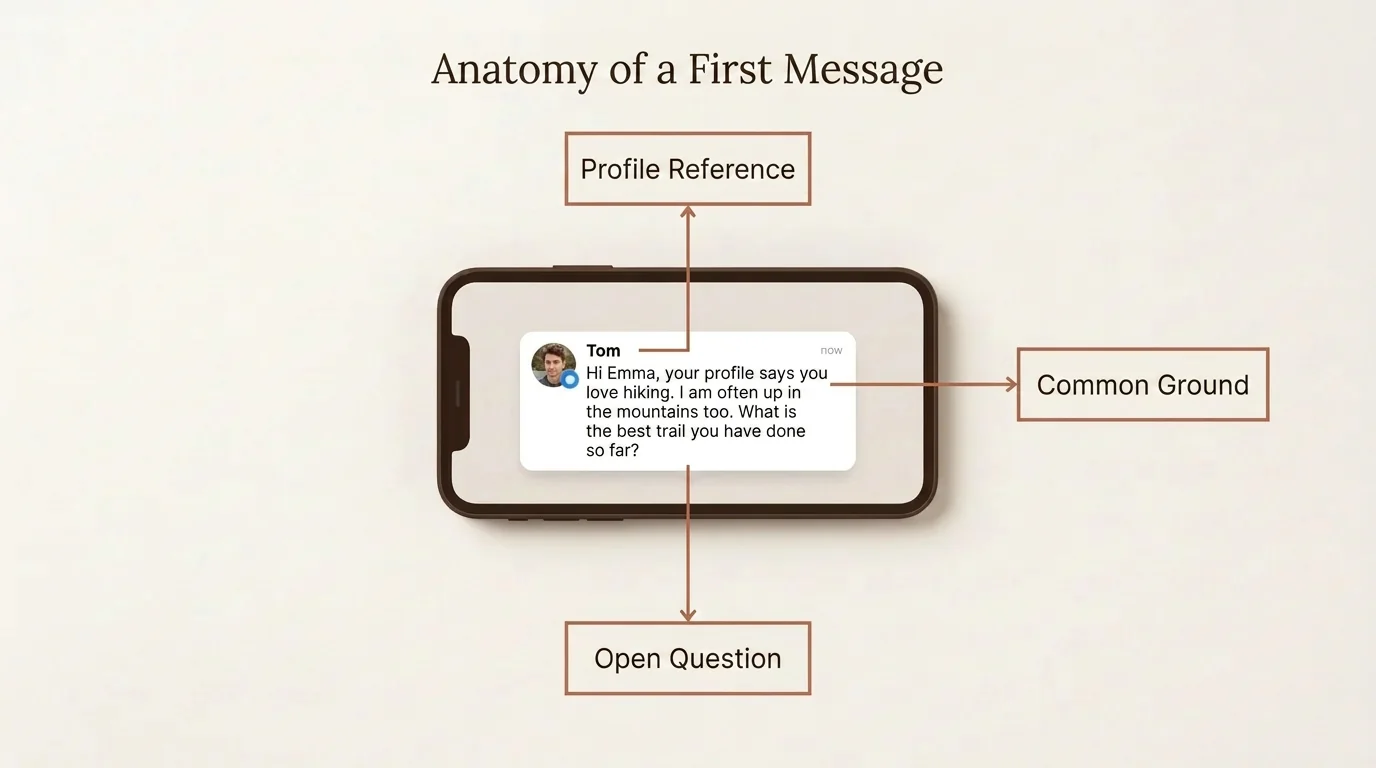
The anatomy of a strong opener

A good opener has three parts:

  1. Reference: 'I saw that you...'
  2. Personal connection: '...I find that interesting too, because...'
  3. Open-ended question: '...what about you?'

This structure shows interest, gives the other person something to reply to, and invites a real conversation.

Anatomy of a perfect first message in online dating, focusing on profile references, common ground, and open-ended questions.

A good opener shows you've read their profile. Combine an observation with a genuine question to significantly increase your response rate.

What you should avoid

  • Generic compliments: 'You're pretty' is a nice thought, but it's interchangeable. It says nothing about you and doesn't invite a conversation.
  • Walls of text: Nobody wants to read a novel in the first message.
  • Asking for a phone number or a date straight away: This comes across as pushy and disrespectful.
  • Copy-and-paste messages: People can tell when a message is sent to everyone.

The right timing

Reply within 24 hours of matching. After that, the response rate drops significantly. This doesn't mean you have to write immediately – but don't let too much time pass, or the moment will be lost.


3. Phase 2: The Getting-to-Know-You Dynamic – Small Talk vs. Deep Talk

The opener worked, the other person has replied – so what now? This is where the real art begins: keeping a dating conversation going without it turning into an interview or becoming boring.

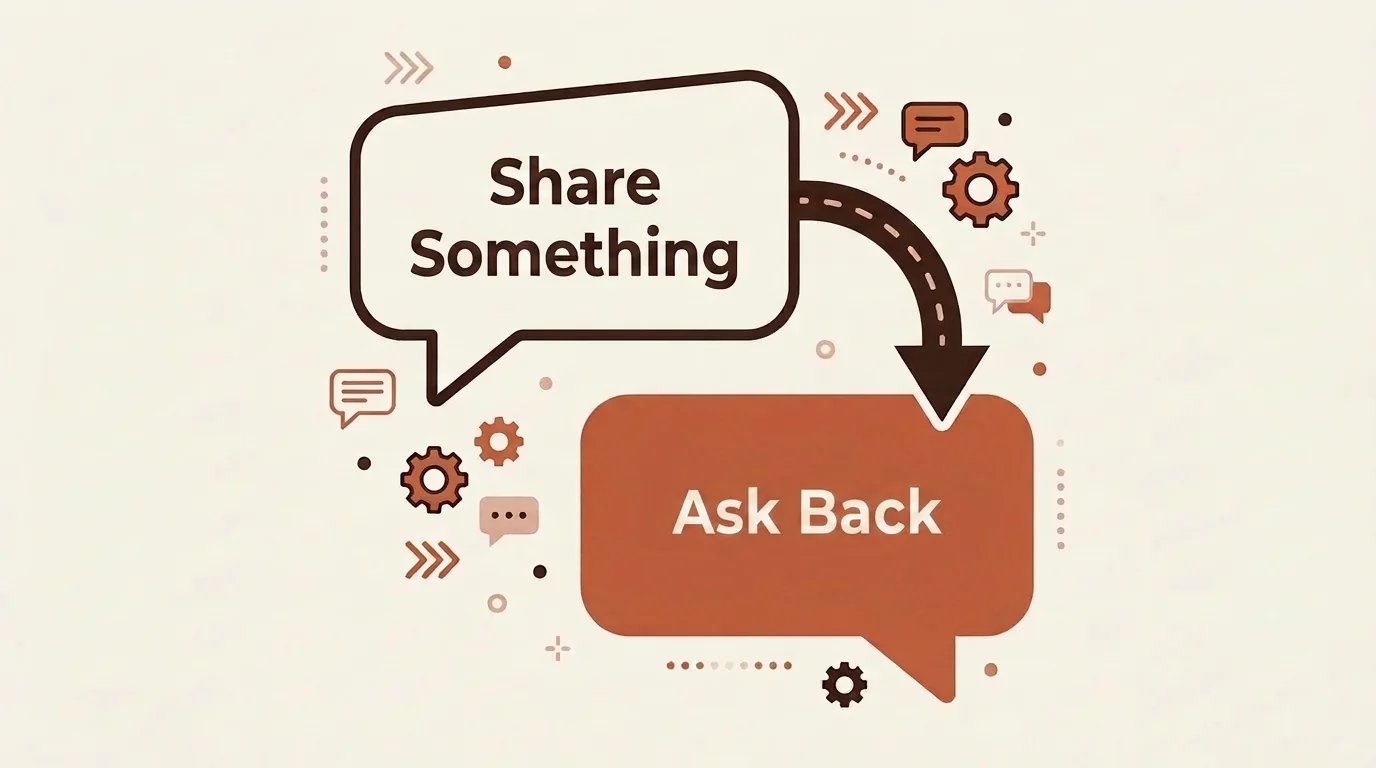
The ping-pong method: Statement + question

The golden rule for good conversations is: Share something about yourself, then ask a question. This creates a natural flow where both people contribute.

Bad (just an interrogation):

  • 'What do you do for work?'
  • 'Where are you from?'
  • 'What are your hobbies?'

Good (ping-pong):

  • 'I've been getting really into baking bread lately – sounds old-fashioned, but I find it quite meditative. Are you a keen cook, or more of a "I know a great restaurant" type?'
  • 'I love listening to podcasts on walks – currently hooked on a history one. Do you listen to anything, or do you need music to get you moving?'

Ask for stories, not just facts

People remember stories, not data sheets. Instead of 'What do you do for a living?' try asking: 'What's the biggest misconception people have about your job?' Instead of 'Where did you last go on holiday?' ask: 'What was the most surprising thing about your last trip?'

These questions invite them to tell a little anecdote – and that's what makes conversations come alive.

Infographic on the ping-pong method in chats: Combining sharing information with targeted follow-up questions for a better conversation flow.

Avoid interview mode by using the ping-pong method: share a small anecdote and always end your message with an open-ended question.

Mirror their energy and length

Pay attention to how the other person writes. If they reply with detailed messages, you can too. If they're more concise, adapt your style – otherwise, you might come across as too intense. This doesn't mean you should pretend to be someone you're not, but a certain amount of mirroring signals: 'We're on the same wavelength.'

Topics that almost always work

  • Travel and places: 'What's the one place that surprised you the most?'
  • Passions and hobbies: 'What's something you could talk about for hours?'
  • Everyday observations: 'What's been the best part of your week so far?'
  • Ambitions and dreams: 'If money were no object, what would you do all day?'

Taboo topics for the early stages

  • Ex-partners: Keep any mentions under two minutes. No one wants to talk about past relationships when getting to know someone new.
  • Negative outlooks on life: Bitterness, frustration with dating apps, or general world-weariness can be off-putting.
  • Politics and religion: Too early in the conversation, these topics tend to divide more than they unite.
  • Physical compliments or sexual innuendo: This almost always comes across as too soon and disrespectful.

Humour as an icebreaker – but use it carefully

A bit of light-hearted teasing can build rapport: 'Wait, you don't like pizza? I think we might have to start this conversation over.' But be careful: humour is subjective. What's funny to you might be hurtful to someone else. When in doubt, it's better to be warm than sarcastic.


4. Phase 3: The Transition – From Chat to Date

The chat is going well, the chemistry feels right – but how do you get to an actual date? Many people hesitate here, afraid of seeming too pushy or getting rejected. Yet this step is crucial: if you only text for too long, you risk the interest fizzling out.

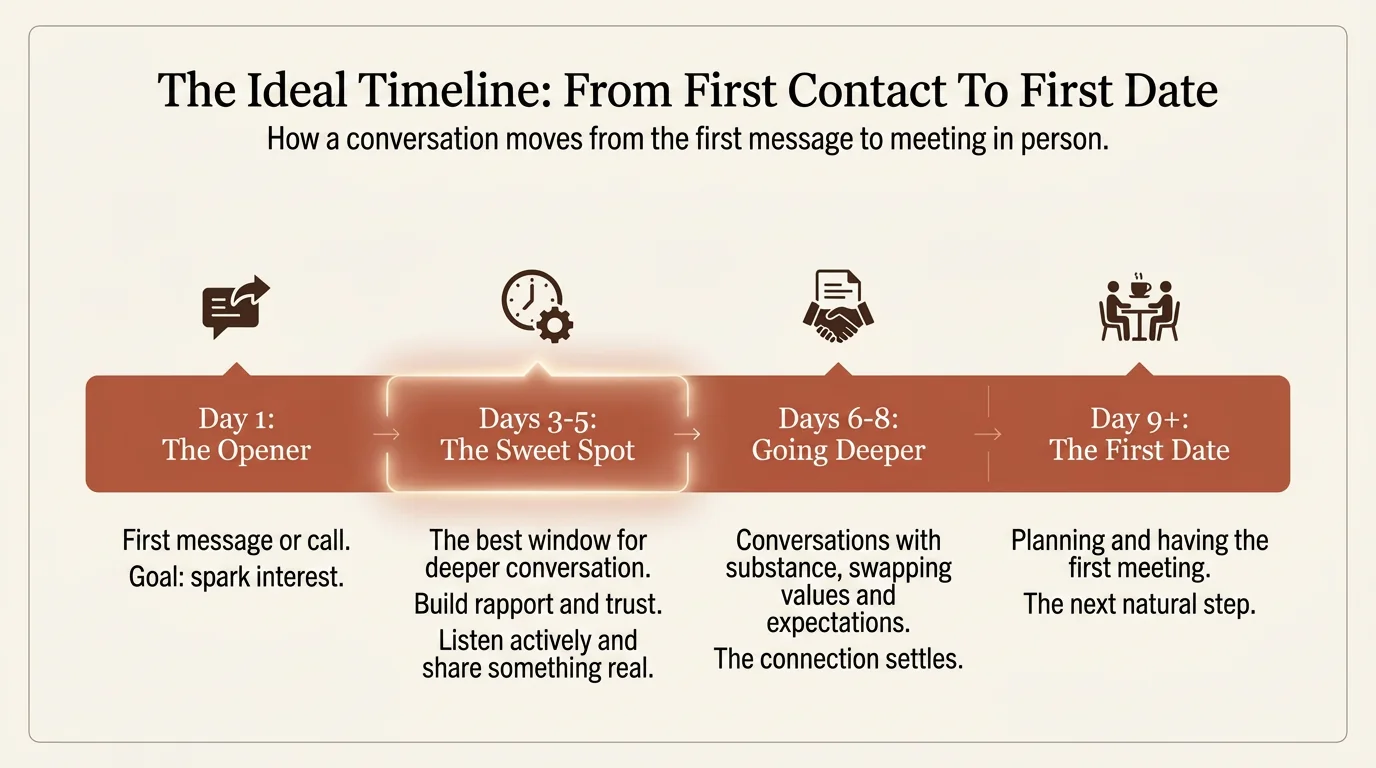
The sweet spot: When is the right time?

The ideal time to ask for a date is between day 3 and day 7 of chatting – or after about 10 to 20 messages. Too soon, and there's not enough trust. Too late, and the spark is gone.

How do you know the time is right?

  • The other person asks genuine, personal questions back.
  • Their replies become longer and more enthusiastic.
  • Shared interests or places come up: 'Oh, I know that café too!'
  • They drop hints like 'We should...' or 'We'll have to check that out together.'

If at least three of these signs are there, it's time.

A timeline for online dating chats showing the ideal time to ask for a date is between day 3 and 5, the so-called sweet spot.

Timing is crucial: chat for too long and you risk the interest fading. The sweet spot for asking them out is usually between day 3 and 5.

Avoiding the pen pal trap

Anyone who texts for more than two weeks without planning a date often ends up in a dead end. The idea you have of the other person becomes too big, expectations rise – and the actual meeting leads to disappointment. Or the conversation simply dies down because the energy is gone.

The rule: The chat isn't the destination, it's the bridge. Use it to find out if you want to meet – not to tell your entire life story.

Specific ways to ask them out

A good date invitation is specific, low-pressure, and gives the other person an easy way out. Avoid vague phrases like 'We should meet up sometime' – it sounds like an intention without a plan.

Examples:

  • 'I'd love to continue this conversation over a coffee. Would Saturday or Sunday work better for you?'
  • 'You've sold me on that ramen place. Saturday afternoon – or is the weekend too soon?'
  • 'This has been a great chat. Let's continue it on a walk sometime – how about Thursday or Friday?'

For singles over 40 or 50 who feel a bit unsure:

  • 'I always find this transition a bit awkward, but: would you be up for meeting for a coffee?'
  • 'I've just realised we've been texting for two weeks without meeting. Let's change that – are you free next week?'

The phone call trick: The bridge before the date

Many singles over 40 and 50 appreciate a short phone or video call before the first date. It lowers the barrier to meeting, gives you a better feel for the other person's voice and energy – and helps protect against any nasty surprises.

'Before we meet up, would you be up for a quick call? I find it gives you a much better sense of a person.'

What to do if the other person hesitates

If you don't get a clear answer to your invitation ('Sounds good, but I'm really busy at the moment'), it's often a polite no. Accept it without any drama: 'No problem, no pressure at all. Let me know if anything changes.' And then: move on. If someone is interested, they'll be in touch.


5. Phase 4: Troubleshooting & Avoiding Mistakes

Not every conversation goes smoothly. Sometimes the other person stops replying, sometimes the chat stalls, and sometimes you just get a feeling that something isn't right. Here are the most common problems – and how to handle them.

Understanding ghosting: It's usually not about you

Ghosting – when someone suddenly goes silent without explanation – is frustrating. But in most cases, it has nothing to do with you. People disappear for all sorts of reasons: they're overwhelmed, they've met someone else, they're dealing with a personal crisis, or they're only using dating apps out of boredom.

What to text back when someone ghosts you?

  • One last message is okay: 'Hey, I've noticed our chat has fizzled out. If you're still interested in meeting up, just let me know. If not, all the best!' This shows maturity and leaves the door open without being pushy.
  • Don't chase them: Multiple messages like 'Hello? Are you still there?' come across as needy and make the situation worse.
  • Let it go: If there's no reply after a week, move on. Your energy is better spent elsewhere.

Spotting the red flags

Some conversations are best ended early because the other person is showing problematic behaviour:

  • Love-bombing: Over-the-top compliments and talk of the future after just a few messages ('You're the one I've been waiting for').
  • TMI (Too Much Information): Sharing too much personal information too soon – about ex-partners, illnesses, or financial problems.
  • Aggression or pressure: When someone gets angry because you don't reply instantly, or pushes you to leave the app and switch to WhatsApp.
  • Inconsistencies: Their story changes, or details don't add up.

Trust your gut. If something feels off, it usually is.

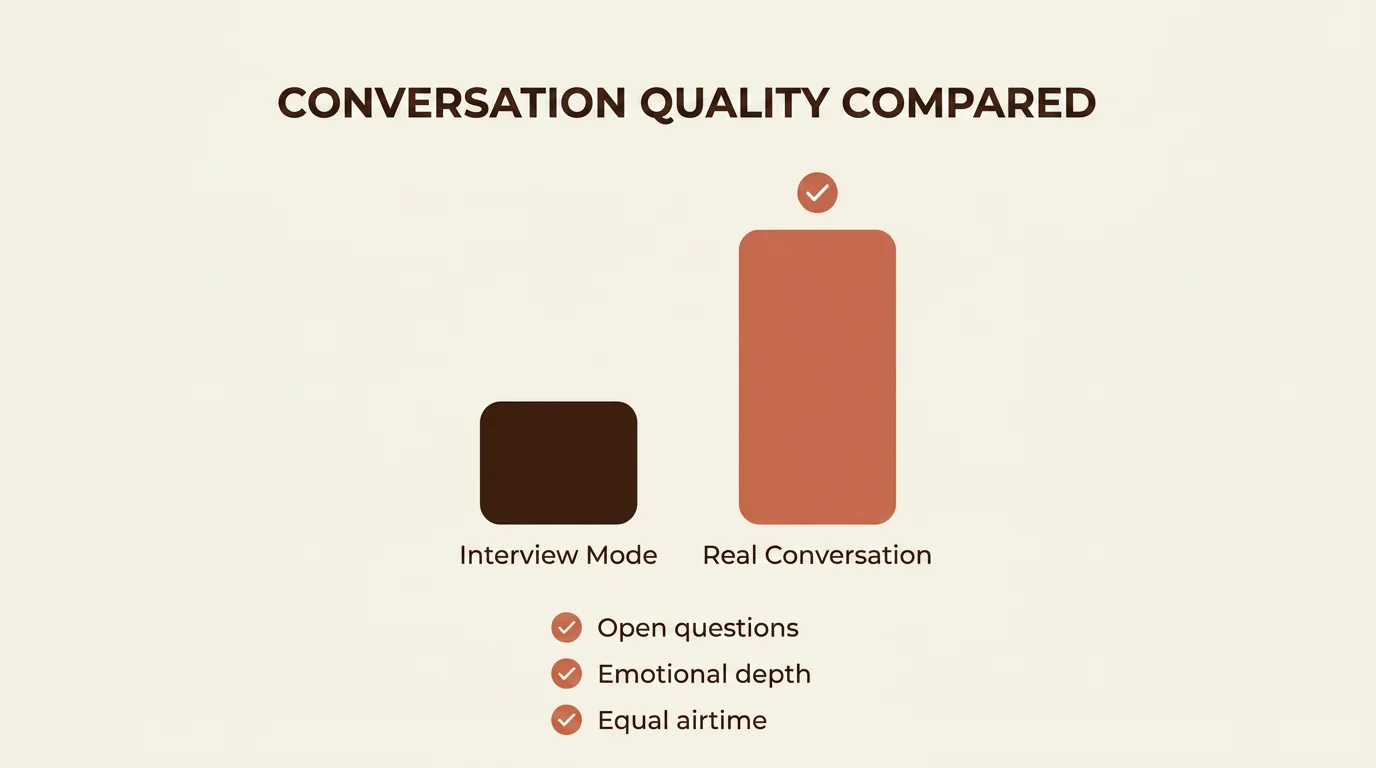
Comparison chart between interview mode and a real dialogue in a dating chat, to avoid ghosting and spark genuine interest.

A real dialogue thrives on emotion and balance. Someone who just fires off questions quickly slips into interview mode, which can feel draining for the other person.

When the conversation fizzles out: The response matrix

Sometimes a conversation loses steam, even though there was interest at first. That doesn't have to be the end.

If the replies are getting shorter:

  • Change the subject: 'Right, let's change topic – tell me: what's the most random thing that's happened to you this week?'
  • Emotional spike: Something unexpected that grabs their attention: 'I just tried to cook pasta and it was a disaster. How do adults survive?'

If the other person is only giving one-word answers:

This is usually a sign of waning interest. You can address it directly: 'I get the feeling this chat isn't really flowing right now. Is it just bad timing, or should I leave you to it?' Honesty is often appreciated – and if not, at least you have clarity.

The step-back test: Is the other person investing too?

A good conversation is a two-way street. If you notice that you're putting in 80% of the effort – you're asking the questions, keeping the chat going, suggesting the date – then take a step back for a few days. See if the other person messages you first. If they don't, that's your answer.


6. Special Considerations for Singles Over 40 and 50

If you're getting back into dating after a long relationship, divorce, or bereavement, you might feel a bit 'rusty'. That's completely normal – and it's exactly why you need a different approach from someone who's been actively dating for years.

Values and sincerity over games

While younger dating culture is often about 'rizz', banter, and tactical games, people over 40 and 50 are usually looking for something else: companionship, sincerity, and a real connection. Nobody has the time or energy for games anymore.

This means:

  • Be honest about your intentions: If you're looking for a serious relationship, say so. If you're not sure yet, that's okay too.
  • No false promises: Over-the-top compliments or talk of the future after two messages just don't feel credible.
  • Authenticity matters more than perfection: If you're nervous, you're allowed to say so. 'To be honest, I haven't done this in 20 years and it feels a bit strange' – that's endearing, not weak.

Dealing with feeling 'rusty'

Many people worry about seeming awkward or clumsy after a long break. The truth is, calling out the awkwardness disarms it.

'To be honest, I'm not really sure how to start these things. But your profile made me curious – tell me, what's been the best part of your week?'

This shows self-awareness and courage – and those are attractive qualities.

Meet sooner rather than texting forever

A common mistake: after long marriages or relationships, many people tend to text for weeks because the thought of meeting up is daunting. The result: the idea of the other person becomes huge, expectations soar – and the actual date is a let-down.

The better strategy: suggest a short, low-pressure meeting after a few days. A coffee, a walk in the park – 30 to 60 minutes to see if the chemistry is there. No pressure, no big dinner date.

'I find you can tell more from a quick coffee than from weeks of texting. Fancy meeting up for one?'

Serious dating sites foster a different conversation culture

Platforms like eHarmony, Match.com, or Ourtime attract people who are specifically looking for long-term relationships. The conversations there are often deeper and more respectful than on swipe-based dating apps like Tinder or Bumble. If you're looking for something serious, you'll often be in better hands there.


7. Safety First: How to Spot Fake Profiles and Scams

Unfortunately, online dating also has its share of people who aren't honest. Some use old photos, some make up stories – and some have criminal intentions. Singles over 40 and 50 are particularly common targets for romance scams. That's why it's so important to know the warning signs.

Your gut feeling is your most important guide

If something feels too good to be true, it usually is. If someone expresses over-the-top emotions after just a few messages ('I think fate brought us together'), if their story doesn't add up, if they're putting pressure on you – then pause and take a step back.

Typical tactics used by romance scammers

  • Quickly moving to WhatsApp or Telegram: 'The app isn't secure, let's chat somewhere else.' This makes it harder for you to report them.
  • Widowed soldiers, doctors abroad, engineers on oil rigs: These professions are often fabricated because they provide a convenient excuse for why a video call isn't possible.
  • Love-bombing: Intense, romantic language right from the start. 'You're the person I've been waiting for my whole life.'
  • Financial emergencies: After a few weeks, a request for money will appear: 'My card isn't working, can you send me a gift card?' or 'I've found an investment opportunity that will help us both.'

Remember: Real people don't have emergencies that require them to ask strangers for money. No one who is genuinely interested in you will ask you for gift cards, bank transfers, or crypto investments.

What you should never do

  • Never send money or buy gift cards – no matter how convincing the story sounds.
  • Don't share sensitive data: your address, employer, or bank details.
  • Don't send nude photos: These can be used for blackmail.

Use the AskAlva Scam Check

If you're not sure whether a profile is genuine, you can use the AskAlva Scam & Safety Check. Simply upload a screenshot of the profile or chat – Alva will check for scam patterns, run a reverse image search, and give you a clear assessment with a risk traffic light. You can find the Scam Check here.


8. The Biggest Conversation Killers: Mistakes to Avoid

Some mistakes in chat are so common that almost everyone makes them. The good news is, once you know what they are, you can avoid them.

1. The panic double-text: Why patience increases attraction

You've sent a message, but haven't heard back for hours. Now you're wondering, 'Should I text again?' The answer is almost always: No.

A second message sent out of impatience ('Hello? Are you still there?' or 'Guess you're not interested...') comes across as needy and insecure. People have different rhythms – some reply instantly, others only in the evening. Give the other person some space.

The exception: A second message for logistical reasons is fine ('Oh, I forgot to say, Saturday works for me too'). But don't send one just to seek emotional validation.

2. One-word answers and a lack of initiative

If you only reply to every question with 'Yes', 'No', or 'Cool' without adding anything yourself, the conversation will die. The other person will feel like they're talking to a brick wall.

Better: Every reply should offer a new hook – a little story, a question back, an opinion.

3. Getting sexual too soon

Physical compliments or sexual innuendos in the first few messages will almost always get you unmatched instantly. They signal disrespect and a lack of interest in the person as a whole.

The rule: Wait until the other person steers the conversation in that direction – and even then, be respectful and read the signals carefully.

4. Unsolicited advice or too much negativity

No one wants to be lectured when they're getting to know someone. Phrases like 'You should try...' or 'If I were you, I would...' sound condescending. The same goes for constantly complaining about dating apps, ex-partners, or life in general. It's a downer.

Better: Stay in the here and now. Be curious, not a know-it-all. And if you do talk about difficult things, do it with a light touch, not with bitterness.

5. Getting stuck in texting limbo

The biggest mistake of all: texting for weeks without ever planning a date. The chat is not an end in itself. If you feel the conversation is going well, take the next step. Otherwise, the energy will be lost – and you'll remain pen pals who never meet.


9. Conclusion: Authenticity Beats Any Tactic

The path from a match to a first date isn't a science, it's an art – and the most important ingredient isn't perfection, but authenticity. You don't have to have the perfect opening line, be witty all the time, or hide every insecurity. What really counts is genuine interest, respect, and the willingness to show who you are.

The key strategies at a glance

  • A good opener shows effort: Refer to something specific in their profile and ask an open-ended question.
  • The ping-pong method keeps conversations alive: Share something about yourself, then ask a question – avoid interview mode.
  • The sweet spot for asking for a date: Between day 3 and 7. If you only text for too long, you'll end up in the pen pal trap.
  • You can spot interest through investment: Someone who asks real questions back, picks up on details, and mentions the future is genuinely keen.
  • Ghosting isn't personal: One final, dignified message is okay – then let it go.
  • Safety first: Trust your gut and use tools like a scam check if you're unsure.

Dare to be imperfect: Why authenticity matters more than perfection in a chat

The dating world can be overwhelming – especially after a long break. But that's precisely why honesty is so valuable. People can sense when someone is being real. They can feel when someone is making an effort without putting on an act. And they appreciate it when someone says, 'I'm nervous, but I'm looking forward to this conversation.'

That's not weakness. That's strength.

AskAlva: Your coach for chats, profiles, and safety

If you need support – with your next reply, a profile check, or figuring out if a profile is genuine – AskAlva is here to help. Alva is the AI dating coach that helps you in the three trickiest moments:

  • Chat Coaching: Upload a screenshot, and Alva will suggest three replies – warm, confident, or with a touch of humour. askalva.ai/chat
  • Profile Check: Get feedback on your photos and bio with specific steps for improvement. askalva.ai/profil
  • Scam & Safety Check: Have other profiles checked for scam patterns, with a clear risk rating. askalva.ai/sicherheit

Alva doesn't save screenshots and works discreetly – like a dignified coach who guides you without judgement.

One last thought

Online dating isn't a sprint; it's a marathon. Matches won't reply. Conversations will fizzle out. Dates won't be a fit. But in between all that, you'll find real connections, surprising conversations, and people who are worth it.

You're not too old, not too inexperienced, not too late. You're right on time – and someone out there is waiting to get to know you. Be brave, be yourself, and go into conversations with a plan. The rest will follow.

10. Frequently Asked Questions About Online Dating Chats

How long should you text before meeting?

Ideally, you should text for about 3 to 7 days before meeting, which usually amounts to 10 to 20 messages. This is enough time to get a basic feel for each other without falling into the pen pal trap. If you text for more than two weeks, you risk the excitement fizzling out. This is especially true for singles over 40 and 50: it's better to meet sooner rather than later, as a short coffee date reveals more about chemistry than weeks of texting.

What should you do if they stop replying?

If the person you're talking to stops replying, you can send one final, dignified message and then let it go. A good example would be: 'Hey, I've noticed our chat has fizzled out. If you're still interested in meeting up, just let me know. If not, all the best!' Sending multiple follow-up messages comes across as needy and won't change the outcome. Remember that in most cases, someone going quiet has nothing to do with you; singles have many reasons for disappearing.

Is a phone call before the date a good idea?

A phone call before a date is an excellent idea, especially for singles over 40 and 50. A short call or video chat of 10-15 minutes has several benefits: you get a better feel for the other person's voice, energy, and authenticity; it reduces nerves before the actual meeting; and it helps protect you from surprises like fake profiles. You can suggest it in a low-pressure way: 'Before we meet up, would you be up for a quick call? I find it gives you a much better sense of a person.'

How do I ask for a date without seeming pushy?

You can ask for a date without seeming pushy by making your invitation specific, low-pressure, and giving the other person an easy way out. Avoid vague phrases like 'We should meet up sometime.' Better options are concrete suggestions like: 'I'd love to continue this conversation over a coffee. Would Saturday or Sunday work better for you?' or 'Let's continue this on a walk sometime – how about Thursday or Friday?' If the other person hesitates, accept it without any drama by replying: 'No problem, no pressure at all. Just let me know if you change your mind.'

How can I tell if someone is genuinely interested?

You can tell if someone is genuinely interested by the investment and initiative they show, not just by their politeness. Look for these signs: the person asks you questions in return, gives longer, enthusiastic answers with personal details, refers back to things you've said before ('How did your meeting go?'), and makes forward-looking comments or even suggests specific times to meet. If you notice you're the one taking most of the initiative, try stepping back for a few days to see how they react.

What are the biggest mistakes to make when texting in online dating?

The biggest mistakes when texting in online dating are sending impersonal and uninspired messages. This includes generic openers like 'Hey', conducting a conversation like an interrogation without contributing anything yourself, and texting for too long with no intention of meeting up. Other mistakes include sending multiple messages in a panic when you don't get a reply, making sexual remarks too early, or only giving one-word answers and showing no initiative.

How do I deal with insecurity after a long relationship?

The best way to deal with insecurity after a long relationship is to accept it as completely normal and to focus on authenticity rather than perfection. You're allowed to mention your uncertainty, for example, with a line like: 'To be honest, I haven't done this in ages and it feels a bit strange.' This shows self-awareness and courage, which singles over 40 and 50 particularly appreciate. No one expects you to be perfect; what matters is genuine interest and the willingness to show up as you are.

How can I spot fake profiles and scams?

You can spot fake profiles and scams by looking for several typical warning signs in the other person's behaviour. These include over-the-top declarations of love very early on (love-bombing), a push to switch to other messaging apps quickly, and classic fabricated professions like a doctor abroad or an engineer on an oil rig. Be especially wary of sudden financial emergencies or if video calls are consistently refused with excuses. The most important rule is: no one who is genuinely interested in you will ever ask you for money.


💬 Chat coach by Alva

In a conversation where you’re stuck? Upload a screenshot — Alva suggests three replies.

Try it free →

Screenshots are never stored.

More from “Chatting & writing