How to Create the Perfect Dating Profile

By Sandra · Updated on 3 September 2026 · ✓ Reviewed by the editorial team

How to Create the Perfect Dating Profile

Getting back into online dating after years of marriage or a long relationship can feel overwhelming. You're sitting in front of a blank profile form, staring at your photo collection and asking yourself: What on earth do I write? Which pictures show the real me without looking desperate? The good news is that a profile that attracts genuine connections follows clear psychological principles – and you don't have to pretend to be someone you're not.

In a nutshell

Your perfect dating profile combines a friendly main photo that clearly shows your face with a personal bio that offers real conversation starters instead of empty clichés.

  • Your main photo makes an impression in 3 seconds: Your face should be clearly visible, with a genuine smile and no sunglasses.
  • Recent photos (12–18 months old at most) are the foundation of trust – old pictures feel like a lie.
  • "Show, don't tell": Instead of saying "I'm funny," write a specific anecdote that proves it.
  • Clichés like "partner in crime" or "I love to laugh" say nothing about you – replace them with specific details.
  • A brief, positive mention of your situation (divorced, widowed) is enough – no need for your life story.
  • Offer a conversation starter: A question or a detail that invites someone to message you.

Table of Contents

  1. The psychology of the first impression: Why 3 seconds are crucial
  2. Photo masterclass: The visual foundation of your profile
  3. Visual no-gos: What to delete from your gallery immediately
  4. The bio: From CV to conversation magnet
  5. Authenticity later in life: Special tips for the 40+ generation
  6. Copy-and-paste templates: The best profile bios for every type
  7. The dark side: Red flags and how to avoid them
  8. AI in dating: How much artificial intelligence is acceptable?
  9. Platform check: Tinder vs. Bumble vs. Hinge & co.
  10. From match to date: The call to action in your profile
  11. Frequently asked questions about the perfect dating profile

1. The psychology of the first impression: Why 3 seconds are crucial

75–80% of the swipe decision is based on photos alone – before anyone has even read a single sentence of your bio. Our brain makes decisions about attractiveness and trustworthiness in a fraction of a second. This cognitive ease means the easier you are to figure out, the more positive the reaction.

The Duchenne smile – a genuine smile that reaches the eyes – generates measurably more first messages than a forced grin. Why? Because our subconscious can tell real warmth from fake warmth in milliseconds. A clear face, direct eye contact and open body language signal: "I'm approachable, I have nothing to hide."

For people getting back into dating after a long relationship, this insight is liberating: you don't have to look perfect. You have to seem authentic and inviting. The attention economy of online dating is ruthless – but it rewards honesty.

The brain decides on attractiveness within seconds. This data illustrates which visual elements have the biggest impact on swiping behaviour.

The goal isn't perfection, it's recognisability. If you show up for the first date as the person you appeared to be in your profile, you've already won. Disappointment caused by outdated photos or embellished descriptions poisons any potential connection from the start.

Profiles with a clear main photo and direct eye contact get significantly more attention than those with group shots or sunglasses. The barrier to making the first move is lower when the other person can immediately see who they're talking to.

2. Photo masterclass: The visual foundation of your profile

The golden rule: Recency over aesthetics

All photos should be a maximum of 12–18 months old. This is the most common and serious mistake, especially among people over 40: using that favourite photo from five years ago because you "looked better back then". This isn't a minor touch-up – it shatters trust at the first meeting.

A good rule of thumb: if you don't immediately recognise yourself in the photo or think, "I don't look like that anymore," it doesn't belong in your profile. The right people will like you for who you are now – not who you were years ago.

The perfect main photo

Your first picture is your calling card. It must meet the following criteria:

  • You alone in the picture – no group, no dog as the main character
  • From the waist up – shows your face and posture
  • Direct eye contact – creates an instant connection
  • A genuine smile – with teeth, if that's you; your eyes must smile too
  • No sunglasses, no hat – these hide 51% of your face and make people wonder, "What are you hiding?"
  • Soft daylight – the golden hour (late afternoon) or bright shade outdoors

A technical tip: The portrait mode on modern smartphones creates a natural depth of field that looks professional without being over the top. The "peach technique" – taking the photo from slightly above, with your body angled but your face towards the camera – is flattering for the chin and neck without looking unrealistic.

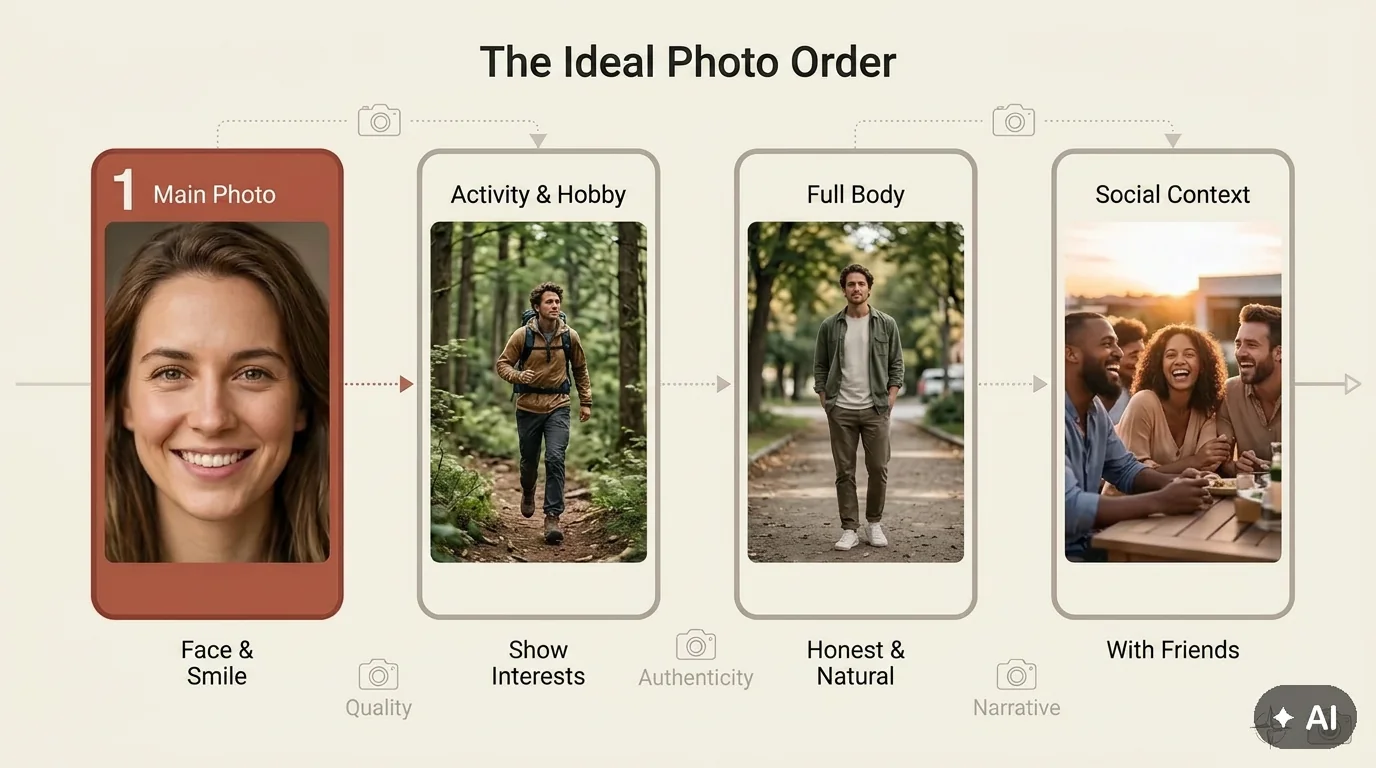
The ideal mix: 4–6 photos with a system

Optimal photo order for your dating profile

Position Photo Type Purpose
Photo 1 Main Photo (Headshot) Clear face, genuine smile, direct eye contact – determines the swipe
Photo 2 Activity/Hobby Shows you hiking, cooking, reading – proves your interests
Photo 3 Full Body Honest about your body type, in a natural setting (not the bathroom)
Photo 4 Social Context With friends or family – you must be clearly identifiable
Optional Second Headshot A different angle or occasion, shows variety

Infographic showing the ideal order of dating profile pictures: lead photo, lifestyle, hobby, and social context, in a branded design.

The right mix of pictures is crucial. This structure shows how to spark interest and curiosity by strategically arranging different facets of your personality.

Lighting is everything. Flash photography mercilessly highlights every wrinkle – avoid it. Dark, gloomy indoor settings can make you look grumpy. Soft, natural light, on the other hand, acts as a free soft-focus filter.

Profiles with a balanced mix of headshots, activity shots, and full-body photos are perceived as more authentic. The variety signals: "I have a real life, not just a staged profile."

Why photos = proof

A Berkeley-Haas study showed that specific, authentic details in profiles get significantly more attention – regardless of photo quality. But if you write "I'm adventurous," you need a photo to back it up. Otherwise, it's just an empty claim. The principle is show, don't tell – and it applies to pictures just as much as it does to text.

3. Visual no-gos: What to delete from your gallery immediately

Sunglasses and hats: The hiding trap

51% of users find sunglasses in profile photos a turn-off. Why? Because eyes are the most important signal of trust. When you hide your eyes, the other person subconsciously asks, "What are you hiding?" Hats often conceal the hairline – a sensitive topic, but honesty is the only way forward here.

Profiles without sunglasses in the main photo receive measurably more first messages. Direct eye contact creates an emotional connection that is blocked by tinted lenses.

The "Where's Wally?" effect: Group photos as your main picture

92% of people surveyed are turned off if the main photo is a group shot. The rule of thumb is: "We assume you're the least attractive person in the picture." Group photos are fine – but never as the first picture, and you must be clearly identifiable.

A group photo in position 4 or 5 shows you're sociable without causing confusion. Tag yourself in the picture or choose one where you are clearly the focus.

Gender-specific turn-offs

Biggest photo mistakes by gender

Men's profiles – Top turn-offs Women's profiles – Top turn-offs
Topless/gym mirror selfies – come across as vain or insecure, especially over 50 Heavy filters/FaceTune – the more obvious, the less believable
Fishing/hunting photos – almost universally disliked ("I don't want to see your dead animal") Only close-ups of the face, no full-body shot – suggests "She's hiding something"
Car/motorbike as the main subject – "I don't want to date your car" Snapchat animal ear filters – ridiculed even by younger users
Bathroom/car selfies – 78% turn-off rate Six photos of the same picture/pose – shows no variety

The mirror selfie trap

Mirror selfies signal, "I don't have anyone to take a photo of me" – which implies isolation or a lack of effort. Messy bathroom backgrounds reinforce the impression of carelessness. Use the self-timer or ask someone to take a few photos for you.

Someone who makes the effort to ask for a photo is perceived as more social and confident. The small effort pays off.

Photos with other people

Photos with potential ex-partners or unidentified companions create immediate confusion: "Is that their ex? Are they still married?" If you show photos with friends, label them or choose ones where the context is clear.

4. The bio: From CV to conversation magnet

The "Show, don't tell" principle

"I'm funny" doesn't work. "I tried to bake sourdough bread last week – now I know why bakers are paid so well" does. The difference? The second one shows humour instead of just claiming it.

A Berkeley-Haas study found that specific, authentic details generate significantly more engagement than generic statements – even when the photos are identical. Instead of "I like to stay active," write: "On Saturdays, I'm usually out hiking the local trails and have started getting into birdwatching."

Show, don't tell: Before-and-after examples

❌ Weak (Tell) ✅ Strong (Show)
"I'm funny" "I tried to bake sourdough bread last week – now I understand why bakers are paid so well."
"I like to stay active" "On Saturdays, you'll find me hiking the local trails, and I've recently started birdwatching (17 species so far)."
"I love culture" "Live jazz on Fridays, the farmers' market on Sundays – and I still get lost in bookshops."
"I'm adventurous" "Latest discovery: a hidden café with the best cake in town. Recommend your secret spot to me."

Avoid generic lists. 'Show, don't tell' turns boring facts into exciting conversation starters that invite potential matches to send the first message.

The forbidden cliché list

These phrases say nothing about you and appear in every other profile:

  • "I love to laugh"
  • "Partner in crime"
  • "Fluent in sarcasm"
  • "Work hard, play hard"
  • "Equally at home in jeans or a suit"
  • "Walks on the beach"
  • "I'm an open book, just ask"

Litmus test: Could this sentence be in any other profile without seeming out of place? If so, delete it.

The ideal length: 125–250 words

Too short seems lazy ("just ask me"). Too long reads like a job application. The sweet spot is around 125–250 words – enough to spark interest, but not so much that it's overwhelming.

Profiles in this length range are read in full, while longer texts are often skimmed or ignored. The attention span for swiping is limited.

Not a CV

People over 40 tend to write their profile like a LinkedIn entry: job, education, a list of hobbies. That's not a dating bio. Instead: 2–3 specific qualities or interests plus a small anecdote or a touch of humour.

Weak: "Versatile, successful person who enjoys their job and many hobbies: reading, travelling, cooking, sports, music, culture. I value communication, humour, flexibility, and curiosity."

Strong: "Retired teacher who still gets lost in bookshops and takes coffee too seriously. Live jazz on Fridays, farmers' market on Sundays. Looking for someone who prefers talking to watching TV – recommend a trail I haven't discovered yet."

The hook: Provide a conversation starter

Every profile needs a call to action – a "hook" that invites the other person to write to you:

  • "Ask me about my favourite travel destination"
  • "What's the most interesting thing you've learned recently?"
  • "Mountains or the sea?"
  • "Tell me your favourite song"

This significantly lowers the barrier to sending the first message, especially for people who are unsure how to start a conversation.

5. Authenticity later in life: Special tips for the 40+ generation

The pain of invisibility

"I feel invisible" – this sentence appears again and again in forums for people over 40. The truth is: age is not the problem. People aged 58 or 68 successfully get back into dating – if they understand the rules.

The biggest obstacle isn't your age, but the fear of no longer being attractive or "enough". This insecurity creeps into every photo, every sentence. Self-confidence is everything – and self-confidence comes from honesty.

Honesty about your age and recent photos

Many people use photos that are 10–20 years old. This isn't a minor touch-up – the lie becomes obvious at the first meeting, and trust is irretrievably lost.

Own who you are. If you're 58, show yourself as a 58-year-old. The right people will find exactly that attractive – because it's real.

Those who use honest, recent photos won't have any unpleasant surprises on the first date. The chemistry that builds online can transfer to real life – because there's no discrepancy between the profile and reality.

Dealing with baggage: Divorce or bereavement

You don't have to hide your past – but it shouldn't dominate your entire profile. A brief, positive mention is enough:

  • "Divorced and wiser"
  • "Widowed for three years, ready for a new beginning"
  • "After a long marriage, I know that my greatest happiness is a loving, stable relationship"

Never: Bitter tirades about your ex, a "shrine" profile with photos of your late partner in every picture, or your life story in the first paragraph. This signals: "I'm not ready yet."

The focus on companionship and "something real"

After decades of living with someone, many people miss the closeness, the shared dinners, the conversations – not primarily the passion.

This isn't a weakness. It's honesty. Write:

  • "I'm looking for something real. No games, no flings. Life is better when you share it."
  • "Looking for someone to share deep conversations, cosy evenings, and spontaneous weekend trips with."

Being clear about your intentions attracts people who are looking for the same thing. If you're looking for "something real," you automatically filter out those who only want superficial connections.

Avoiding "mid-life crisis" props

A Harley, a sports car, fishing photos, selfies on a boat – if they dominate your entire profile, it can look like an overreaction to getting older. Show your real life, not a staged version of youth.

6. Copy-and-paste templates: The best profile bios for every type

Category 1: Funny & Witty (for Tinder & Bumble)

Example 1: "Tried to bake sourdough last week. Now I understand why bakers are paid so well. Otherwise: live jazz on Fridays, farmers' market on Saturdays, sofa on Sundays. If you can show me a trail I don't know, I'll buy you a coffee."

Example 2: "Two truths and a lie: I've seen the Northern Lights in Iceland. I can make a perfect omelette. I'm fluent in Italian. Take a guess."

Example 3: "Retired teacher who still gets lost in bookshops and takes coffee way too seriously. Looking for someone who prefers talking to watching TV – and can put up with my obsession with true-crime podcasts."

Category 2: The Adventurous/Active Type

Example 1: "On Saturdays, I'm usually out hiking the local trails and have started getting into birdwatching (17 species so far, and very proud). Sundays are for yoga, and I'm in a book club during the week. Looking for someone who's spontaneous but also likes a good plan – mountains or the sea?"

Example 2: "I love to travel, but not just to faraway countries – also to new cuisines, new books, and new conversations. Latest discovery: a hidden café with the best cake in town. Next goal: finding someone to share it with."

Category 3: Serious & Thoughtful (for eharmony & Match.com)

Example 1: "Down-to-earth person who loves a good laugh. After a long marriage, I know that my greatest happiness is a loving, stable relationship. I enjoy deep conversations, cosy evenings, spontaneous weekend trips, and cooking together. Flings aren't for me. If you're compassionate and reliable – let's get a coffee."

Example 2: "Divorced and wiser. I'm looking for something real – no games, no flings. Life is better when you share it: a good meal, a long walk, an evening with music. If you know what you want and don't mistake kindness for weakness, I look forward to hearing from you."

Category 4: The Insider Reference Technique

Instead of "I like films," write: "If you understand why the rug in 'The Big Lebowski' really tied the room together, we'll get on just fine." Insider references attract like-minded people and filter out others – without sounding arrogant.

Category 5: Interactive Formats

Example: "The best first date would be… a walk with a coffee, a visit to a museum, or a spontaneous gig. What would you choose?"

These formats invite interaction and make it easier for someone to message you.

7. The dark side: Red flags and how to avoid them

"Swipe left if you smoke / have no sense of humour / like drama / don't have time / aren't over 6ft / can't spell…" These lists of demands come across as aggressive, bitter, and arrogant. They say more about your frustrations than about you.

Better: Write positively about what you do want, not what you don't want. "I'm looking for someone who is honest and loves to laugh" instead of "No liars, no drama."

The psychological impact of spelling mistakes

65% of women swipe left because of spelling mistakes – not because they're picky, but because typos signal: "I couldn't be bothered." And if you can't be bothered with your profile, why would someone believe you'd make an effort in a relationship?

Tip: Write your bio in a word processor with a spell checker before you paste it in. Or ask someone to proofread it.

Bitterness in your profile: Why complaining about an ex is an instant deal-breaker

"My crazy ex…" / "I've loved, I've lost, and I want to love again. I'm carrying a bit of baggage…" / "No drama, no games, no liars" – all of this screams: "I'm not over my past."

Anyone who mentions drama brings drama. Anyone who demands "no baggage" is carrying some themselves. Negativity is the biggest turn-off – even more so than bad photos.

Profiles with positive language get significantly more matches than those with negative lists or warnings. Your tone sets the first impression.

Avoiding a list of demands

"You should be smart, attractive, successful, funny, sporty, chivalrous, a non-smoker, plus have good grammar!" – This is a job specification, not a dating profile. You're not hiring for a position; you're looking for a relationship.

Better: Describe yourself, not your ideal partner. The right people will see themselves in your description.

8. AI in dating: How much artificial intelligence is acceptable?

AI tools for your bio: Using ChatGPT as a sparring partner

AI can help improve your phrasing, identify clichés, or test different versions of your bio. But: use AI as a sparring partner, not a ghostwriter. If your bio is written entirely by ChatGPT, it will sound generic and lifeless – exactly what we want to avoid.

How to use AI correctly:

  1. Write a first draft yourself.
  2. Ask the AI to identify clichés.
  3. Let it suggest alternative phrasing.
  4. Choose the version that sounds the most like you.

AI photo enhancement: Where optimisation ends and deception begins

Tools like Lensa or FaceApp can improve lighting, remove blemishes, or tidy up the background. That's fine – as long as you still look like yourself.

The line: If you alter your face so much that you're unrecognisable on a first date, you've crossed the line. Filters that make you look 10 years younger or 10 kilos lighter are lies.

Transparency: Why AI-generated avatars permanently damage trust

Completely AI-generated photos (e.g., "AI headshots") may be technically impressive – but they are not real photos of you. If you match with someone using an AI avatar and then send a real photo, it feels like catfishing.

Rule of thumb: Optimise real photos, but don't invent new ones.

How AskAlva helps with your profile check

Tools like AskAlva (askalva.ai/profil) analyse your photos and bio with AI and give you concrete feedback: Which photo works best as your main picture? Which clichés should you remove? What gap could you best fill with a new photo?

The difference to pure AI generators: AskAlva assesses the quality of your photos, never you as a person. The goal isn't to change you, but to help you present yourself better.

9. Platform check: Tinder vs. Bumble vs. Hinge & co.

Tinder: Focus on visual speed

Tinder is the fastest, most visually driven platform. Here, the main photo is everything. The bio should be short, punchy, and have a touch of humour – 200 characters max.

Tinder bio formula: [Surprising fact] + [Niche hobby] + [CTA question]

Example: "I can make a perfect omelette (after 47 attempts). Jazz on Saturdays, farmers' market on Sundays. Mountains or the sea?"

Bumble: The importance of Profile Prompts

Bumble makes you answer questions ("My ideal weekend…" / "I'm a nerd for…"). Use these prompts to be specific, not generic.

Weak: "My ideal weekend: Relaxing, spending time with friends." Strong: "My ideal weekend: Farmers' market on Saturday morning, a museum in the afternoon, and live jazz with a glass of wine in the evening."

Bumble profiles with completed prompts get significantly more matches than those with empty fields. The platform rewards completeness.

Hinge: Why every photo needs to tell its own story

Hinge is the "relationship app" – here, every photo can be commented on. Use the captions to provide context:

  • Photo while hiking: "On a trail in the Peak District last summer. Looking for a partner for the next tour."
  • Photo while cooking: "My famous risotto – famous among my friends, at least."

Niche platforms: When specialised dating sites are worth it

Platforms like SilverSingles or Ourtime are aimed specifically at people over 50. The advantage: users are usually looking for serious relationships, not quick flings. The disadvantage: a smaller user pool.

Rule of thumb: If you're frustrated with the major platforms, try a niche dating site – but stick to the same profile rules (recent photos, honest bio, not a CV).

10. From match to date: The call to action in your profile

Why every profile needs a call to action

Many profiles just end – with no invitation, no question. It's like a sales pitch without a close. A good call to action lowers the barrier to sending the first message.

Profiles with a clear question or prompt at the end receive measurably more first messages. The CTA gives the other person a specific hook to respond to.

Examples of effective CTAs

  • "Tell me your favourite song – I'm making a playlist for our first date."
  • "Mountains or the sea? I'm team mountains, but you can try to convince me."
  • "Ask me about my most embarrassing travel story – it's a good one."
  • "What's the most interesting thing you've learned recently?"
  • "Recommend a trail I haven't discovered yet."

The psychology of curiosity: Open loops

An "open loop" is an incomplete piece of information that sparks curiosity:

  • "I lived in Japan for three years – ask me why."
  • "My most unusual hobby: baking bread. It's more complicated than you think."

This technique invites questions and gives the other person an easy way to start the conversation.

How AskAlva helps with chat coaching

If you have a match but don't know what to write, AskAlva (askalva.ai/chat) can help: upload a screenshot of the profile or conversation, and Alva will suggest three replies in different tones – warm, confident, or humorous. This helps you find your own style without resorting to generic "Hey, how are you?" messages.

Conclusion: Your profile is your second chance at a first impression

Online dating after a long relationship or a loss isn't easy. The dating apps can be draining, and the competition overwhelming. But an honest, thoughtful profile – with recent photos, a specific bio, and a touch of courage – is the key to standing out from the noise.

You don't have to pretend. You don't have to be perfect. You just have to be yourself – clear, authentic, and inviting. The right people will find that very attractive.

And if you need support – whether it's checking your profile, wording the first message, or spotting scam patterns – AskAlva (askalva.ai) is there for you. Not a wingman, no cheesy pick-up lines, but a warm, discreet coach to guide you through the world of digital dating with dignity.

The perfect dating profile is not an accident. It's the result of honesty, effort, and the courage to show who you are. You have all the tools – now it's up to you to use them.

11. Frequently asked questions about the perfect dating profile

Should I state my height?

You should state your height if the platform asks for it. Honesty is crucial here. If you're 5'9", write 5'9". The right singles will find you attractive anyway, or even because of it.

Do I have to mention my children/grandchildren in my profile?

You should mention your children or grandchildren in your profile, but briefly and not as the main focus. A sentence like "Proud mum of two grown-up children" or filling in the relevant status field is enough. Avoid building your entire profile around your children or grandchildren, as this can signal that a new relationship might always be the second priority.

How often should I update my photos?

You should update your photos at least once a year, or whenever your appearance changes significantly. This could be a new hairstyle, a change in weight, or a new beard. The rule of not having photos older than 12 to 18 months ensures that you will be recognised on the first date.

What should I do if I feel uncomfortable in photos?

If you feel uncomfortable in photos, one thing helps above all: practice. Ask someone to take a whole series of photos of you on a day with good light – in different poses, from different angles, and in different places. Then choose the best ones. The more photos you take, the more natural you will become in front of the camera. An alternative is a professional dating photoshoot, which can provide high-quality, authentic photos.

Should I mention that I'm divorced or widowed?

You should mention if you are divorced or widowed, but keep it brief and positive. Most platforms have a dedicated status field for this – use it. In your profile description, a short sentence like "Divorced and wiser" or "Widowed and ready for a new chapter" is enough. Definitely avoid long explanations or a bitter tone.

How do I deal with the fear of scams?

The best way to deal with the fear of scams is to take it seriously, because it's rational. Romance scams are real. You can use special tools to check profiles and chats for scam patterns, for example, by doing a reverse image search. As a rule of thumb: if something sounds too good to be true, it usually is. Never transfer money to someone you've only met online, and try to meet in person sooner rather than later.

What is the biggest mistake people over 40 make?

The biggest mistake singles over 40 make is using old photos. This is by far the most common and serious error, closely followed by CV-style profile descriptions, negativity, clichés, and a generally outdated profile. All of these mistakes are easy to avoid.

How long does it take for a good profile to get matches?

How long it takes for a good profile to get matches depends on many factors, such as your location, age group, and the platform you choose. However, one thing is certain: an optimised profile with recent photos and a specific description will get significantly more attention than a carelessly put-together one. Recent and well-lit photos, in particular, can noticeably increase the number of likes and messages you receive.
📸 Profile check by Alva

Want to know how your profile comes across? Upload a screenshot — Alva gives you honest feedback on photos and bio.

Try it free →

Screenshots are never stored.

More from “Dating profile