How to share what you're looking for in your dating profile without sounding demanding

By Sandra · Updated on 27 August 2026 · ✓ Reviewed by the editorial team

How to share what you're looking for in your dating profile without sounding demanding

Knowing what you want is good – but communicating it the right way is crucial. A premium membership on a serious dating site can be an investment, but many profiles don't fail because of the budget, but because of their tone. If you're getting back into online dating after a breakup or loss, you'll know that tension: you know exactly who you're looking for, but you don't want to come across as demanding or dismissive. The solution isn't to hide your desires – it's to frame them differently.

In a nutshell

You can state your preferences on your dating profile without sounding demanding by framing them as positive invitations and avoiding 'no' lists or rigid criteria.

  • Turn demands into invitations: Instead of "You must...", write "I enjoy..." or "We could..."
  • Avoid 'no' lists like "No liars" or "No drama" – they come across as bitter and off-putting.
  • Use specific activities instead of abstract traits: Show what a great time together could look like.
  • Express values, not checklists: "Honesty is important to me" instead of "You must be honest".
  • Your profile should be a magnet, not a bouncer – invite people in instead of filtering them out.

1. Why do my standards often come across as demanding or arrogant on my dating profile?

Profiles that read like a list of requirements sound like a job advert – and that's precisely the problem. Many singles write things like: "No liars. No games. Must be over 6ft. Sporty. Non-smoker. Career-driven." Lists like this can trigger a defensive reaction in the reader before a conversation can even begin.

You're sending two signals at once: first, you sound like someone who's had bad experiences and isn't over them yet. Second, you're setting conditions before any connection has been made.

Imagine meeting someone in real life, and the first thing they say is, "I only talk to people who are over 6ft, don't smoke, and work out." You'd probably turn around and walk away. That's exactly what happens when someone reads a profile like that – only faster, with a single swipe.

The difference between healthy boundaries and a shopping-list mentality is all in the tone. Boundaries are important. But they work better when you show what you have to offer, rather than demanding what the other person must provide.

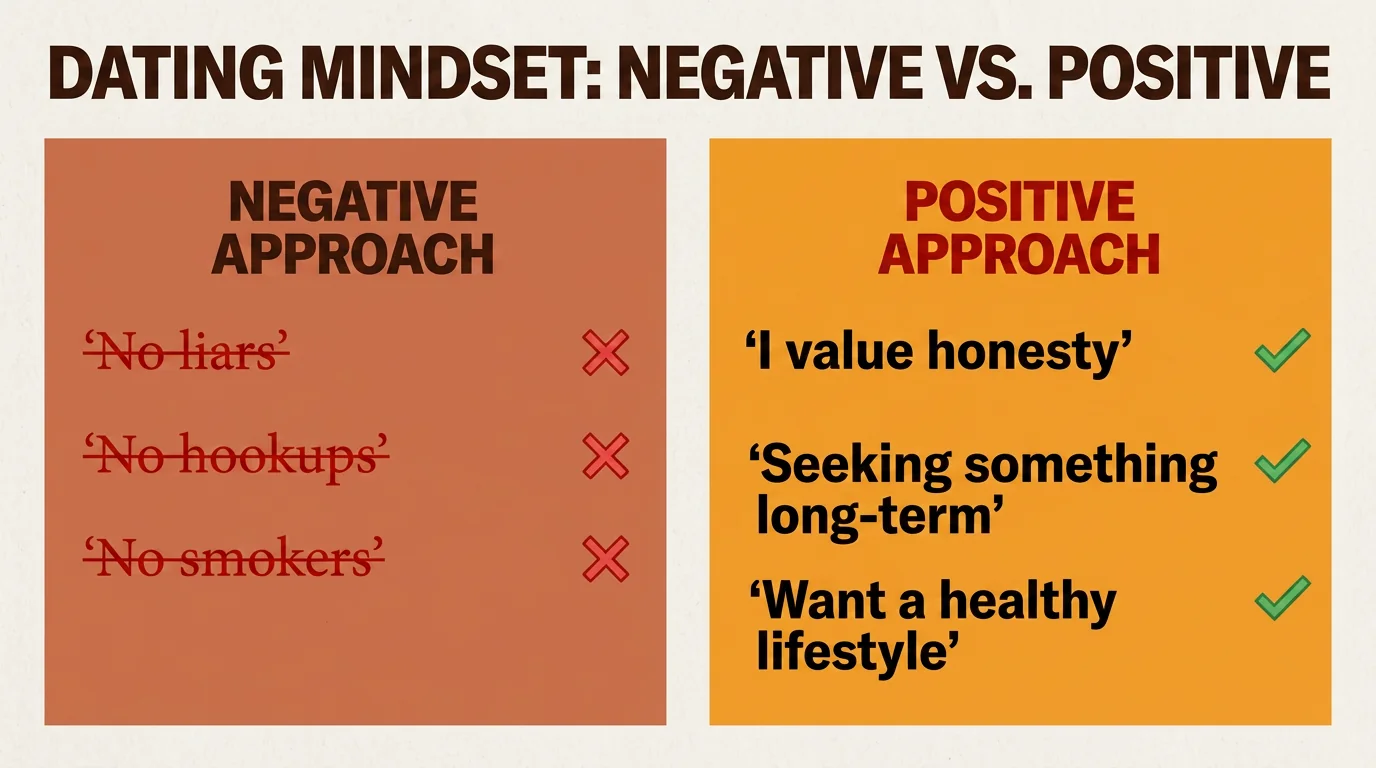
Absolute statements like "You must..." or "Only if..." can subtly convey a sense of victimhood. "No liars" really says: "I've been lied to and I'm still hurt." That's understandable, but it's not an invitation to a fresh start. Profiles with positive language get significantly more quality matches than those filled with deal-breakers.

Infographic comparing negative deal-breakers with positive phrasing on a dating profile for a better psychological impact. By replacing prohibitions with positive desires, your profile immediately seems more approachable and less demanding to potential partners.

2. How can I turn harsh demands into charming invitations?

The transformation follows a simple principle: move from "You must" to "We could". Instead of listing traits, you paint a picture of what a great time together would look like. This method creates positive images in the reader's mind – and that's what makes the difference between rejection and anticipation.

This "bridge-building" method turns every desire into a shared activity or value. Instead of saying what the other person has to be, you show what you could be together.

Transforming Demands into Invitations

How to turn demanding statements into charming desires

Demanding (off-putting) Inviting (charming) Why it works
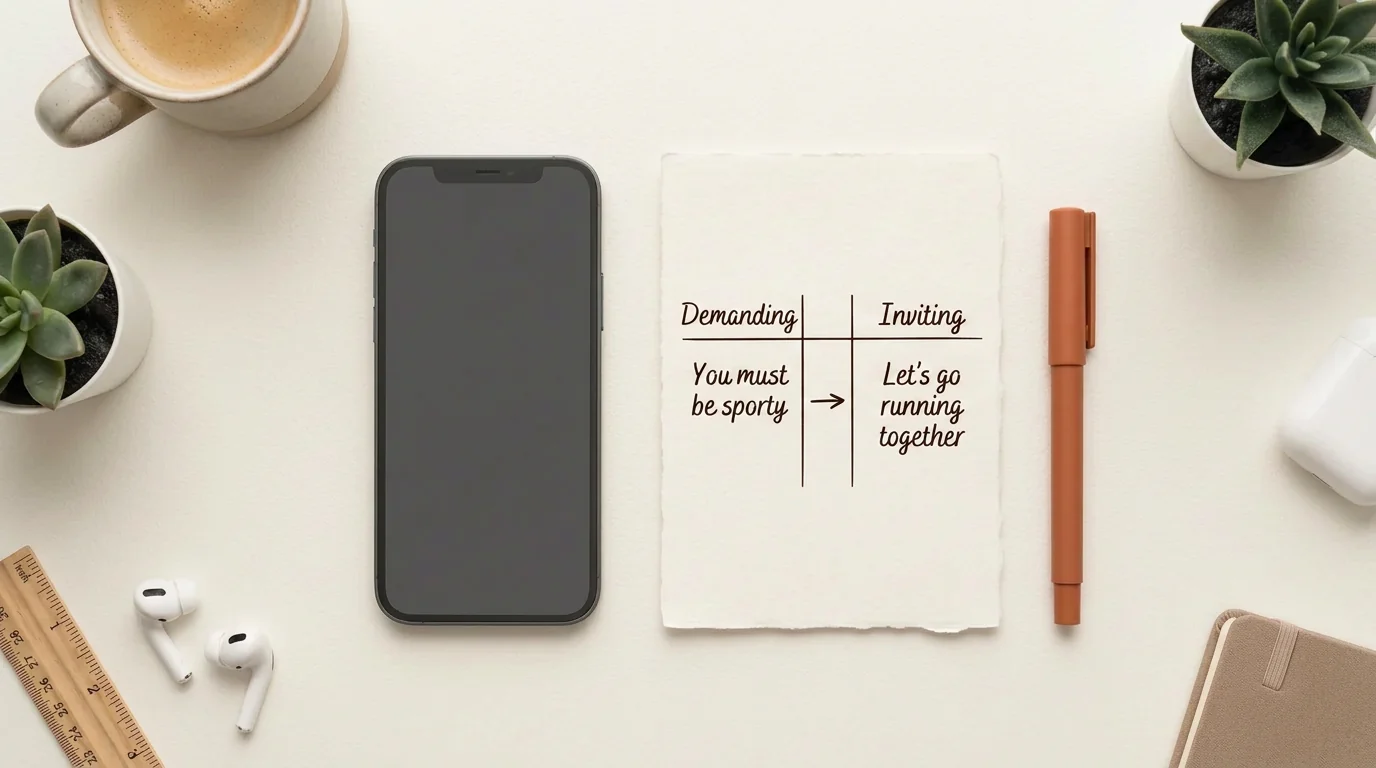
"You must be sporty." "I love lacing up my running shoes on a Sunday – fancy joining me?" Shows a specific activity, invites participation
"No liars, no games." "Honesty is important to me – I appreciate people who say what they mean." Frames the value positively, without accusation
"Must be at least 6ft tall." "I love wearing heels and like to have someone I can look up to." Explains the preference as a personal taste, not a requirement
"Non-smoker, period." "I enjoy fresh air and a healthy lifestyle." Describes your world instead of issuing a ban
"You must have a successful career." "I'm looking for someone who's found their passion in their work." Focuses on mindset rather than external status

This creates positive imagery in the reader's mind. Instead of feeling like they're being tested, they can picture the two of you jogging, laughing, or deep in conversation.

Every sentence should sound like something you'd actually say in a real conversation. Read your text out loud – if it sounds stiff or unnatural, rewrite it.

Flat-lay composition of a notepad comparing demanding requirements with inviting activities in a dating context. Turn static traits into living activities to communicate your standards in a charming and inviting way.

3. Should I mention things like height or smoking status directly in my bio?

Not as a demand, but as part of your world. On dating apps like Tinder or Bumble, there are often specific fields for height, smoking status, or diet. Fill those in – that's your discreet filter. But don't write it again in your bio, and definitely not as a deal-breaker.

If height is important to you, use the "high heels" technique from the table above. Or you could write: "I like to feel safe and looked after." It's honest without being harsh. The message gets across without you having to state a minimum height.

When it comes to smoking status, the rule is: communicate lifestyle choices through values, not prohibitions. Instead of "Non-smoker," write: "I enjoy hiking in the countryside and looking after my health." Someone who smokes won't feel it's for them. Someone who doesn't will see themselves in it. No judgement, just clarity.

Specificity works better than generic criteria. "I love the fresh air" is stronger than "Non-smoker". "I enjoy cooking vegetarian food" is clearer than "You should have a healthy lifestyle."

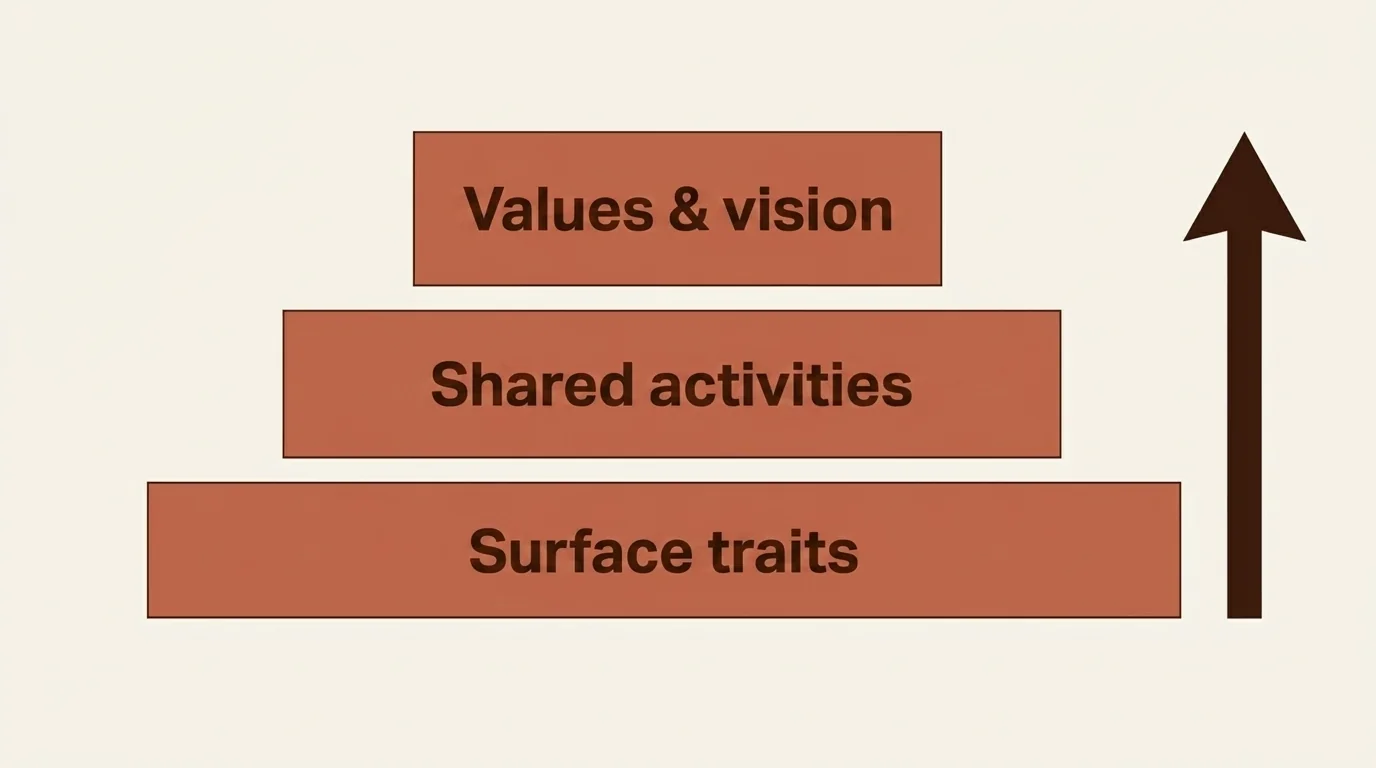
Profiles that describe values instead of demanding traits tend to get higher-quality matches. The quantity might drop, but the compatibility will increase significantly.

Diagram showing the depth of matching on a dating profile: from superficial traits to deep-seated values and visions. The more you can frame your desires in terms of values and visions, the higher the quality of your potential matches will be.

4. How do I communicate life goals, like wanting children, without sounding clinical?

With serious topics like wanting children, blended families, or future plans, you need clarity – but without the pressure. The difference is in the tone. Clinical would be: "I want two children and am seeking a partner with a stable income for this purpose." Charming is: "I dream of a growing family and am looking for someone who can imagine that too."

Value-based matching means you talk about the vision, not the checklist. Instead of "You must like kids," you could write: "I love Sunday afternoons in the park, with kites and ice cream – even when things get a bit loud." This phrasing conveys the same desire, but with warmth instead of a requirement.

For singles over 40 with children or blended family situations, honesty builds trust. On serious dating sites like eharmony or Match, most people expect you to be clear about your life situation. But here, too, it's all about positive framing.

Instead of "My kids live with me, you have to accept that," write: "My children are a huge part of my life – I'm looking for someone who values family and can see themselves becoming part of ours."

You strike the balance between clarity and the magic of getting to know someone by stating the facts in the designated profile field or in a single sentence. But leave room for conversation. You don't have to sort everything out in your profile – just the things that are genuine deal-breakers.

Major life decisions (wanting kids, relocating, blended families) belong in the profile. The details of how they'd work belong in the first conversation.

5. What are some good examples for the "I'm looking for..." section?

Specific examples work better than abstract advice. Here are a few templates you can adapt. They're warm, inviting, and still filter effectively.

Example 1 – Looking for a serious relationship: "I'm looking for someone who knows what they want and is ready for something real. I value deep conversations, shared adventures, and the quiet comfort of just being together. If you can imagine growing old with someone – let's grab a coffee."

Example 2 – Active and loves nature: "I love spending my weekends outdoors – whether it's hiking, cycling, or just with a book in the park. I'm looking for someone who appreciates nature just as much and is up for discovering new trails. If you'd rather talk than watch TV – perfect."

Example 3 – Into arts and culture: "I love getting lost in bookshops and take my coffee far too seriously. Live jazz on a Friday, farmers' market on a Sunday. I'm looking for someone who's curious, loves a good discussion, and gets excited about the little things in life."

The "insider reference" technique works like this: mention specific hobbies or tastes that only like-minded people will recognise. "I love Scandi noir" filters differently than "I like to read". "I collect vinyl" speaks to a different crowd than "I like music". This specificity creates an instant connection with those who share it – and doesn't put off anyone who doesn't.

Avoid clichés like "partner in crime," "fluent in sarcasm," or "love to laugh." They say nothing about you and come across as lazy. Everyone loves to laugh – the question is, what about?

Read your text out loud. Ask yourself: would I want to date me? Does this sound like a person I'd want to get to know, or a job application?

Have someone you trust read your text. Ask them: "Does this sound like me? Does it sound inviting or off-putting?" An outside perspective can reveal blind spots.

Close-up of a person reviewing their dating profile against a checklist for positive phrasing and honesty. Use this filter check to make sure your desires are perceived as an invitation, not a rigid demand.

6. Conclusion: How to become a magnet for the right matches

A strong dating profile works like a magnet, not a bouncer. It attracts the right people rather than filtering out the wrong ones. The most important rule: values over traits. Talk about what's important to you, not about what someone has to look like or be. Show who you are and invite others to become a part of your world.

Authenticity without bitterness is the key. You're allowed to have standards. You're allowed to know what you want. But frame it in a way that makes someone happy to read your profile – not feel like they're being tested.

Transforming demands into invitations isn't manipulation – it's clarity with warmth. You filter just as effectively, but without being off-putting. People who aren't a good fit for you won't feel spoken to. People who are will feel seen.

If you're unsure whether your profile sounds inviting or demanding, get a second pair of eyes on it. The AskAlva Profile Check analyses your photos and bio and gives you concrete suggestions for improvement – honestly, respectfully, and without judging you as a person. Just upload a screenshot, and you'll get feedback that really helps in seconds.

You're not too demanding. You just need to learn how to package your desires so they sound like an invitation – not an exam.


Frequently Asked Questions (FAQ)

How do I say I don't want children without sounding harsh?

To say you don't want children without sounding harsh, frame your desires positively and focus on what you're looking for. Instead of "No kids, ever," you could write something like: "I really enjoy my freedom and I'm looking for someone who values life as a couple just as much." Or you can simply use the designated profile field for this and leave it at that. Those who want kids won't match, and those who don't will recognise a kindred spirit.

Why am I not getting matches even though I'm being honest?

The reason you're not getting matches despite your honesty often lies in the tone of your profile, not the content. Honesty is crucial, but if your profile is just a list of no-gos and demands, it comes across as off-putting. Try flipping the perspective: show what you offer, not what you demand. Also, check your photos – recent, well-lit pictures with a genuine smile often make the biggest difference.

Should I mention that I'm getting back into dating after a divorce?

Yes, you can mention that you're getting back into dating after a divorce, as long as you keep it brief and positive. A sentence like, "New to this after a long relationship – ready for a genuine new beginning," is perfectly fine. Avoid going into details about the separation or making negative comments about your past relationship, as this can suggest you're not quite ready to move on. Keep your focus on the future.

How can I filter for serious intentions without sounding dismissive?

To filter for serious intentions without sounding dismissive, state clearly and positively what you're looking for, rather than what you don't want. A phrase like, "I'm looking for something real, not interested in playing games," is direct but not bitter. Avoid defensive statements like "No hookups" or "Don't waste my time." A positive framing attracts the right kind of singles and deters the wrong ones.

Is it okay to list my deal-breakers?

Yes, it's okay to mention your deal-breakers, as long as you present them as positive values rather than a list of prohibitions. For example, instead of "No smokers, no heavy drinkers, no workaholics," you could write: "Health and spending quality time together are really important to me." It filters just as effectively but sounds inviting instead of demanding.

How long should my "I'm looking for..." bio be?

Your "I'm looking for..." bio should be short and to the point; two to four sentences is plenty. Mention one or two key values and an activity or vision you'd like to share. Any more than that dilutes the message – your profile isn't a novel. It's meant to spark interest in a conversation, not give everything away upfront.

What should I do if I have a lot of standards?

If you have a lot of standards, it's important to prioritise them and distinguish between genuine deal-breakers and mere preferences. Real deal-breakers, like wanting children or a certain lifestyle, belong in your profile (framed positively, of course). Preferences, on the other hand, like a specific sense of humour or level of education, are best demonstrated through your own way of writing. The right person for you will get it.

Should I update my profile regularly?

Yes, you should review your profile regularly to make sure it still sounds authentic and positive. Read it out loud every few weeks and ask yourself if it sounds inviting or frustrated. If you notice a hint of bitterness has crept in, it's time to adjust the tone. Your profile should show the best version of you – not the tired version.


📸 Profile check by Alva

Want to know how your profile comes across? Upload a screenshot — Alva gives you honest feedback on photos and bio.

Try it free →

Screenshots are never stored.

More from “Dating profile