
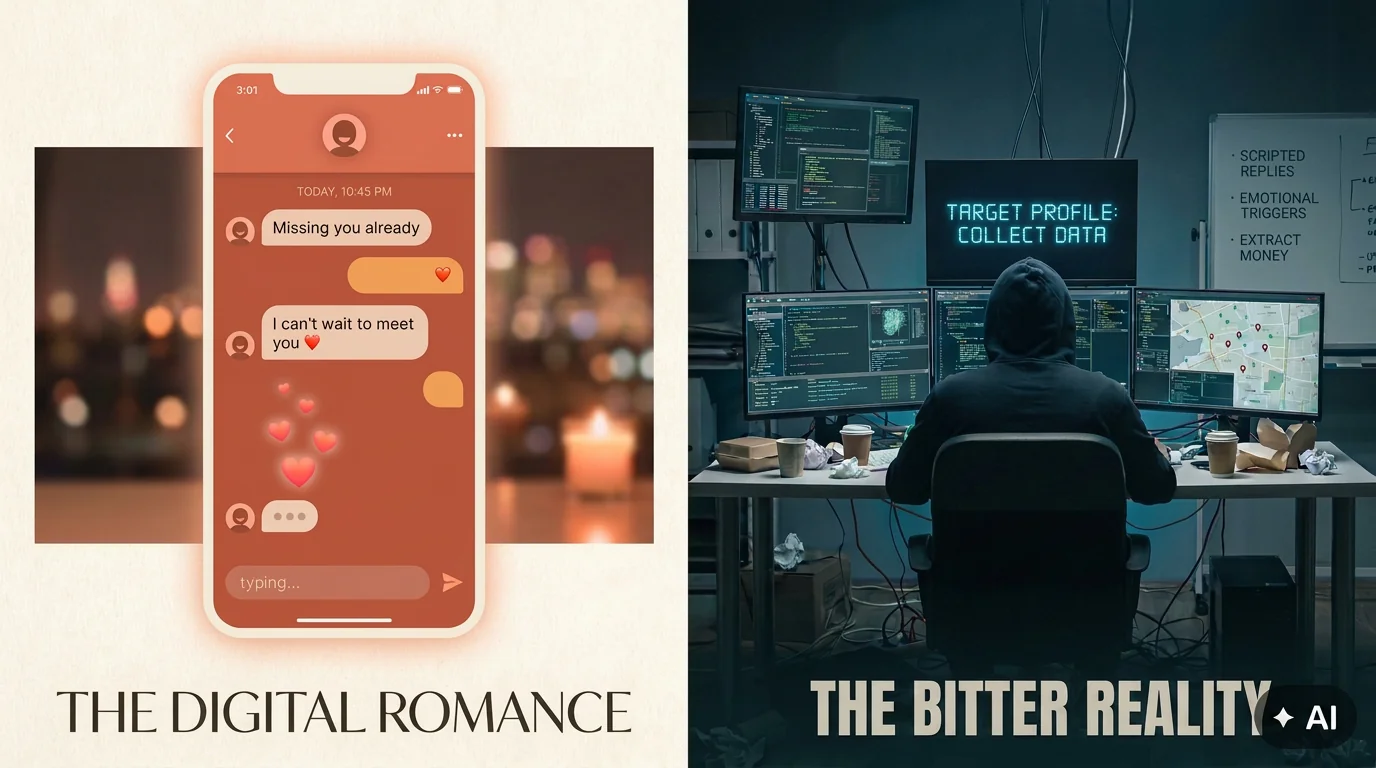
Spotting Romance Scams: Your Complete Guide to Staying Safe

By Sandra · Updated on 3 September 2026 · ✓ Reviewed by the editorial team

Spotting Romance Scams: Your Complete Guide to Staying Safe

Romance scamming is one of the fastest-growing types of fraud worldwide. The perpetrators use a set pattern of psychological manipulation: love bombing, rapid emotional intensity, and calculated isolation – a tactic that affects people from all walks of life. With the right knowledge, you can spot the tricks before feelings or money get involved.

In a nutshell

You can spot a romance scam by rushed declarations of love, a consistent refusal to video call, and, ultimately, the first request for money. These are classic warning signs of scammers on dating apps and dating sites.

  • Romance scammers use a set pattern of psychological manipulation: love bombing, rapid intensity, and calculated isolation – tactics that affect people from all walks of life.
  • The 7 key red flags: Pushing to move to WhatsApp/Telegram, always avoiding video calls, profile photos that are too perfect, quick declarations of love, jobs that "guarantee" absence, a time zone that doesn't match their identity, and any request for money.
  • Modern scammers use AI deepfakes for video calls – the best protection is a spontaneous, unannounced call and the "hand-swipe test".
  • Technical self-defence: Reverse image search (Google Lens, TinEye), Googling their name + "scam", and asking for spontaneous, on-demand photos.
  • If you suspect a scam or have already been defrauded: Cut off all contact immediately, save the evidence, inform your bank, report it to the police – and don't feel ashamed: the manipulation is professional.

Table of Contents

  1. The emotional trap: Why romance scams can happen to anyone
  2. Scammer personas: The 5 most common cover stories
  3. The anatomy of a scam: The 8 phases of 'pig butchering'
  4. The 7 ultimate red flags: How to reliably spot the signs of a romance scam
  5. AI & deepfakes in online dating: Protecting yourself from manipulated identities
  6. Tech tutorial: How to run an identity check
  7. The trick question matrix: Using strategic communication to unmask a scammer
  8. Excuses for money: The scammers' devious scripts
  9. Psychological barriers: It's not your fault
  10. Emergency plan: 5 steps to take if you've already been scammed
  11. Summary & checklist for safe online dating
  12. Frequently asked questions about romance scams (FAQ)
1. The emotional trap: Why romance scams can happen to anyone

Romance scamming is based on professional psychological manipulation. Scammers specifically target universal human needs: the desire for companionship, for a genuine connection, for someone who sees and understands you. Especially after a separation, divorce, or the loss of a partner, the longing for companionship is strong – and it's this very longing that scammers systematically exploit.

What is romance scamming?

In a romance scam, fraudsters on dating platforms, social media, or through "random" contact feign romantic interest to build trust over weeks or months. The goal: financial exploitation. The victims transfer money for supposed emergencies, invest in fake crypto platforms, or are unwittingly drawn into money laundering schemes.

Why it can happen to anyone

The perpetrators work with sophisticated psychological techniques:

Love Bombing: An overwhelming shower of attention, compliments, and future plans in an unnaturally short time. The intensity feels incredible – "finally, someone who really gets me".

Mirroring: The scammer adapts their story to your life circumstances. Also widowed, also looking for something real. This apparent soulmate connection is no coincidence; it's a calculated move.

Manufactured Intimacy: Daily "good morning" messages, emotional openness, the feeling of a deep connection. In reality, this routine creates a bond through habit.

Isolation: Subtly cutting you off from friends and family ("they don't understand us", "they're just jealous"). It's a major red flag when they start questioning the judgement of anyone close to you who expresses doubt.

These techniques don't work because the victims are "stupid". They work because they are human. Empathy, generosity, and the desire to help are deliberately used against you.

Protection starts with knowledge

This guide will walk you through everything from prevention (how do I spot a fake profile?) and dealing with acute suspicion (is my acquaintance genuine?) to damage control (what do I do if I've already sent money?). You'll learn about the modern tricks – including AI deepfakes and crypto fraud – and get concrete tools to protect yourself.

Check it now with our free security check

2. Scammer personas: The 5 most common cover stories of love scammers

Scammers use the same roles over and over because they work. These "personas" explain why the person never has time for video calls, why meeting up is impossible – and they generate sympathy at the same time.

The US soldier on deployment

The story: Stationed in Syria, Afghanistan, or on a foreign military base. Communication is "restricted", and video calls are "forbidden for security reasons". The uniform in the photos looks impressive – but it's usually stolen from real soldiers' profiles.

Why this role works: It explains long absences, irregular communication, and the lack of video calls. It creates respect and a protective instinct.

Telltale details: Real soldiers have access to regular communication and are allowed to make video calls. They don't ask for money for leave or "discharge papers".

The offshore engineer on an oil rig

The story: Working on an oil rig, often off the coast of Norway or in the Gulf of Mexico. "No internet", "only a sporadic satellite phone", "I'll be back on shore in 6 weeks".

Why this role works: It explains complete isolation and technical limitations. It suggests a high income.

Telltale details: Modern oil rigs have Wi-Fi. Real engineers have shift patterns and come ashore regularly.

The widowed doctor on a humanitarian mission

The story: A surgeon with Doctors Without Borders, the WHO, or another NGO. Usually in Africa. His late wife died of cancer, and he's raising a child alone. "God-fearing", looking for a new partner.

Why this role works: It generates enormous sympathy. The widower story often mirrors the victim's own situation. It explains their absence with "noble" work.

Telltale details: Real doctors on overseas assignments have rotation schedules, leave to go home, and functioning means of communication.

The international businessman with frozen accounts

The story: A civil engineer, architect, or investor with projects in Dubai, Malaysia, or Turkey. Suddenly, his accounts are "frozen", a fee is blocking access, and an important contract is at stake.

Why this role works: It explains why someone who is "supposedly rich" suddenly needs money. It creates a sense of urgency.

Telltale details: Legitimate business people have lines of credit, lawyers, and emergency funds. They don't ask an online acquaintance for money.

The widowed single dad

The story: Alone with a daughter/son after the death of his wife. Looking for a loving partner to "become part of the family". Often combined with one of the professional stories above.

Why this role works: It targets the caring instinct. The feeling of being "needed" is particularly powerful.

Telltale details: Real fathers show spontaneous, unposed photos with their child – not just professional portraits.

The common pattern: All these roles explain why the person is never available for spontaneous meetings or video calls. If your new acquaintance tells one of these stories AND avoids video calls, be extremely cautious.

3. The anatomy of a scam: The 8 phases of 'pig butchering'

"Pig butchering" is the cynical industry term for a scam that combines romance fraud with crypto-investment fraud. The name comes from farming: the "pig" (victim) is "fattened up" over weeks (emotionally bonded and financially prepared) before being "slaughtered" (maximum financial exploitation).

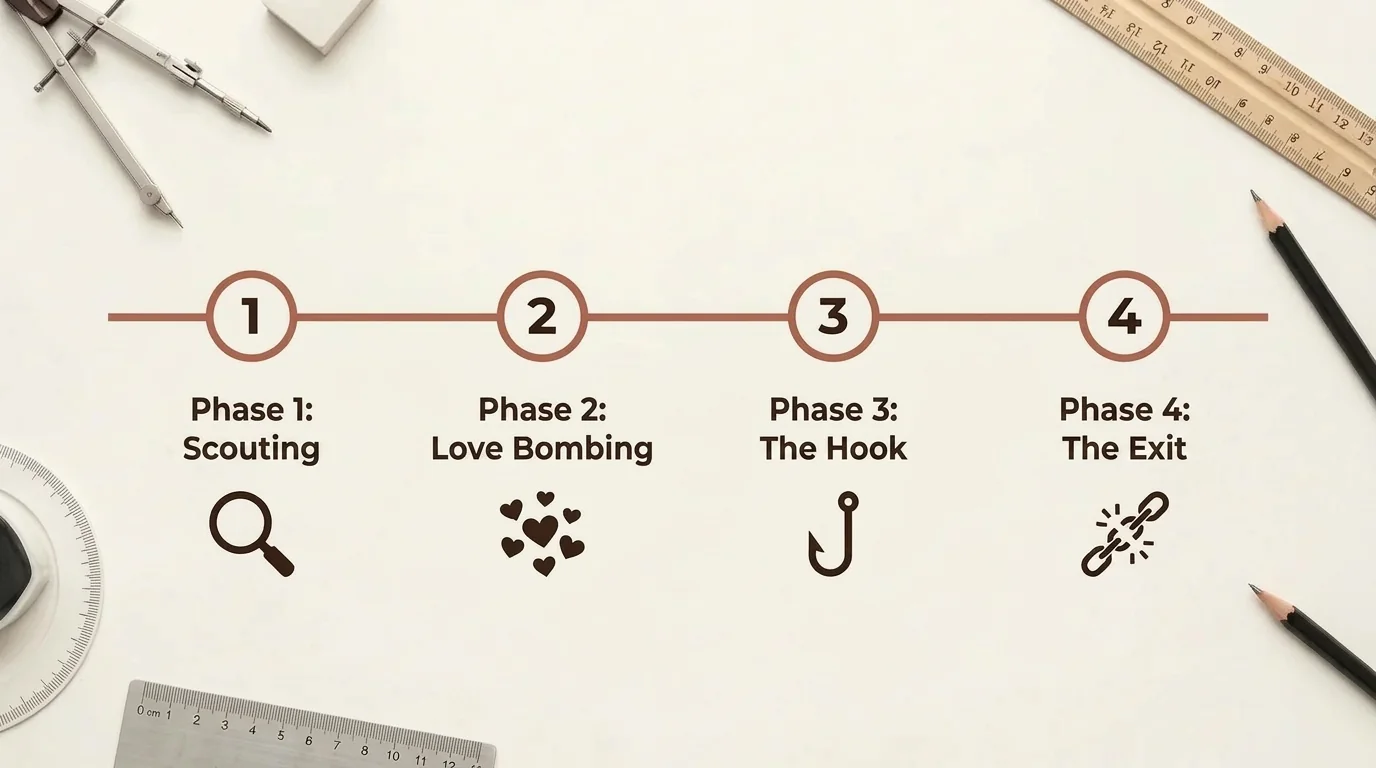
An infographic showing the stages of a romance scam, including scouting, love bombing, the hook, and the demand, in brand colours of beige and terracotta. The four phases of the scam: From the initial contact and psychological manipulation to the targeted request for money – understand the system behind the scheme.
Phase 1: The bait – The 'wrong number'

The initial contact often comes via a seemingly accidental message: "Hi Anna, are we still on for dinner?" or "Hey, is that Lisa? Someone gave me your number at the conference."

When you reply "Wrong number," you don't get the expected "Sorry." Instead, you get warm interest: "Oh, my apologies! But maybe fate wanted us to meet. How's your day going?"

Alternative: The "perfect match" on a dating platform – an attractive profile, shared interests, a charming first message.

Phase 2: The grooming – Building trust through daily life

Now the trust-building begins. Daily "good morning" messages, photos of home-cooked meals, updates from their workday. The person seems real, warm, and interested. They ask questions, remember details, and show genuine empathy.

Duration: 1-3 weeks of intense, daily contact.

Phase 3: Love bombing – When it gets too intense, too fast

The feelings escalate unnaturally quickly. Phrases like:

  • "I've never felt this way about anyone before"
  • "You're my soulmate"
  • "God brought us together"
  • "I know it sounds crazy, but when you know, you know"

Warning sign: This level of intensity after just a few days or weeks is not a sign of great love; it's a script.

Phase 4: The switch – Getting you off the dating app

Early on, they'll ask you to switch to WhatsApp, Telegram, or another platform. The reason: "I'm rarely online here" or "The app isn't secure, and I don't want to lose you."

Why this is dangerous: Dating platforms have reporting systems and safety features. On WhatsApp, you're unprotected, and the scammer can no longer be banned from the platform.

Phase 5: Painting the future – Making plans together

Now they start making concrete plans for the future: a house together, moving to your city, marriage, travelling together. You get the feeling this person is completely committed.

Psychological effect: You become emotionally invested in this future. The bond gets stronger. Any doubts are reframed as you being "cold" or "distrustful".

Phase 6: The casual investment – Crypto enters the picture

Now the person casually mentions that they make good money from crypto trading. "My uncle works at a big bank; he gives me insider tips." You're invited to join in, "for our future together".

The person sends screenshots of their profits. You open an account on a recommended trading platform. The platform is fake, controlled by the scammers.

The first small withdrawal works – this is the trust trick. You see "real" money in your account and invest more.

Phase 7: The withdrawal trap – Endless fees

When you try to withdraw a larger sum, the payment is suddenly blocked. Reasons given:

  • "You need to buy a Golden Membership upgrade first"
  • "A 20% income tax must be paid in advance"
  • "Your wallet has been flagged as high-risk; you need to pay a security fee"

The person "helps" you, even "lends" you money – but you never see any real cash. Just numbers on a manipulated website.

Documented cases: People have lost thousands of pounds in just a few weeks this way – sometimes their life savings.

Phase 8: The disappearance – Ghosting after getting the maximum

As soon as it's clear you have no more money or are becoming suspicious, the person vanishes. They block you on all channels. The trading platform is suddenly offline. You're left with an empty bank account and a broken heart.

It's important to understand: The investment idea is NEVER the starting point. It comes AFTER weeks of trust-building. That's what makes it so dangerous – by that point, you already believe you know and love this person.

4. The 7 ultimate red flags: How to reliably spot the signs of a romance scam

No single warning sign automatically makes someone a scammer. Real people can be shy, have bad internet, or send awkward photos. But the pattern – several of these signs appearing together – is a dead giveaway.

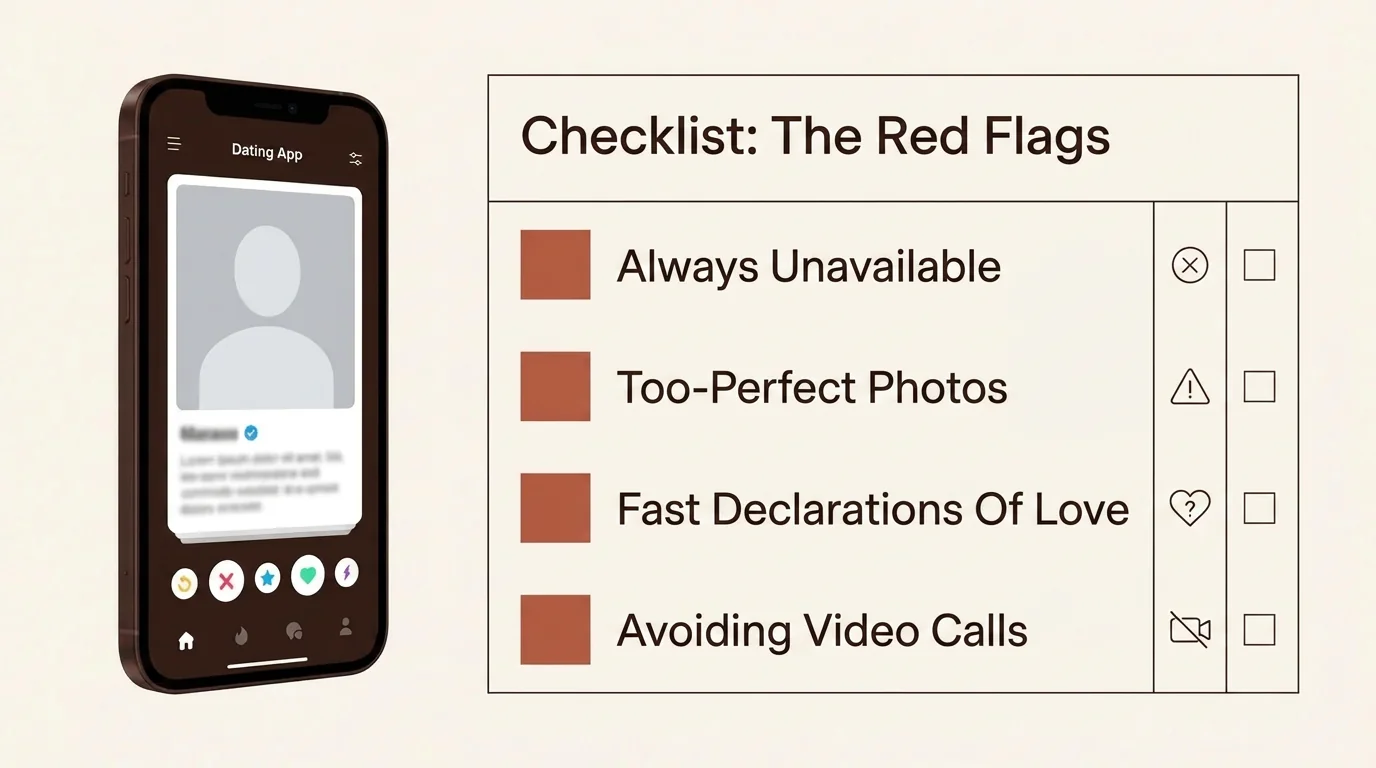
A checklist of romance scam signs, including points like 'guaranteed absence' and quick declarations of love, on a beige background. Watch out for these warning signs: If a profile seems too perfect or they consistently avoid meeting in person, you need to be extremely cautious when dating online.
Red Flag 1: The push to go off-platform – 'Let's switch to WhatsApp'

Scammers want to lure you away from the dating platform quickly. Reasons they give:

  • "I'm rarely online here"
  • "The app isn't secure"
  • "I don't want to lose you when my subscription runs out"

Why this is a problem: Dating apps have reporting and blocking features. On WhatsApp/Telegram, you're unprotected.

How to test it: A genuine person will accept it if you say, "I'd rather stay here until we know each other a bit better."

Red Flag 2: A series of technical hitches – No video calls

The camera is always broken. The internet on the oil rig/military base is too weak. Video calls are "forbidden for security reasons". Every time you suggest a video call, there's a new excuse.

Why this is the biggest red flag: Modern scammers use stolen photos. A live video would expose them immediately.

How to test it: Insist on a spontaneous, unannounced video call. A genuine person will find a way. A scammer will make excuses.

Red Flag 3: Too good to be true – Model shots with no candid snaps

The profile has 3-4 perfectly lit, professional-looking photos. They all show the same person in a similar pose. No spontaneous snapshots, no photos with friends, no everyday situations.

Why this stands out: Real people have a mix – a blurry photo from a hiking trip, a selfie in the car, a picture from a family party.

How to test it: Do a reverse image search (see section 6). Ask for a spontaneous photo with a specific gesture (see section 7).

Red Flag 4: Linguistic inconsistencies – Translation errors

The person claims to be from the UK but makes typical non-native speaker mistakes:

  • "Kindly do the needful" (a common phrase in Indian English)
  • Unnatural sentence structure
  • Switching between perfect and broken English (a sign of a shift change in a scammer call centre)

Another version: They claim to be from a specific region but use phrases that are clearly from a translation tool or can't answer questions about local dialect.

Red Flag 5: Time zone mismatch – Their activity doesn't add up

The person claims to live in New York but is instantly available at 3 a.m. their time and messages you "Good morning" at 3 p.m. UK time.

Why this stands out: Scammer organisations are often based in West Africa or Southeast Asia. Their active hours match their office hours, not their claimed location.

Red Flag 6: Secrecy – 'Don't tell anyone about us'

The person asks you to keep the relationship secret from friends and family. Their reasons:

  • "My family is just jealous"
  • "They wouldn't understand us"
  • "I want to introduce you in person before I tell them"

Why this is dangerous: Isolation is a classic manipulation technique. Friends and family would spot the warning signs.

Red Flag 7: The sudden emergency – The first request for money

After weeks of building trust, the first financial request comes. It's usually "small" (£50-£200) and urgent:

  • "My card isn't working, and I need medicine"
  • "I'm stuck at the airport; I'm £150 short for the flight to see you"
  • "A fee has blocked access to my account"

The absolute red line: Any request for money, gift cards (iTunes, Amazon, Steam, Google Play), or crypto transfers is a scam signal. Genuine partners do not ask an online acquaintance for financial help.

Tool tip: If you're unsure whether a profile or chat is genuine, use the AskAlva Scam Check. Upload a screenshot, and the AI will analyse it in seconds for typical scam patterns, providing specific warnings and a risk level. Screenshots are never saved.

5. AI & deepfakes in online dating: Protecting yourself from manipulated identities

The latest development in romance scamming: fraudsters are using artificial intelligence to perfect their deception. AI-generated photos, voice cloning, and deepfake videos can render traditional protective measures ineffective.

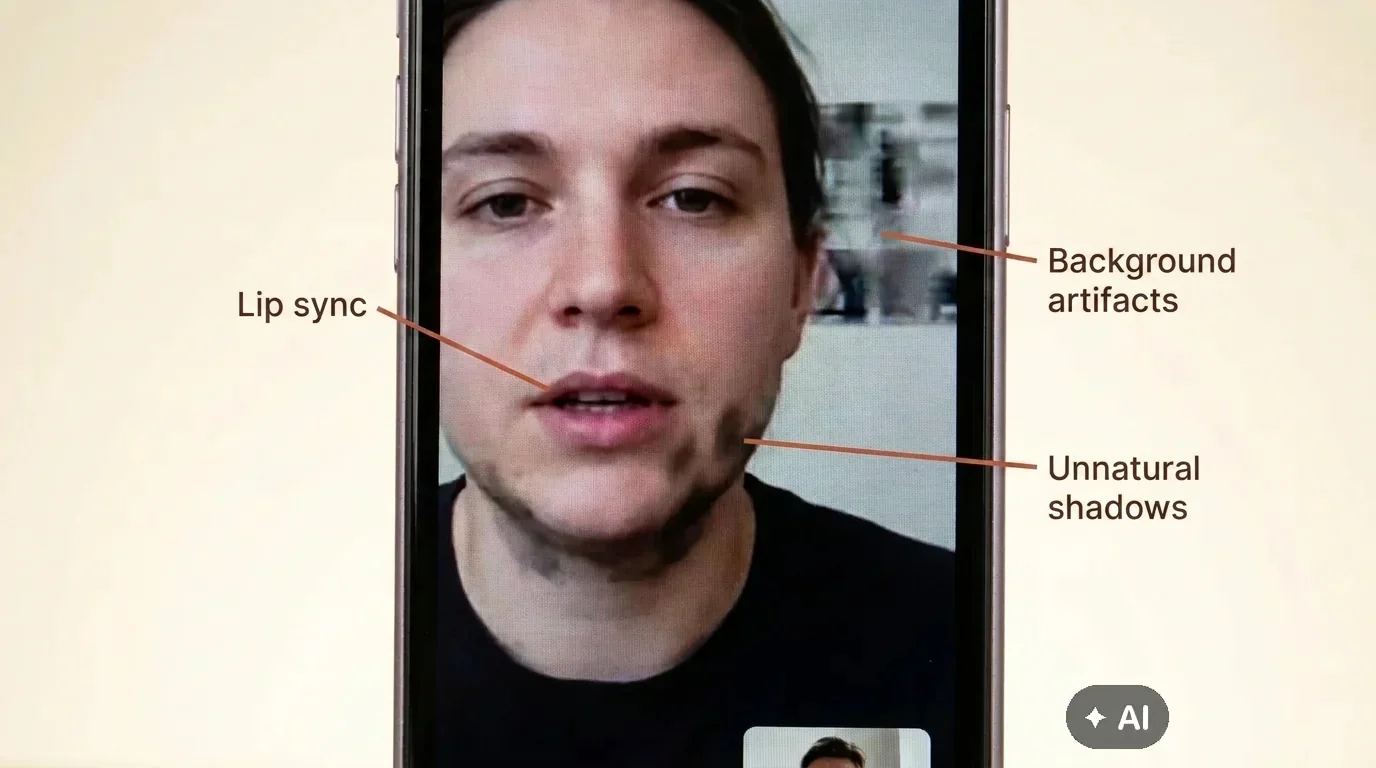
A close-up of a smartphone showing tips for detecting AI deepfakes, such as unnatural shadows and a lack of lip-sync. Spotting modern scams: You can unmask AI-generated video calls by looking closely for unnatural shadows and delays in lip-syncing.

AI-generated profile photos – When reverse image search fails

In the past, stolen photos could be exposed with a reverse image search. Today, scammers use AI tools like Midjourney or Stable Diffusion to create entirely new faces that don't exist anywhere else online.

Telltale signs of AI photos

Background artefacts: Distorted text, impossible architecture, blurry details. A closer look often reveals inconsistencies in reflections or perspective.

Hair transitions: Hair blends unnaturally into the background or has pixelated edges.

Symmetry errors: Asymmetrical earrings, different spectacle lenses, uneven pupil sizes.

Hands: Too many or too few fingers, unnatural positions (AI struggles with hands). It's a proven method: always check the hands – they are the most reliable giveaway for AI generation.

Overly smooth skin: Porcelain-like perfection without any pores or blemishes. Real skin has texture, even in good lighting.

Portraits only: Exclusively perfect headshots, never full-body shots or candid snaps.

How to protect yourself: Ask for an on-demand photo – the person should hold up a piece of paper with today's date and a word of your choice, handwritten. AI can't (yet) fake this in real time.

Deepfake video calls – The new deception

Modern deepfake software can superimpose a person's face onto a video in real time. The scammer is sitting in front of the camera, but you see the stolen face.

Telltale signs of deepfakes

Lip-sync: A slight delay between mouth movements and sound. It's more noticeable when they speak quickly or laugh.

Shadows and lighting: Unnatural shadows on the hairline or jaw. The lighting on the face doesn't match the lighting in the room.

Movement artefacts: The image flickers or distorts during quick head movements or gestures, especially around the edges of the face.

Blinking: Too infrequent or too mechanical. Real people blink 15-20 times a minute, irregularly.

Background transitions: At extreme angles (head turned fully to the left/right), a "seam" might become visible.

The hand-swipe test: During the video call, ask the person to slowly swipe a hand in front of their face. Deepfake overlays struggle with objects passing between the camera and the face – it can cause flickering or distortion.

The best protection: The spontaneous, unannounced video call. Message "Let's have a quick call now" without any warning. Deepfakes need preparation time. Anyone who makes an excuse ("can't now, later") is showing a clear pattern.

Voice cloning – When the voice is a fake

With just 3 seconds of audio, AI can clone a voice. Scammers use this to fake voice messages.

Telltale signs

Monotone sound: A lack of emotional fluctuation. Real voices have micro-modulations that AI can't (yet) perfectly replicate.

Robotic pauses: Unnatural speech rhythms. Pauses occur in grammatically incorrect places.

No filler sounds: Real people breathe, clear their throats, and have small pauses with background noise.

Echo or reverb: An unnatural room sound that doesn't match the supposed environment.

How to protect yourself: Insist on a spontaneous live conversation, not just voice messages. Ask unexpected questions that pre-recorded clips can't answer.

Why AI makes the threat worse

In the past, scammers needed stolen photos and avoided video calls completely. Today, they can be visually convincing – at least on the surface. This makes it harder to spot a scam and increases the victim's emotional attachment.

Your defence: Spontaneity. AI tools need preparation. Anyone who repeatedly avoids spontaneous video calls, unannounced phone calls, or on-demand photos has something to hide.

6. Tech tutorial: How to run an identity check

Basic identity checks take 5-10 minutes and can save you from months of deception. These steps require no technical expertise.

On a smartphone (Android)

  1. Open Google Chrome
  2. Go to images.google.com
  3. Tap the camera icon in the search bar
  4. Select "Upload an image"
  5. Upload the profile photo (a screenshot or saved image)
  6. Google will show you where else this image appears online

On a smartphone (iOS)

  1. Download the "Google Lens" app
  2. Open the app and select the photo from your gallery
  3. Google Lens will show similar images and websites

On a computer

  1. Go to images.google.com
  2. Click the camera icon
  3. Upload the image or paste the image URL

What you're looking for: Does the photo appear on modelling sites, stock photo platforms, or in scam warnings? Is the same photo being used with different names?

Alternative tools

  • TinEye (tineye.com): Specialises in image tracking
  • PimEyes (pimeyes.com): Facial recognition (paid, but very accurate)

Important: AI-generated photos will NOT be found because they don't exist anywhere else. That's why a reverse image search is only the first step.

Step 2: Social media scouting – Check their profile

Creation date: Was the Facebook/Instagram profile created just a few weeks ago? Scammers often set up new profiles.

Follower quality: Does the person have 3,000 followers but only 5 likes per photo? This suggests bought followers. Genuine profiles have a balanced ratio.

Photo consistency: Do all the photos show the same person? Are there photos with friends, family, in different situations? Or just perfect solo portraits?

Interactions: Do friends comment on their posts? Are there real conversations? Or just generic "Great pic!" comments from fake accounts?

Step 3: Name search – Google is your friend

Enter the person's name combined with:

  • "Scam": "John Miller scam"
  • "Fraud": "John Miller fraud"
  • "Romance scam": "John Miller romance scam"
  • Profession + scam: "US soldier romance scam"

Scam warning forums like scamwarners.com, romancescam.com, or Reddit (r/Scams) document known scammer identities.

Step 4: Metadata check – What do the photos reveal?

If someone sends you a photo directly (not via a dating app, but e.g., WhatsApp), metadata can provide clues:

On a computer

  1. Right-click on the image file
  2. "Properties" → "Details"
  3. Check the capture date, GPS coordinates (if available), and camera model

Contradictions: Does the person claim to have taken the photo in New York today, but the GPS data shows Lagos, Nigeria? That's a clear signal.

Important: Most messengers (WhatsApp, Telegram) automatically remove metadata. This check only works for photos sent directly via email or a cloud link.

Step 5: Checking the phone number

Enter the phone number into Google (with the country code). Sometimes, numbers appear in scam warnings.

WhatsApp profile picture check: If the person gives you their number, save it and check their WhatsApp profile picture. Is it the same as on the dating platform? Or a completely different (stolen) photo?

Combining tools for maximum security

Use several methods at once:

  1. Reverse image search (TinEye + Google)
  2. In-depth social media profile check
  3. Googling their name + "scam"
  4. Requesting an on-demand photo (see section 7)
  5. A spontaneous video call

If a person passes all these checks AND is willing to have video calls and meet up, the risk is significantly lower.

7. The trick question matrix: Using strategic communication to unmask a scammer

Scammers work from scripts. They often manage dozens of "relationships" at once and can't remember every detail. You can provoke inconsistencies with targeted questions.

Trick question 1: Local details about their hometown

The question: "You said you're from Manchester. What's your favourite pub there? I was at The Old Wellington last year – do you know it?"

Why this works: Scammers often use large cities in their stories but know no details. They'll reply vaguely ("Oh, I know so many, I can't decide") or quickly Google it and name the most famous one.

A real person: Will spontaneously name a specific place, often with a personal story ("The Briton's Protection, my grandad used to take me there as a kid").

Variations

  • "Which tube line do you take to work?"
  • "What was the name of the street you grew up on?"
  • "What's your favourite coffee shop in the city centre?"

Trick question 2: Deliberately introduce an inconsistency

The technique: Repeat a detail from an earlier message, but get it wrong on purpose, and see how they react.

Example: The person told you they have two children. You write: "How are your three kids doing?"

A scammer's reaction: They agree or ignore the mistake (because they don't remember or are managing multiple victims with different stories).

A real person: Corrects you immediately ("I have two children, not three").

Trick question 3: The on-demand photo test

The request: "Can you send me a photo of you holding a piece of paper with my name and today's date on it? Handwritten."

Why this works: Scammers only have stolen or AI-generated photos. They can't provide a spontaneous, personalised photo.

A scammer's reaction

  • Evasion ("Why don't you trust me?")
  • Delay ("I'll do it later")
  • A Photoshop attempt (recognisable by poor quality, wrong shadows)

A real person: Takes the photo within minutes.

Variations

  • "Hold up 3 fingers"
  • "Wear something red"
  • "Take a photo in front of your bathroom mirror"

Trick question 4: The spontaneous video call

The request: "Let's have a quick call now, I've got 5 minutes."

No warning, no time to prepare.

A scammer's reaction: Always an excuse. "I'm at work right now," "Camera's broken," "Later, I promise" (later never comes).

A real person: Either agrees spontaneously or suggests a concrete alternative ("Can't right now, but I can at 8 p.m.").

Trick question 5: The script-breaking question

The technique: Ask a question that can't be answered with standard platitudes.

Examples

  • "What's the most embarrassing thing that's ever happened to you?"
  • "If you could have any superpower, what would it be and why?"
  • "Tell me about your worst date."

A scammer's reaction: Generic, short answers. Or they ignore the question and steer back to their script ("I'll tell you when we meet. How was your day?").

A real person: Engages with the question, tells a story, asks you back.

Trick question 6: The silence test

The technique: If the person asks for money or makes an unusual demand, don't reply immediately. Wait 24-48 hours.

A scammer's reaction: They push, apply pressure ("I need it urgently," "Don't you trust me?"), use emotional manipulation ("I thought we meant something to each other").

A real person: Understands that you need time to think. Withdraws the request if it was inappropriate.

The two-question reciprocity rule

Scammers often ask a lot of questions about you (to build your profile) but answer questions about themselves only vaguely.

The test: Ask two specific questions about them. Do they answer both in detail? Or do they evade and immediately ask you a question instead?

The pattern: If you know more about the person than they know about you, that's a good sign. If it's the other way around – be careful.

8. Excuses for money: The scammers' devious scripts

The request for money is the moment a romance scam becomes an overt crime. Scammers use the same scenarios over and over because they are psychologically effective.

Overview: The most common excuses for money

Excuse Typical phrasing
The customs lie "I sent you a gift, but it's stuck in customs. I need £300 for the fee."
The hospital scam "I've had an accident / I'm ill. I'm in the hospital and can't access my account. Can you send £500?"
The travel cost trap "I'm just £400 short for the plane ticket to come and see you. I'll pay you back as soon as I arrive."
The business crisis "My account is frozen. I have to pay a fee to get access to it again."
The gift card demand "Can you buy me £200 worth of iTunes / Google Play cards and send me the codes?"
The crypto investment "I've found a guaranteed investment opportunity. If you invest £500, we can double it for our future."

The customs lie

The scenario: "I sent you a gift – jewellery, a laptop, a package of personal items. It's stuck at customs. I need £300 for the customs fee."

Why this works: It sounds plausible. You feel flattered (a gift!) and want to help.

The truth: There is no package. Even if there were, customs would contact you directly, not the sender. Customs fees are not paid with gift cards.

The hospital scam

The scenario: "I've had an accident / I'm ill / I need an urgent operation. I'm in hospital and can't access my account. Can you send £500 for the treatment?"

Variation: "My child is sick; I need money for medicine."

Why this works: Medical emergencies create panic and sympathy. You want to help, to save a life.

The truth: Hospitals treat emergencies without advance payment. Real people have health insurance, credit cards, and friends nearby.

The travel cost trap

The scenario: "I've finally got time off! I can come and visit you. I'm just £400 short for the plane ticket. Can you help me? I'll pay you back as soon as I arrive."

Why this works: You're longing to meet them. The prospect of finally seeing the person is overwhelming.

The truth: The person will never arrive. The first payment is often followed by a second request ("visa fee", "luggage fee"). The game continues until you stop paying.

The business crisis

The scenario: "My account is frozen. I have to pay a fee to get access to it again. Without it, I can't close my deal, and I'll lose everything. Can you lend me £1,000?"

Why this works: The person seems successful, legitimate. It's "just" a loan, not a gift.

The truth: Legitimate business people have lines of credit, lawyers, and emergency funds. They don't ask an online acquaintance for money.

The gift card demand – The absolute warning sign

The scenario: "Can you buy me £200 worth of iTunes / Google Play / Steam / Amazon gift cards and send me the codes?"

Why gift cards?: Gift cards are anonymous, untraceable, and can be converted to cash immediately. Bank transfers can sometimes be reversed; gift cards cannot.

The truth: Nobody, absolutely nobody, needs iTunes gift cards in a real emergency. This request is a 100% sign of a scam.

The crypto investment – Pig butchering

The scenario: "I've found a guaranteed investment opportunity. My uncle works at a bank and gives me insider tips. If you invest £500, we can double it for our future together."

Why this works: The person has spent weeks earning your trust. You believe in the relationship and the future you've planned.

The truth: The trading platform is fake. The profits you see are just numbers on a screen. Your money is gone the moment you transfer it.

The absolute rule

No money, no gift cards, no crypto transfers to online acquaintances. Ever. No exceptions.

A genuine partner will not ask you for financial help before you have met in person. Anyone who does is a scammer.

9. Psychological barriers: It's not your fault

When you realise you've been the victim of a romance scam, the feelings can be overwhelming: shame, anger at yourself, the feeling of having been "stupid". These feelings are understandable – but they're based on a misunderstanding.

Why we want to believe – Confirmation bias

Confirmation bias means that people look for information that confirms their existing beliefs and ignore contradictions.

When you've fallen for someone, you want to believe that person is real. Your brain filters out warning signs and amplifies positive signals. This isn't a weakness – it's human nature.

Example: The person sends you a vague photo. Your brain thinks, "Maybe they're just shy" (confirming your hope) instead of "This is suspicious" (contradicting your hope).

Scammers deliberately exploit this mechanism. They give you enough positive signals (daily messages, compliments, future plans) that your brain ignores the negative ones (no video calls, vague answers).

Professional manipulation is not your fault

Romance scammers are professionals. They have scripts that have been perfected over years. They know exactly which words build trust, which stories evoke sympathy, when to apply pressure, and when to back off.

You weren't scammed because you're stupid. You were scammed because you were professionally manipulated.

Victims of romance scams come from all educational backgrounds and age groups. Intelligence does not protect you from emotional manipulation. On the contrary, empathetic, generous people are often particularly vulnerable because they assume the best in others.

Breaking through the shame

Shame prevents victims from seeking help or reporting the crime. Scammers count on this. The longer you stay silent, the longer they can continue.

It's important to understand

  • You are not the only victim. Romance scamming is a billion-pound industry.
  • The police and support organisations have seen thousands of similar cases. You will not be judged.
  • Talking about the scam is the first step towards healing.

Dealing with emotional dependency

Even when you rationally know the person is a scammer, the feelings can be real. You've invested weeks or months emotionally. The loss feels like a real breakup.

This is normal. The feelings were real, even if the person wasn't.

Steps to healing

Cut off all contact completely (see section 10). Any further contact prolongs the emotional attachment.

Talk to someone: Friends, family, a therapist, or a support line like the Samaritans (116 123).

Give yourself time: Grieving takes time. Allow yourself to grieve – not for the person, but for the hope and the future you had imagined.

Learn, but don't judge yourself: What can you take away for the future? Which warning signs did you overlook? Use this as knowledge, not as a reason to blame yourself.

The path back to dating

Many victims are afraid to ever date again. "How can I ever trust anyone again?"

The truth is: Most people on dating platforms are genuine. Scammers are a minority – but a dangerous one.

With the right knowledge, you are now better protected than before. You know the warning signs. You know what to look for. You have tools (image searches, trick questions, video calls).

Trust is a process. Give yourself time. And use the safety measures from this guide to date safely.

10. Emergency plan: 5 steps to take if you've already been scammed

If you have sent money or suspect you've been the victim of a romance scam, every minute counts. Here is your immediate action plan.

Step 1: Cut off all contact on all channels immediately

What to do

  • Block the person on all platforms (dating app, WhatsApp, Telegram, Facebook, email, phone)
  • Do NOT delete the chat history – you need it as evidence
  • Do not reply to any more messages, no matter how emotional or urgent they sound

Why this is important: Any further contact gives the scammer another opportunity to manipulate you. "Just one last conversation" will turn into further demands.

A common mistake: Victims want "answers" or "closure". You will not get it. Scammers will never admit they lied. They will invent new stories to keep you hooked.

Step 2: Save the evidence – Screenshot everything

What to save

  • All chat logs (in full, with timestamps)
  • Profile photos and all images they sent
  • Bank transfer receipts, receipts for gift cards
  • Emails, phone numbers, platforms used
  • Names and details the person gave you

How to save it

  • Take screenshots (multiple, to document the entire conversation)
  • Save everything in a separate folder (on the cloud or an external hard drive)
  • Print out important documents

Why this is important: Without evidence, the police can't do anything. The more documentation, the better.

Step 3: Inform your bank – Attempt chargebacks and secure your accounts

Call immediately

  • Your bank (for bank transfers)
  • The gift card provider (iTunes, Google, Amazon – for gift cards)
  • Your crypto wallet provider (for crypto transfers)

What to say: "I have been the victim of a scam. I transferred [amount] to [recipient] on [date]. Can the payment be reversed?"

Realistic expectations

Bank transfers: If the money is already in a foreign account, a reversal is unlikely. However, some banks can stop payments within 24-48 hours.

Gift cards: Once the codes have been redeemed, the money is gone. But you should still report it so the provider can document the fraud.

Crypto: Crypto transactions are irreversible. The money is lost.

Additionally: Change all your passwords (bank, email, social media) if you gave the scammer any personal information.

Step 4: Report it to the police and the platforms

Report it to the police

  • Report the crime to Action Fraud online or by phone
  • Provide all the evidence you have saved
  • Even if the chances of catching the perpetrator are slim, every report helps to identify patterns and protect others

In the UK: Action Fraud is the national reporting centre for fraud and cybercrime: www.actionfraud.police.uk

Report the scam on the platforms

  • Dating app: Use the "Report" function on the profile
  • Facebook/Instagram: Report the profile for "Scam or Fraud"
  • WhatsApp: Block and report as spam

Why this is important: Even if the police can't find the perpetrator (most scammers are based abroad), your report helps to compile statistics and allocate resources for prevention.

Step 5: Seek psychological support

Support services in the UK

  • Samaritans: 116 123 (free, confidential, 24/7)
  • Victim Support: 08 08 16 89 111 (Victim Supportline)
  • Citizens Advice: For advice on financial steps

Online communities

  • r/Scams (Reddit): A place to share experiences with other victims
  • romancescam.com: A forum for victims

Why this is important: The emotional damage is often worse than the financial loss. Professional help can help you process what happened and learn to trust again.

What you should NOT do

Don't hire "scam recovery" services: Services that promise to get your money back are often scammers themselves (known as "recovery scams").

Don't pay to get "proof": If the scammer says, "Pay one more time, and you'll get everything back" – it's another lie.

Don't try to "hunt" the scammer yourself: It's dangerous and pointless. Leave it to the authorities.

11. Summary & checklist for safe online dating

You now have the knowledge to protect yourself from romance scams. Here is a compact checklist for safe online dating.

The safety rules at a glance

Before the first contact

  • Do a reverse image search on all profile photos
  • Check their social media profile (creation date, follower quality, photo consistency)

12. Frequently asked questions about romance scams

What's the quickest way to spot a romance scammer?

The quickest way to spot a romance scammer is by a pattern, not a single detail: the person wants to move off the dating site quickly (to WhatsApp or Telegram), repeatedly makes excuses to avoid spontaneous video calls, makes grand declarations of love unusually early, and eventually asks for money. Never make a decision under pressure. If you're unsure, you can have your chat or the profile checked for free by Alva.

I've already sent money. What should I do now?

If you've already sent money, the first thing to remember is: it's not your fault, and you're not alone. Cut off all contact and do not send any more money, no matter what reasons they give. Contact your bank immediately (some payments can still be stopped), save all evidence (chat logs, profiles, account details), and report it to the police. The faster you act, the better.

Is a video call proof that the person is genuine?

A video call is no longer certain proof that a person is genuine. Short, glitchy, or constantly interrupted video calls can be manipulated with AI deepfakes. Insist on a longer, spontaneous conversation in good light and ask the person to do something specific, like turn their head to the side. A real person will have no problem with this.

My match wants to move from the dating site to WhatsApp straight away. Is that a bad sign?

If your match wants to switch to WhatsApp immediately, it's not automatically a bad sign, but it is one of the most common warning signs. Scammers want to get you off the platform, where reporting and safety features are in place. A very early, pushy request to switch, combined with other red flags, is a good reason to be more cautious.

Should I be embarrassed that I almost fell for it?

No, you shouldn't be embarrassed that you almost fell for it. Romance scamming doesn't work because victims are naive; it works because the perpetrators use professional psychological scripts that specifically target basic human needs. It affects people from all walks of life. The fact that you're informing yourself is exactly the right step to take.

How can I check if a profile photo is real?

The best way to check if a profile photo is real is with a reverse image search: if the same photo appears under different names or on stock photo sites, be cautious. Also, look out for overly perfect, model-like photos with no everyday snapshots. Alva's Security Check can run this reverse search and an AI image detection for you automatically.

🛡️ Scam check by Alva

Not sure about a contact? Upload a screenshot — Alva checks it for fraud patterns in under a minute.

Try it free →

Screenshots are never stored.

More from “Safety & scam protection