Ditch the Dating Rules: Why Being Too Polite Kills the Spark

By Sandra · Updated on 11 November 2026 · ✓ Reviewed by the editorial team

Ditch the Dating Rules: Why Being Too Polite Kills the Spark

The date seemed perfect. Easy conversation, polite laughter, no awkward silences. You said your goodbyes, and then… nothing. No butterflies, no spark, no second date. The problem wasn’t that something went wrong. The problem was that everything went too smoothly.

Many singles hide behind an invisible rulebook of politeness and dating etiquette. They wait three days before getting in touch. They avoid ‘heavy’ topics. They play a role they think their date will find attractive – and then wonder why there’s never a spark.

The uncomfortable truth is that if you’re only ever ‘nice’, you’re not showing any real personality. And without personality, there’s no attraction.

In a nutshell

Being too polite can kill the spark because you hide your true colours, which prevents the tension needed for attraction. Authenticity creates a much deeper connection than following tired old dating rules and helps you find the singles who are a genuine match.

  • Politeness can be a mask that prevents real vulnerability and intimacy
  • A little friction and a few rough edges are necessary to create tension and attraction
  • Outdated rules like the three-day wait now just seem manipulative and fake
  • Authenticity beats rigid etiquette – both on dating apps and on the date itself
  • Asking bold questions builds a real connection faster than endless small talk
  • Showing your quirks is the best way to filter for people you’ll actually click with

1. Myth: You have to wait three days to message after a date

The three-day rule is a manipulative game from a bygone era, a time before smartphones and instant messaging. These days, it's far more likely to cause confusion than anything else.

The thinking behind it was that waiting makes you seem busy and desirable, whereas messaging straight away makes you look desperate. But on dating apps like Tinder or Bumble, where communication is instant, this strategy is completely outdated.

If you had a good time on a date but then go silent for three days, the other person isn't going to think, "Wow, how mysterious." They’re far more likely to conclude, "I guess they weren’t that interested after all."

Why it’s better to get in touch sooner

Getting in touch promptly shows self-confidence and genuine interest. It proves you know what you want and you’re not afraid to show it.

A quick, friendly message lets the lovely feeling from your evening together linger. Waiting around, however, just creates uncertainty – and that’s rarely attractive.

Message when it feels right, not when some outdated rulebook tells you to. A simple "Thanks for a lovely evening, I really enjoyed myself" sent on the same night is honest and confident – and that’s how trust is built. Getting in touch promptly saves the other person all the guesswork, which is always better than playing strategic games.

2. Myth: Deeper subjects are off the table on a first date

"What do you do?" – "Whereabouts do you live?" – "Have you been here before?" Small talk is safe. It’s polite. And it's also the reason why so many first dates feel like job interviews.

Traditional dating etiquette says you should steer clear of politics, religion, ex-partners and anything that might be ‘too personal’. The result? A superficial chat where you’re both playing a part instead of properly getting to know each other.

Deeper conversation: your shortcut to a real connection

You’ll often find a connection forms more quickly when you share more personal, even vulnerable, topics. This doesn’t mean you need to unpack your entire life story over your first coffee.

One brave question can be the difference between a ‘nice enough’ evening and an ‘I have to see them again’ feeling. Once you get past the surface-level chat, you'll have so much more to build on after the date.

A few examples of questions that go deeper:

  • "What's something you've learned about yourself in the last few years?"
  • "What are you dreaming of right now – professionally or personally?"
  • "Tell me about a time you were really brave."
  • "What's one thing you'd do differently if you could?"

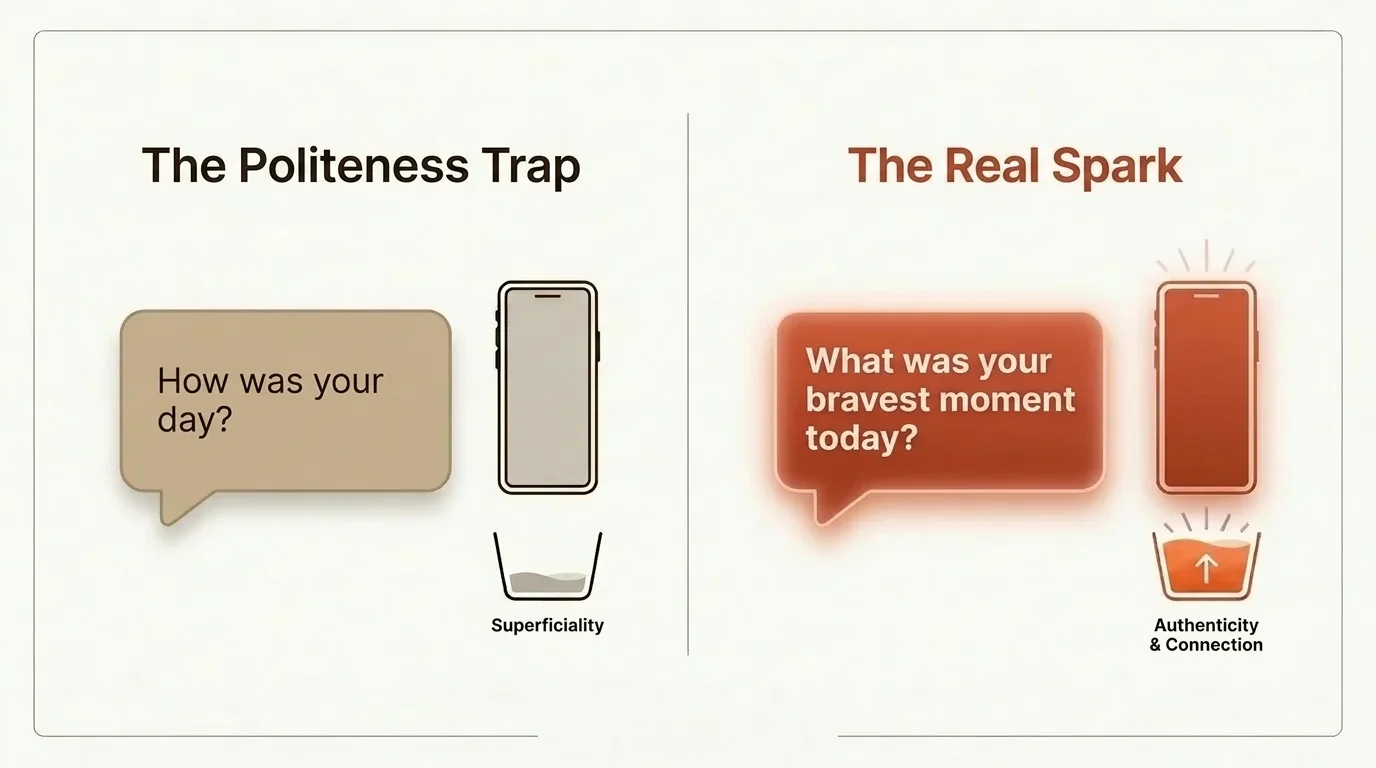
A comparison between boring small talk and authentic questions in dating, shown in a minimalist brown and terracotta design. Why standard pleasantries can kill attraction before it starts: a comparison between the safe 'politeness trap' and the bold, genuine questions that create an instant spark.

These questions go beyond mere politeness. They show you’re genuinely interested in the person, not just their polished exterior. And that’s what really lights the spark.

Pay close attention to their reaction. If your date seems to dodge the question or changes the subject, respect that. But more often than not, they’ll be relieved to be asked a genuine question instead of hearing the same old recycled lines.

3. Myth: There are strict rules about who pays the bill

Who pays on a first date? This question has been dividing the dating world for decades. The traditional rule was that one person paid for the other, traditionally the man. Today, these rigid gender roles often cause more awkwardness than romance.

The money minefield

Many singles feel caught in a bind. Insist on splitting the bill, and you might seem "unromantic". Offer to pay for everything, and you could come across as "old-fashioned" or "dominant". But if you let them treat you, you might feel like you owe them something.

The solution isn't to create a new rule, but to be authentic and communicate openly. On many dating sites, singles already make their values clear in their profiles – and that often includes their views on equality.

Some straightforward approaches

These ideas might help:

  • Whoever initiated the date pays the bill – regardless of gender.
  • Splitting the bill shows you're on an equal footing and takes the pressure off.
  • You can take it in turns on the second date.

Just bring it up casually, ideally before the bill arrives. A simple "Shall we go halves?" or "This one's on me, you can get the next one" is perfectly fine. Sticking to rigid gender roles is a missed opportunity to show who you really are – and that's what makes you interesting.

4. Why a bit of healthy friction is sexy, and total harmony is boring

For there to be attraction, you don't have to agree on everything. While shared values create a bond, it's having different opinions on everyday things that makes a conversation lively. If you just nod along, you’re not giving your date anything to get their teeth into.

The risk of speaking your mind

Many singles are afraid of rocking the boat. They nod politely when their date says something they don't actually agree with. They hide their political views, their passions, their quirks.

The result: they come across as interchangeable.

It's our quirks and imperfections that people fall for, not people-pleasers. If you have a different opinion, don't be afraid to say so. Do it respectfully, but clearly. This shows emotional intelligence and a bit of backbone, proving you’re your own person and comfortable in your own skin.

Why disagreeing can make you more attractive

  • It proves you think for yourself
  • It sparks lively conversations, not boring monologues
  • It helps you filter out people who aren't a good match
  • It shows you're not afraid of a little disagreement

You don't need to pick a fight on the first date. But if your date says, "I'm more of a dog person," and you're firmly on Team Cat – say so. With a smile and a bit of humour, but be honest about it.

It's these little points of friction that bring a conversation to life. If you discover early on that you can both disagree without the atmosphere turning sour, it's a great sign of how you’ll handle bigger issues later on.

5. The new unwritten rules of dating that really count

While it's time to throw the old dating rulebook out the window, a new set of guidelines matters far more. These aren't about old-fashioned etiquette, but about respect and emotional intelligence.

Be upfront about what you're looking for

On dating apps and sites, you'll find people looking for all sorts of things. Some want a serious relationship, others something casual. Problems start when these intentions are kept under wraps, often in a misguided attempt to be "polite".

Be clear. If you're on platforms like Ourtime or SilverSingles, which are aimed at singles over 50, many people are looking for a serious relationship.

Say what you're looking for. This saves everyone time and potential heartache. Make your expectations clear early on – ideally while you're still chatting, not several dates down the line.

Don't ghost – end things respectfully

Ghosting – simply disappearing without explanation – is the modern form of misplaced politeness. Many people think it's "nicer" to just vanish than to tell someone it's not a good fit. In reality, the opposite is true.

A short, honest message like, "Thanks for a lovely time, but I just didn't feel a real connection" is far more respectful than days of radio silence. It gives the other person clarity and allows them to move on.

Dating app etiquette

  • If you're interested, reply in good time – long silences are easily taken as a sign of disinterest.
  • If you're not interested, say so or don't match in the first place.
  • No copy-and-paste messages – people can spot them a mile off.
  • Respect their silence: if someone doesn't reply, accept it and move on.

If you're unsure how to respond to a message, or worried your profile isn't doing you justice, the AskAlva Chat Coach or Profile Check can help. Just upload a screenshot to get practical suggestions.

6. Beyond the dinner date: Ideas for a real connection

The classic dinner date in a smart restaurant can feel more like an interview than a romance. You’re both sat opposite each other, on your best behaviour and in your best clothes – and that’s precisely why it can be so hard to make a genuine connection.

Why formal settings make us put on a front

In a formal environment, many of us feel pressured to present our ‘best’ self. The problem is, that polished version often isn't the real you. And attraction is sparked by authenticity, not by perfection.

Trying out real-life dates to test compatibility

Instead of a pricey restaurant, try an activity that shows how you’d get on in everyday life:

  • Stroll through a weekend market and try something from a stall.
  • Visit a flea market or a car boot sale and see what makes you both laugh.
  • Go for a walk with a takeaway coffee instead of sitting in a stuffy café.
  • Tackle an escape room or another activity that requires a bit of teamwork.

These kinds of dates take the focus off a grilling session and create space for a natural back-and-forth. You get to see how the other person deals with small frustrations, how they make decisions, and whether they have a sense of humour. These are the moments where real chemistry happens.

Many people find that doing something together is far more relaxing than making conversation across a dinner table for two hours.

Don't feel you have to plan the perfect date

You don't need a flawless, Instagram-worthy itinerary. Sometimes, a simple “I know a lovely spot, let's just see what happens” is far more charming than a minute-by-minute schedule.

It shows you're relaxed enough to be flexible – and that’s an attractive quality. Spontaneity is a sign of self-confidence and the ability to handle the unexpected. Both tend to matter more in a long-term relationship than perfect planning.

The bottom line: Be ‘weird’, not just polite

Dating rules exist to make social situations predictable. But attraction is anything but. It sparks when someone has the courage to be their true self, with all their quirks, imperfections and unconventional opinions.

The key thing to remember is this: politeness is a social lubricant, but attraction needs friction. When you try too hard to fit in, you're hiding the very things someone could fall in love with.

Your next step

On your next date, whether it’s online or in person, dare to ask an ‘uncomfortable’ question. Text someone straight away if you feel like it. Say what you really think, even if it goes against the grain. Use your quirks as a filter, not a flaw.

And if you're unsure how your profile is coming across on dating apps or whether your messages sound authentic, the AskAlva Profile Check and Chat Coach can give you honest, no-nonsense feedback. Because in the end, it’s not about how many matches you get, but whether the right people find you: the real you.

It’s better to be weird than generic. That spark ignites when you stop trying to force it.


FAQ

Why do I never feel a spark, even when my dates are lovely?

Not feeling a spark, even with lovely people, often comes down to one thing: being nice isn't enough to create real attraction. If you're just being polite, you aren't showing your true personality or letting your guard down. On your next date, try asking a more personal question or sharing an opinion that goes beyond the usual small talk.

When should I get in touch after a first date?

When you should get in touch after a first date really just depends on how you feel. If you had a good time, there's no harm in sending a message that same evening or the next day. The old three-day rule is completely outdated and just comes across as disinterested, not mysterious. Showing you're genuinely interested is always more attractive than playing games.

What questions are completely off-limits on a first date?

There are very few questions that are completely off-limits on a first date, as long as you ask them respectfully. That said, it's best to avoid anything that sounds judgemental, like "Why are you still single?", or anything too invasive, like "How many partners have you had?". On the other hand, deeper questions about dreams, fears or big life decisions are often a great way to connect.

How can I tell if someone is genuinely interested or just being polite?

You can usually tell if someone is genuinely interested or just being polite by how much effort they put into the conversation. Someone who's truly interested will get in touch, ask you questions, and suggest firm plans to meet up. If they're just being polite, you'll likely get short replies and find you're the one making all the effort.

Should I make my intentions clear straight away on dating apps?

You should definitely make your intentions clear early on when using dating apps, though perhaps not in your very first message. There's no need to open with "I'm looking for a serious relationship", but once you've been chatting for a little while, it's a good idea to make sure you're both on the same page. This avoids any confusion and saves everyone's time.

How should I deal with being ghosted?

The best way to deal with being ghosted is to accept that some people just don't have the emotional maturity to be upfront and say they're not interested. If you feel you must, send one brief follow-up message, like "Hope you're okay?", but then leave it at that and move on. Remember, being ghosted says far more about them than it does about you.

Which dating sites are best for finding a serious relationship over 40?

Platforms like eHarmony or Match.com are often chosen by people seeking a long-term partner. If you're over 50, Ourtime and SilverSingles are also very popular. These sites are designed for people who want to find a long-term partner, and they tend to have more in-depth profiles and intelligent matching systems than the faster, swipe-style dating apps.

How can I make my dating profile more authentic?

You can make your dating profile more authentic by swapping clichés for quirks. Instead of just writing "I love to travel", for instance, talk about a specific place that you love and what draws you to it. And for your photos, choose pictures that show the real you, doing things you enjoy, rather than stiff, posed shots.


🧭 Dating coach by AskAlva

Not sure how to go about it? Upload a screenshot. AskAlva gives you a clear read in under a minute.

Try it free →

Screenshots are never stored.

More from “Strategy & mindset”