The Post-Date Text: Why Messaging Sooner is a Winning Move

By Sandra · Updated on 9 September 2026 · ✓ Reviewed by the editorial team

The Post-Date Text: Why Messaging Sooner is a Winning Move

The date's over – it went well, maybe even really well. Now you're sitting on the sofa, phone in hand, staring at an empty chat.

Should you message right away? Or is it better to wait so you don't seem too keen?

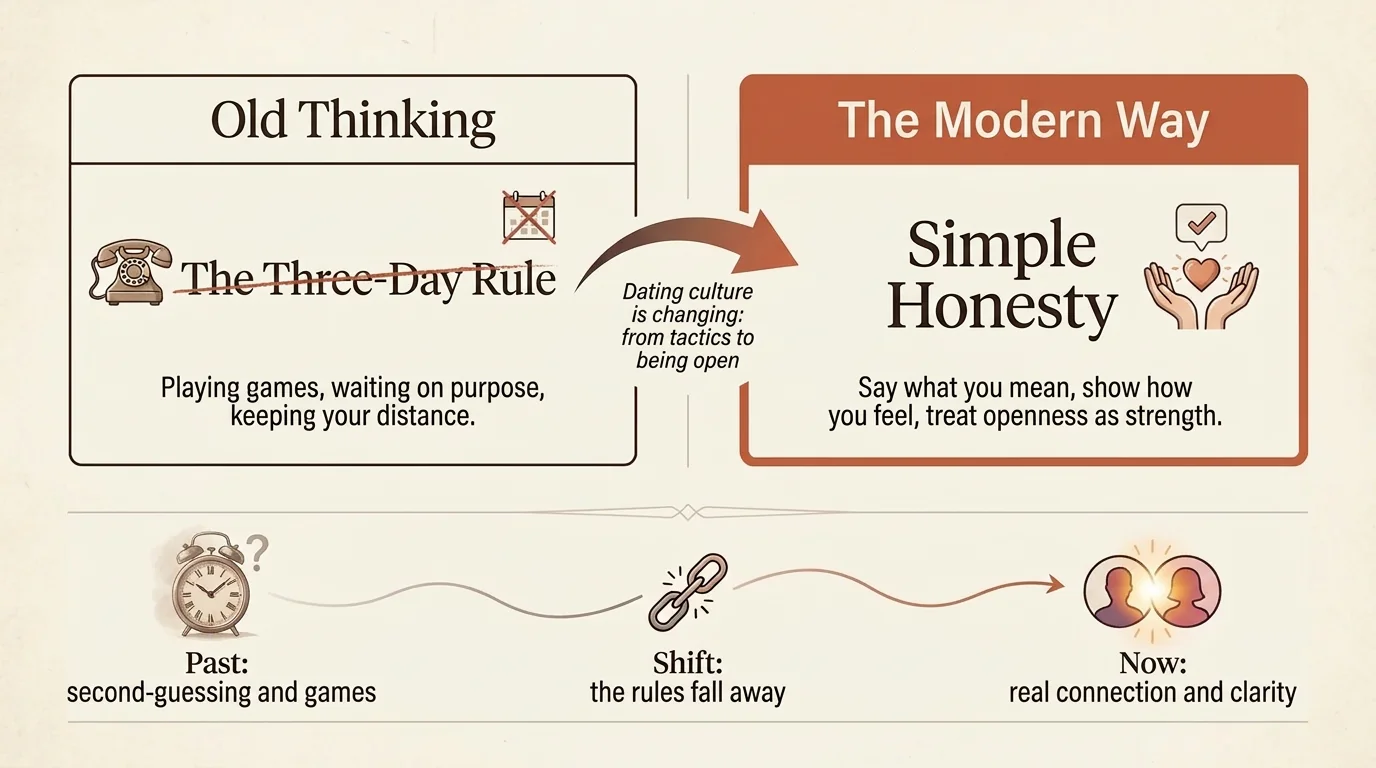
The old 3-day rule whispers in your ear that playing it cool makes you more attractive. But that rule comes from a time without smartphones, dating apps and being constantly available.

Hours of silence don't make you seem mysterious – they make you seem disinterested.

A comparison between the 3-day rule and the modern strategy of radical honesty after a first date, shown in brand colours. The shift in dating culture: Why tactical games like the 3-day rule are now seen as a sign of insecurity rather than allure.

In a nutshell

Sending a timely message after a first date is a winning move. It shows confidence and genuine interest while preventing misunderstandings. A quick, authentic response comes across as attractive and breaks with outdated dating rules.

  • The outdated 3-day rule does more harm than good to a new connection
  • Authenticity and timely feedback after the date come across as confident and attractive
  • A message within the first 24 to 48 hours is ideal
  • Honesty prevents misunderstandings and ghosting
  • Showing initiative is a sign of emotional intelligence
  • Gender doesn't matter – if you had a good time, you're allowed to show it

1. Why you should start ignoring the 3-day rule today

The 3-day rule is a relic of the nineties, when landlines and answering machines set the pace of communication. Back then, the thinking was: playing hard to get makes you seem desirable. Calling too soon makes you look desperate.

This logic was based on the idea that distance creates tension.

Dating works differently today. We're used to getting replies within minutes – to texts, emails, and chat requests.

When someone goes quiet for days after a good date, we don't see it as self-confidence. We think: "Not interested" or "Playing games".

A study from Leuphana University looked into how waiting times affect the willingness to form a connection. It found that after more than 40 hours without contact, the emotional bond weakens significantly. The positive energy from the date just evaporates.

Doubts start to creep in.

Tactical waiting is seen as insecurity:

  • You're clinging to outdated rules instead of listening to your gut.
  • The other person is left in the dark, feeling stressed instead of excited.
  • You're going against the modern expectation of direct, honest communication.

Singles over 40 value clarity. After years in relationships or following a separation, you don't want to play games anymore – you want to know where you stand.

And you have every right to expect the same from others.

2. The psychology of waiting

You had a really great conversation at that Italian place. You laughed, you made eye contact, maybe even shared a quick hug goodbye. The vibe was light and warm.

And then: radio silence. One day. Two days. Three days.

What's going on in your head during that time?

You start to overthink things. Was the laughter just polite? Did I say something wrong?

Maybe they're dating someone else? The positive memory gets clouded by doubt.

The sweet spot: Research shows that the willingness to form a bond drops significantly after 48 hours of radio silence.

That 40-hour mark is crucial. Psychologists call it the emotional echo window.

In the first 48 hours after an intense experience – and a good date is exactly that – the readiness to deepen the connection is at its peak. After that, the curve flattens.

That doesn't mean you should panic. If you're genuinely interested, there's nothing wrong with showing it. On the contrary – it shows emotional maturity.

Messaging soon comes across as confident:

  • You own your feelings without apologising for them.
  • You go after what you want – contact with someone you like.
  • You prove you're not afraid of rejection.

Waiting a long time often seems like the opposite: insecure, calculating, and fearful.

3. The best time to send your message

There's no single "perfect" time – but there is a window where a message feels natural and welcome.

The 'Same-Night Vibe'

A quick message right after the date can be perfect if:

  • The date went really well and you found it hard to say goodbye.
  • You're still thinking about the date on your way home.
  • You just want to say: "That was lovely".

For example: "Just got home safely – that was a really lovely evening. Thank you!"

That's not a needy message. It's a genuine, warm signal.

Short, clear, and with no pressure to reply.

The 'Morning-After Check'

For many, the next morning is the ideal time. You've had time to let the date sink in, you're well-rested, and you can write a thoughtful message.

For example: "Morning! Just remembered our inside joke about the waiter – last night was great. Fancy a second date?"

This message shows:

  • You remember specific moments (the inside joke).
  • You're direct about your interest (a second date).
  • You give the other person a clear way to respond.

What to avoid

  • Messaging seconds after saying goodbye: It seems rushed and doesn't leave any space for the good feeling to linger.
  • Waiting longer than 48 hours: The emotional connection cools off and doubts creep in.
  • Messaging at three in the morning: Even if you can't sleep – wait until morning.

The goal is to preserve the positive energy, not force it.

4. The right message for every situation

Not every date ends with fireworks. Sometimes it was nice, but nothing more.

Sometimes you're not sure. And sometimes you know straight away: this isn't a match.

For each of these situations, there's an honest and respectful way to communicate.
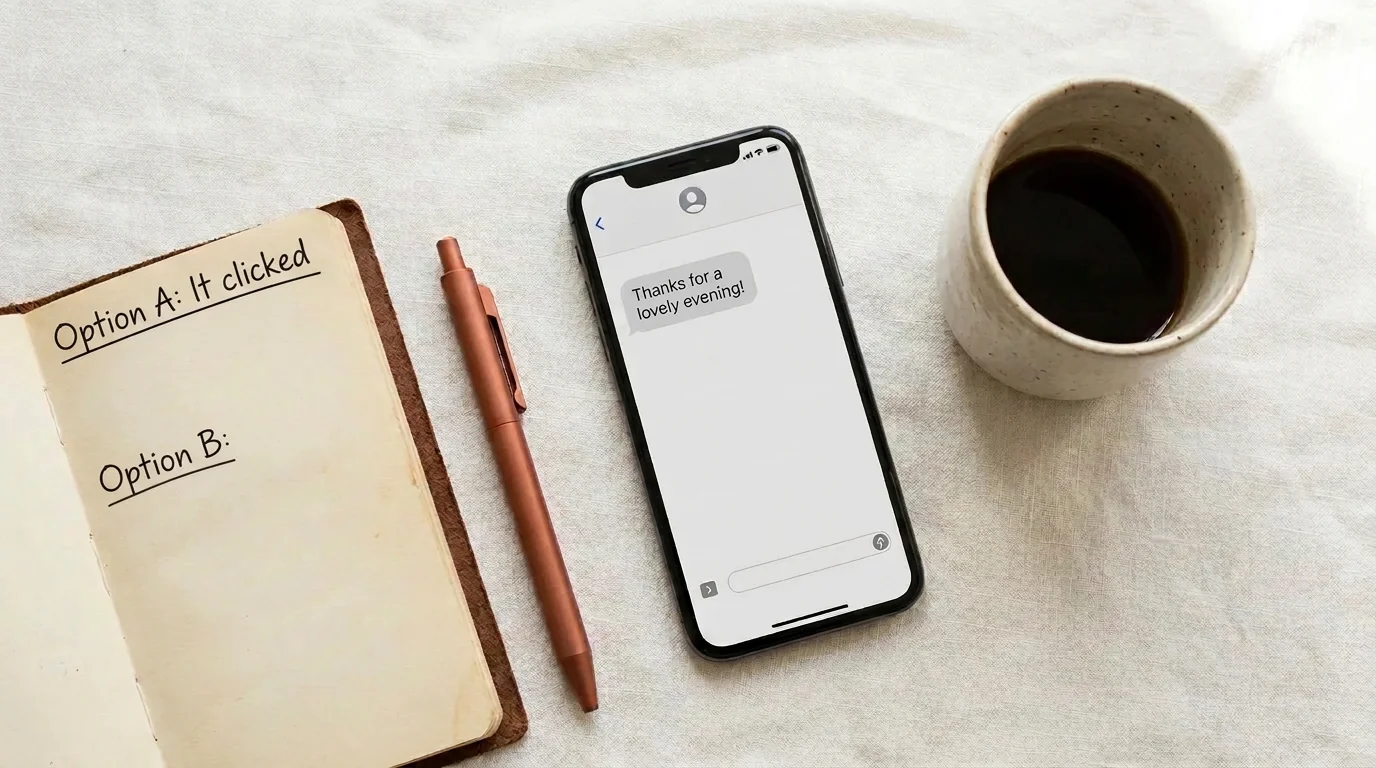
A flat-lay arrangement of a smartphone showing a post-date message, alongside a notebook with different scenarios. Preparation is everything: Having a few structured templates helps you find the right words, even in emotional moments.

Scenario A: The sparks were flying

You're thrilled. The date was just right. You want more.

Your message should:

  • Mention specific moments from the date (shows genuine interest).
  • Suggest a second date directly (no half-measures).
  • Sound light and warm (not forced).

For example: "Hey! I still can't believe you're also a fan of that obscure series. I had a really great time – would you be up for cooking together next time? I promise my pasta is better than my jokes."

This message works because it's:

  • Personal (the series).
  • Humorous (self-deprecating).
  • A specific activity (cooking together).

Scenario B: It was nice, but you're not sure

The date was okay. No red flags, but no clear "wow" moment either.

You're open to a second date, but you're not certain.

Your message should:

  • Be friendly and positive.
  • Leave room to explore things further.
  • Be honest (don't make false promises).

For example: "Thanks for a lovely evening yesterday! It was nice getting to know you. Maybe we could grab a coffee sometime and see how it feels?"

It's not a love letter – but it's respectful and gives you both the option to either continue or not.

Scenario C: No spark

You know after the date: this isn't going anywhere. The chemistry isn't right, your values don't align, or you're simply not interested.

Your message should:

  • Be clear and unambiguous (no false hope).
  • Remain respectful (the person took time out for you).
  • Be brief (long explanations don't help).

For example: "Thanks for meeting up yesterday. I just didn't feel a spark on my end – wanted to be honest with you instead of ghosting. I wish you all the best in your search!"

This message is fair. It saves you both time and prevents that agonising wait for a reply that never comes.

Why 'I had a lovely time' is a strong starting point

This sentence is simple but powerful. It's honest without promising too much.

It opens the door for more, without being pushy.

You can use it in almost any situation – and then decide how to follow up.

If you're unsure how your message will land with the other person, AskAlva can help. Just upload a screenshot of your draft and you'll get feedback in seconds – including alternative phrasings that match your writing style.


5. How to handle your date's reaction with confidence

You've sent the message. Now the waiting begins.

Three possible reactions – and how to handle them:

Reaction 1: Enthusiasm

The reply comes quickly and it's warm. "Yes, I had a great time too! When are we meeting again?"

What you do now:

  • Go with the flow and suggest a specific second date.
  • Keep the energy light and positive.
  • Plan something that fits with your shared interests.

For example: "Perfect! How about Saturday? I know a great spot for brunch."

Reaction 2: Radio silence

No reply after 24 hours. Still nothing after 48.

What you do now:

  • Don't send a second message ("Did you see my text?").
  • Don't spend hours trying to interpret it.
  • Accept that silence is also an answer.

Your message was an offer, not a request for validation. If someone doesn't reply, it says nothing about your worth – but it does say something about their priorities or courage.

Reaction 3: A polite 'no'

"Thanks for the message! I had a nice time too, but I don't think it's a match."

What you do now:

  • Be grateful for the honesty (it's become rare).
  • Reply briefly and politely ("Thanks for letting me know!").
  • Move on without overthinking it.

How to prevent ghosting – from you and others

Ghosting often stems from a fear of awkward conversations. When you lead by example with honest communication, you set a standard.

Some people will follow your lead. Others won't – and that's okay.

You can only control how you behave. Acting with confidence means being clear, being honest, and moving on.

6. Who should message first? Why initiative matters

"But shouldn't the man make the first move?"

"Won't I seem too forward if I message first?"

These questions are leftovers from outdated gender roles.

In dating, the rule is: if you had a good time, you're allowed to show it. Regardless of your gender.

Why taking the initiative is attractive

People who know what they want and go after it radiate self-confidence. That's attractive – whether you're a man, a woman, or non-binary.

Taking the initiative shows:

  • You're not afraid of rejection.
  • You go after what you want (contact).
  • You own your feelings.

That's the opposite of needy. Needy is when you message to get validation.

Confident is when you message because you want to.

Why making the first move is liberating

Many singles wait for the other person to get in touch. They sit by their phone, hoping.

It's exhausting and drains your energy.

When you take the initiative yourself, you take back control. You decide what happens next.

You're not waiting for permission – you're taking action.

And for the other person? It's a relief. Maybe they were just as unsure as you were.

Your message takes the pressure off.

Gender is irrelevant. Whether you message first or not should depend on how you feel – not on some dating rule from the nineties.

7. Dating sites for honest communication

Not all dating sites encourage the same kind of communication. On fast-paced swiping apps like Tinder or Bumble, it's often about first impressions and spontaneous matches.

That's fine – but if you're looking for something more serious, it's worth checking out platforms that foster long-term connections.

Where honest communication is valued

For singles over 40:

  • eHarmony: Focuses on compatibility and serious relationships, with in-depth profiles.
  • EliteSingles: Aimed at educated professionals, uses a personality test for matching.
  • Match.com: A well-established site with a diverse user base looking for genuine connections.

For singles over 50:

  • Ourtime: Specifically for people over 50, with a relaxed atmosphere.
  • SilverSingles: For mature singles who want to take their time getting to know someone.
  • eDarling: Detailed profiles and matching based on personality.

Differences in messaging culture

On sites geared towards long-term relationships, the expectations around communication are different. Here, it's appreciated when you:

  • Refer to their profile in more detail.
  • Send a thoughtful message after the first date.
  • Communicate honestly if it's not a match.

The quality of communication often starts with your profile. If you're not sure how your profile comes across to others, the Profile Check from AskAlva can help.

You get specific feedback on your photos and bio – without any judgment, just a focus on improvement.

8. Conclusion: Authenticity beats tactics

The dating world has changed. What used to be considered strategic – waiting, playing hard to get, playing games – now just seems insecure and outdated.

The most modern form of attraction is honesty.

When you message after a good date and say, "I had a lovely time", you're showing courage. You're owning your feelings without apologising for them.

And that's more attractive than any tactic.

Your gut feeling is your best guide. Not some rule from an advice column (not even this one).

If you had a good time and want to show it – then do it.

If you need space – take it. But don't let the fear of rejection stop you from being honest.

Next steps:

  • Message within 24 to 48 hours after a good date.
  • Mention specific moments from your meeting.
  • Be direct about your interest (or your lack of it).
  • Trust that honesty will attract the right people.

And if you're ever unsure how your message will be received or how to reply to a response: AskAlva is your discreet companion. Upload a screenshot and you'll get specific reply suggestions in seconds – in your style, without the games.

Dating in the 21st century means: authenticity wins.


Frequently Asked Questions

How long should I wait to message after a first date?

The ideal time to get in touch after a first date is between 24 and 48 hours. A message the next morning comes across as confident and shows genuine interest without being pushy. Waiting longer than 48 hours can be seen as a lack of interest.

Who should message first after a first date?

Who messages first after a date shouldn't depend on gender. The person who had a good time and is interested in a second meeting is free to show it. Taking the initiative is a sign of self-confidence, not neediness.

What should I write if the date went well?

If the date went well, it's best to write a message that mentions specific moments from your time together and directly suggests a second date. For example, refer to an inside joke or a shared interest and ask: “Last night was really lovely – would you be up for going to the cinema next week?”

How do I politely decline a second date if I'm not interested?

To politely decline, you should write a clear, brief, and respectful message. For example: “Thanks for the lovely meeting. I realised the chemistry wasn't quite right for me – just wanted to be honest with you. All the best!” Ghosting is not an option if you value honest communication.

What does it mean if my date doesn't get in touch?

If your date doesn't get in touch, it usually means they're not interested. Silence is also an answer, and if you haven't heard anything after 48 hours, the person is either not interested or not brave enough to say so. Don't send a second message – just move on.

Is the 3-day rule really outdated?

Yes, the 3-day rule is completely outdated. It comes from a time before smartphones and dating apps, which is why waiting a long time today doesn't seem mysterious, just disinterested. Honest, timely communication is valued as a sign of emotional intelligence.

Can I message right after the date, or does that seem too keen?

You can message right after the date without seeming too keen, as long as the message is short and appreciative. A brief, warm message like “Home safe – that was a lovely evening!” can be perfect if the date went really well, as it shows appreciation without adding any pressure.

How do I deal with feeling unsure after a date?

The best way to deal with uncertainty after a date is to be specific and honest. If you're not sure how your message will be received, it helps to avoid clichés and just own how you feel. Tools like AskAlva can help you find the right words – discreetly and without storing your data.

📍 Chat coach by Alva

Unsure what to write before or after the date? Upload a screenshot — Alva suggests the right words.

Try it free →

Screenshots are never stored.

More from “First date & after