
'Hi, is this Lisa?': The 'Wrong Number' Scam on WhatsApp, Explained

By Sandra · Updated on 26 November 2026 · ✓ Reviewed by the editorial team

'Hi, is this Lisa?': The 'Wrong Number' Scam on WhatsApp, Explained

That ‘Hi, is this Lisa?’ message might seem like a harmless mistake. It’s just a text from a number you don’t recognise, after all. You’re not Lisa, of course, and that’s exactly why you feel you should reply and let them know.

And that’s the moment the scammers are counting on. In many cases this isn’t a simple mix-up; it’s a carefully planned script, part of the classic ‘wrong number’ WhatsApp scam. It’s often the first step towards a romance scam or cryptocurrency fraud.

In this article, we’ll clear up the common misconceptions, show you how the scam unfolds, and explain the warning signs. We’ll also give you clear steps to take if you’ve already replied.

In a nutshell

A message like ‘Hi, is this Lisa?’ is often the start of a scam where criminals play on your good nature to gain your trust, with the goal of committing crypto fraud later on. Don’t reply to these kinds of messages – block and report the number straight away.

  • A message like ‘Hi, is this Lisa?’ is often part of a professional scam known as ‘pig butchering’.
  • The scammers play on your politeness, spending weeks building your trust before moving on to crypto fraud or romance scams.
  • Don’t reply to messages from unknown numbers that look like they’ve been sent to you by mistake. Just block and report them.
  • They won’t mention investing straight away; that usually only happens after they’ve spent days or weeks gaining your trust.
  • If you’re ever in doubt, the AskAlva scam check can help. According to AskAlva, screenshots are not stored.
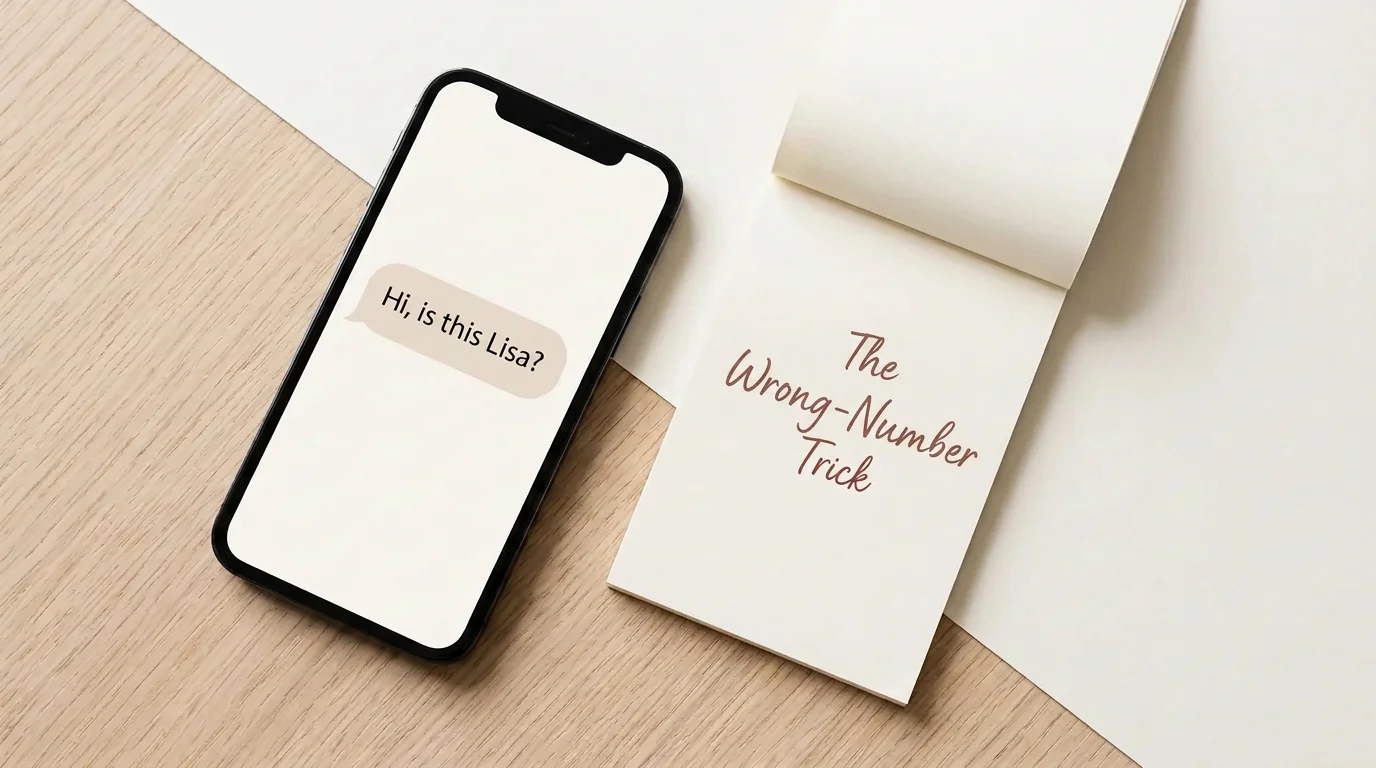
Table of Contents

  1. The ‘Wrong Number’ Scam: Why ‘Lisa’ Is Texting You
  2. Myth: ‘It’s just an innocent mistake’
  3. Pig Butchering: How a friendly chat turns into fraud
  4. Myth: ‘I can spot a scammer by their poor English’
  5. Spotting the Red Flags
  6. The ugly truth about WhatsApp romance scams: Who's really texting you?
  7. Myth: ‘It can’t happen to me on a reputable dating app’
  8. Your safety checklist: What to do next
  9. Your Gut Instinct Is Your Best Defence
  10. WhatsApp Scams: Your Questions Answered

1. The ‘Wrong Number’ Scam: Why ‘Lisa’ Is Texting You

In the ‘wrong number’ scam on WhatsApp, a scammer deliberately sends you a harmless-sounding message to strike up a conversation. It comes across as personal, a bit helpless and completely non-threatening. After all, no one feels suspicious of someone who is just trying to find a friend.

A smartphone on a wooden table showing a WhatsApp message with the question 'Hi, is this Lisa?' as an example of the wrong-number scam. This innocent-looking first message is a psychological trap: the scam begins with what appears to be a simple mix-up on WhatsApp.
This is a textbook example of social engineering. The scammers aren’t relying on technology, but on psychology. Being polite, most of us don't want to leave a stranger confused or unanswered. A quick reply like, ‘Sorry, wrong number, hope you find them!’ feels like the decent thing to do.

These messages are sent out in their thousands, often automatically or from large, professionally run scam operations. Typical opening lines include, ‘Hey, is that Lisa? Someone from the conference gave me this number,’ or a message about arranging to meet for golf or dinner.

So where did the scammers get your number from? Often it’s from data leaks or public profiles, or they could simply be trying numbers at random. Being contacted in this way says nothing about you as a person. It’s not your fault.

2. Myth: ‘It’s just an innocent mistake’

That's rarely the case. Wrong-number scams follow a set script that’s almost identical the world over. The wording might change a little, but the pattern is always the same.

The point of that first message isn’t to share information, but to get a reaction. Anyone who replies confirms two things: that the number is active, and that there’s a polite person on the other end who’s willing to engage.

Even a polite ‘Sorry, wrong number’ opens the door. The reply is often something like: ‘Oh, sorry about that! You seem nice, though. How's your day going?’ And just like that, a simple mistake becomes a conversation.

A genuine mix-up ends after one message. A scammer, on the other hand, turns it into the start of a relationship.

3. Pig Butchering: How a friendly chat turns into fraud

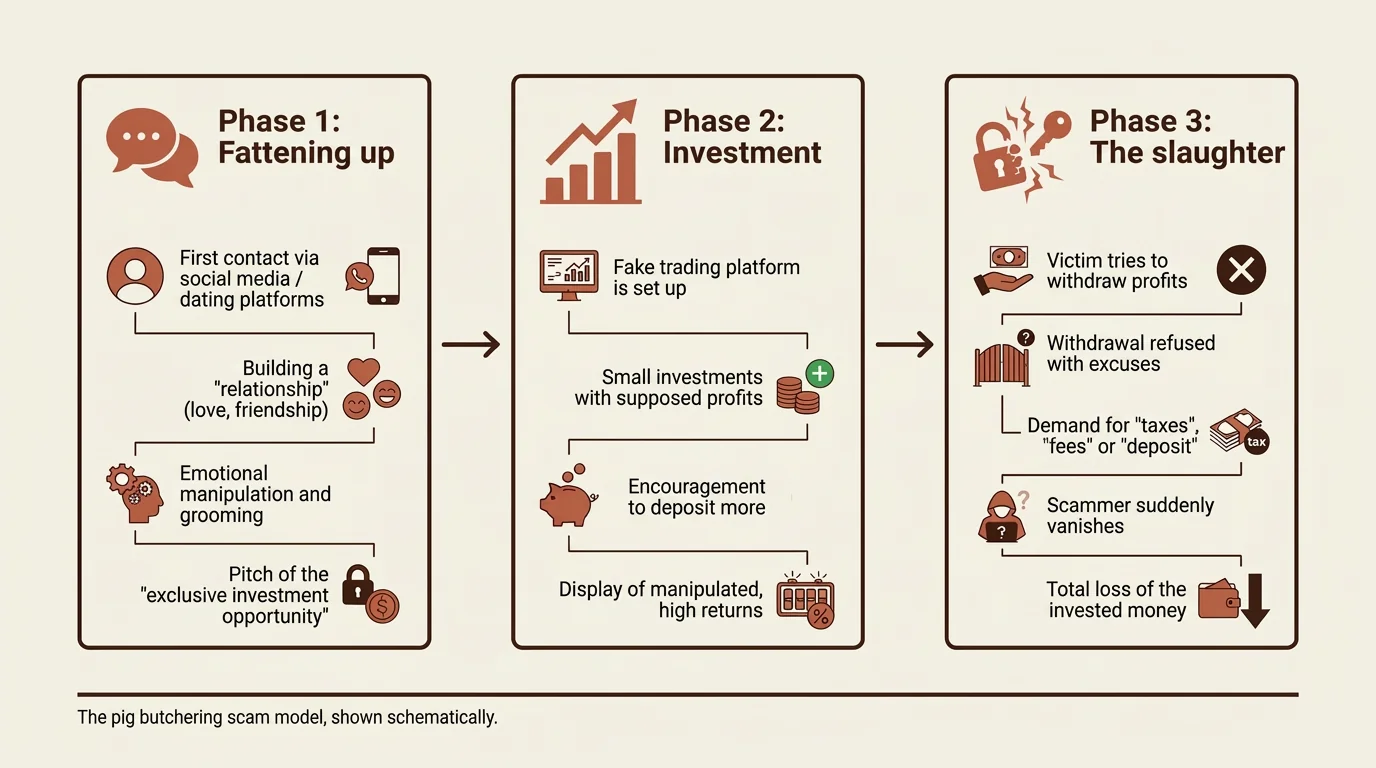
Pig butchering is a long-con scam where criminals build your trust over time, only to lure you into a cryptocurrency investment scam. The name comes from the Chinese phrase ‘Sha Zhu Pan’, which roughly translates as ‘pig slaughtering’. The victim is ‘fattened up’ with attention, compliments and a false sense of intimacy before they are ‘slaughtered’ for their money.

Here’s how the scam typically unfolds in three phases:

  • Fattening up: They’ll send daily ‘good morning’ and ‘good night’ messages, photos from their day, and lots of questions about your life. Scammers will often make up stories about past hardships that sound very similar to your own.
  • The investment: They'll casually mention their own crypto profits or perhaps an ‘uncle with insider knowledge’. Then comes the offer to let you in on the secret.
  • The slaughter: They’ll direct you to a fake trading platform that shows bogus profits. You might even be able to withdraw a small amount to prove it’s legitimate. But when you try to take out a larger sum, it’s suddenly blocked by demands for ‘taxes’ or ‘fees’. Once they have your money, the scammer vanishes.

The key thing to remember is that the profits only exist as numbers on a fake screen. The money you put in, however, is real, and it’s gone. Scammers will spend weeks building this rapport without asking for a penny, which is precisely why it all feels so convincing.

Infographic explaining the three phases of a pig butchering scam: the fattening up, the investment, and the slaughter. From the ‘fattening up’ to the ‘slaughter’: the three phases of pig butchering show the scammer’s long and calculated process of manipulation.
4. Myth: ‘I can spot a scammer by their poor English’

That's an outdated idea. Thanks to AI and translation tools, scammers can often write flawless English. So, looking out for spelling mistakes is no longer enough to protect you.

Pictures and voices can be faked, too. Profile photos are sometimes generated by AI or stolen from a real person’s social media profile. A reverse image search won’t help with AI-generated photos because the face is completely made up.

Even voice notes can be cloned, and video calls can be manipulated using deepfakes. A more reliable test is to ask for a spontaneous video call without giving them any warning. Ask them to do something simple, like hold a hand up to their face or turn their head to one side. While it’s not foolproof, it makes it much more difficult for them to keep up the pretence.

If someone is constantly dodging video calls, they usually have a reason.

5. Spotting the Red Flags

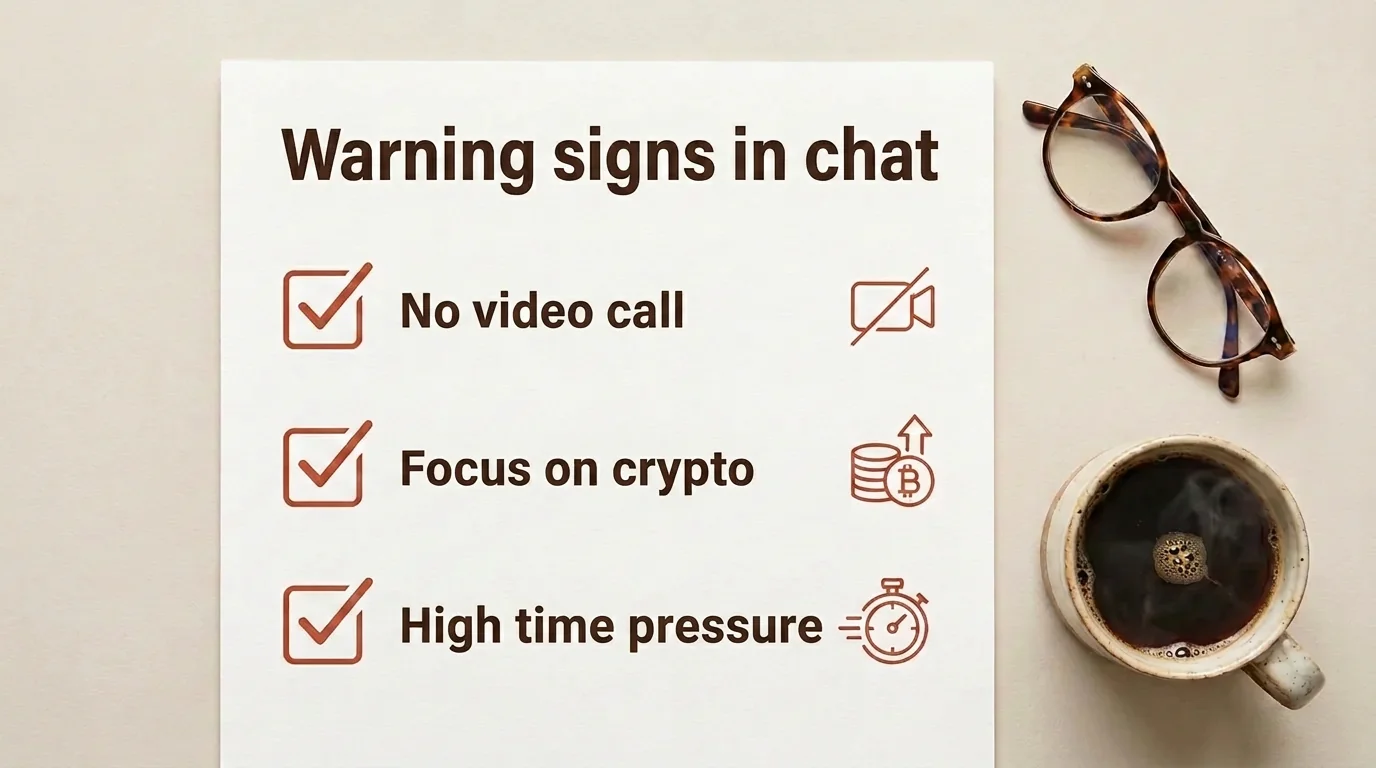
The biggest warning signs of a WhatsApp romance scam are constant excuses to avoid video calls, a sudden switch to talking about money, and putting you under pressure. One sign on its own doesn't prove anything, of course – some genuine people are just shy on camera. It's the overall pattern that counts.

  • No video calls, no meet-ups: A constant stream of excuses like ‘my camera's broken’, ‘the internet is too bad’, or last-minute cancellations.
  • A sudden switch to money talk: The conversation turns to crypto, trading, or a ‘sure-fire opportunity for both of us’.
  • Pressure and urgency: You’ll hear things like, ‘it’s only for today’ or ‘the window of opportunity is closing’.
  • Too much, too soon: They’ll come on very strong with lines like, ‘It must be fate’ or ‘I’ve never felt this way before’.
  • Generic messages: Their texts feel like they could be sent to anyone, and they don't give a proper answer to your specific questions.
  • The time zone doesn’t add up: They claim to be in the UK but are active at night and quiet during the day.

The moment money is mentioned, the alarm bells should be ringing. Any request for payment using gift cards, crypto or an international bank transfer is a massive red flag.

A checklist of warning signs for WhatsApp scams, such as making excuses to avoid video calls and suddenly focusing on crypto investments. How to spot a scam: these warning signs will help you recognise a scammer's tactics early on.
6. The ugly truth about WhatsApp romance scams: Who's really texting you?

It’s not a lonely Lisa or a charming stranger sending you these messages, but usually an organised crime network. Many of these scam operations are run from Southeast Asia, in countries like Cambodia or Myanmar.

The tragic truth is that some of the people writing these messages are victims themselves. They’ve been lured by fake job offers and are forced to work against their will. While this doesn't change the need to protect yourself, it helps explain why they follow their scripts to the letter.

Just blocking the number won’t stop the whole operation. Be sure to report the number directly in WhatsApp as well. This makes it easier for the account to be suspended, and you’ll be protecting others from being targeted.

7. Myth: ‘It can’t happen to me on a reputable dating app’

Unfortunately, it absolutely can. Scammers are actively looking for targets on swipe-based dating apps like Tinder, Bumble and Hinge. Their first move is nearly always the same: to get you to switch the conversation from the dating app to WhatsApp or Telegram.

This push to switch platforms is one of the biggest red flags. Once you move off the dating site, you lose all the protection it offers, such as moderation and the ability to report someone.

Attempted scams happen on sites for serious relationships, too. While these platforms have their own checks in place, there’s always a small risk. You still need to keep your wits about you. The old saying, ‘if it seems too good to be true, it probably is,’ holds true everywhere.

Someone who tries to lure you away from the dating site early on rarely has your best interests at heart. Stick to the platform until you feel you’ve got a good sense of the person you’re chatting with.

8. Your safety checklist: What to do next

If ‘Lisa’ texts you, the rule is simple: don't reply, block, and report.

Close-up of hands blocking a contact with the 'Block contact' button visible as a security measure. Act, don't wait: blocking and reporting suspicious numbers straight away is your most effective protection.

  1. Don't reply. Not even for a polite goodbye.
  2. Block and report as spam, directly within WhatsApp.
  3. Adjust your privacy settings: Set your profile picture and 'About' info to 'My Contacts' only.
  4. Don't click any links or install any software recommended by someone you've only just met.
  5. Never send money, whether in the form of a gift card, crypto, or cash to be 'passed on' to someone else.

Already replied? Don't worry, it's an easy mistake to make and nothing to be ashamed of. Just end all contact immediately, block the number, and if you're feeling unsure, have a word with someone you trust.

And remember, never click on links or share any codes that could be used to connect your WhatsApp account to another device. Scammers use this trick to try and take over your account (a technique known as ghost pairing).

Have you already sent money? Here's what to do next. First, gather all the evidence you can, such as chat logs, bank statements and the names of any platforms involved. Then, report the incident to the police and contact your bank straight away. The sooner you do this, the better your chances of stopping the payment, though there are no guarantees.

If you're not sure whether a contact is genuine, the AskAlva scam check can help. Simply upload a screenshot of the chat or their profile, and you'll get a risk rating that highlights any specific red flags. According to AskAlva, screenshots are not saved, and you can try it for free (terms and conditions may change). The rating is just a guide and shouldn't replace your own judgement.

9. Your Gut Instinct Is Your Best Defence

Real connections rarely begin with a ‘wrong number’ message out of the blue. Dating sites with moderation and a report function can offer some protection, but stay alert there too.

There's absolutely nothing to be ashamed of in wanting companionship and a genuine connection. It's this very desire that scammers prey on. You don't have to be suspicious of everyone – you just need to learn to spot the warning signs.

Stick to well-known dating sites, don't let anyone rush you into moving your conversation elsewhere, and be on your guard if they suddenly start offering financial advice. Suggesting a spontaneous video call or meeting in a public place makes it much harder for a scammer to keep up the pretence. Always let someone you trust know your plans beforehand.

If that little voice in your head is telling you something’s not right, take it seriously. And if you'd like a second opinion, just upload a screenshot to AskAlva.

WhatsApp Scams: Your Questions Answered

What should I do about a 'wrong number' message on WhatsApp?

If you get a message from what seems to be a wrong number on WhatsApp, the best thing to do is not reply. Simply block the number and report it as spam. Whatever you do, don't click on any links they send. If it's a genuine mistake, there's no harm done if you just ignore it.

Why am I getting messages from unknown numbers?

You're getting messages from unknown numbers because scammers often send out messages automatically and en masse, fishing for potential victims. Your number was likely taken from a data leak, found in a public directory, or even just generated at random. It's almost never personal.

How can I spot a crypto scam on WhatsApp?

You can spot a crypto scam on WhatsApp by looking out for several tell-tale signs, like the conversation suddenly turning to investments or you being pressured to make quick decisions. Scammers will often offer so-called 'insider tips' and point you towards trading platforms promising unrealistically high returns. Be extra wary if you try to withdraw your money and find it's blocked pending a series of unexpected new 'fees'.

What is 'pig butchering'?

'Pig butchering' is a particularly cruel scam where fraudsters spend a long time building up your trust before making their move. The name refers to the method: the victim is metaphorically 'fattened up' with attention and affection before being fleeced of their money, usually via fake crypto-investment platforms. The term is a translation of the Chinese phrase 'Sha Zhu Pan'.

Is ‘Hi, is this Lisa?’ always a scam?

A message like ‘Hi, is this Lisa?’ isn't necessarily a scam, but it is a very common opening line for them. So while a message like this might be an innocent mistake, it definitely pays to be cautious. You're taking no risk at all by simply ignoring it.

What is 'ghost pairing'?

'Ghost pairing' is a method scammers use to try and hijack your WhatsApp account. They do this by sending you a link or a code, which then allows them to mirror and control your account on one of their own devices. This is why you must never share verification codes or link any unfamiliar devices to your WhatsApp account.

I've already replied. Is that bad?

If you've already replied to a suspicious message, try not to worry. A single reply is not a disaster, but it confirms to the scammers that your number is active. You will likely get more messages, but do not reply again. End all contact immediately, block the number, and be absolutely sure not to give away any personal or financial details.

How can AskAlva help?

AskAlva can help by letting you upload a screenshot of a suspicious chat or profile for analysis. The AskAlva scam check will look at the content for known scam patterns and give you an instant risk assessment, highlighting any specific warning signs it finds. According to AskAlva, screenshots are not stored.

🛡️ Scam check by AskAlva

Not sure about a contact? Upload a screenshot. AskAlva checks it for fraud patterns in under a minute.

Try it free →

Screenshots are never stored.

More from “Safety & scam protection”