
Ready for a Relationship? Your Mental Checklist

By Sandra · Updated on 25 November 2026 · ✓ Reviewed by the editorial team

Ready for a Relationship? Your Mental Checklist

You love your independence and have a life that works for you, so why are you asking yourself: Am I ready for a relationship? Far from being a sign of weakness, it’s a very smart question to be asking.

Moving from being single to being part of a couple can feel like a bit of a culture shock. After years of making your own plans and decisions, you suddenly need to think about someone else, share your space and let your guard down. It’s a big adjustment, because being independent and being a partner are two very different ways of life. That kind of change doesn’t happen overnight.

This guide will help you navigate that transition, with a handy checklist, real-life examples and a roadmap for the first 100 days. While it’s no substitute for professional counselling or therapy, it offers a clear framework to help you find your way.

In a nutshell

You know you’re ready for a relationship when your past isn’t calling the shots anymore and you feel open to genuine intimacy.

  • Relationship-readiness means your past no longer controls how you act, and you’re truly open to letting someone in.
  • Making a smooth transition is all about balancing dedicated ‘us time’ with your own essential ‘me time’.
  • Your conversations will shift from coordinating diaries to sharing how you really feel.
  • Your independence is still important in a close relationship – it’s not the enemy of love.
  • The first 100 days tend to unfold in phases. Hitting a few bumps along the way is normal, as long as you both treat each other with respect.
1. The quick checklist: Are you ready for a relationship?

You’re ready for a new relationship when you're no longer held back by the past, you can genuinely make room for someone in your life, you feel whole on your own, and you're open to letting someone new in. Read through the statements below and tick the ones that feel true for you. This isn't a test you can pass or fail – think of it as a mirror, helping you reflect on where you are right now.

Open notebook with pressed flowers and the words 'Ready for a relationship?', next to a coffee cup and fountain pen A healthy new beginning starts with an honest look at what you really need.
Emotional freedom

  • I can think about my last relationship without being overcome by anger or longing.
  • I'm not looking for someone to fill a void.

Time and space

  • I genuinely have room in my daily life for another person.
  • I'm prepared to be flexible with my plans.

Self-worth

  • I feel whole and content on my own.
  • I'm looking for a partner, not a saviour.

Openness

  • I can let someone know when I'm feeling hurt.
  • I'm curious about people who think differently to me.

What it means: If most of these statements ring true, you're on a great path. And if there are a few you couldn't tick? Don't worry. They simply highlight areas you might want to explore a little further.

2. A personal check-in: Baggage, time and self-worth

Understanding these three areas – your emotional baggage, your time and your self-worth – will help you feel much calmer about meeting new people. Let’s take a closer look at each one.

Freeing yourself from past baggage

Finding closure doesn't mean the past stops meaning anything to you. It simply means it no longer gets to call the shots.

If a break-up or loss is still weighing heavily on you, talking to a counsellor or therapist can help.

A common hurdle is retroactive jealousy. You hear about someone new’s past partners and suddenly find yourself making comparisons. That’s only human. You can find more on making a fresh start in our guide to getting back into dating.

It’s helpful to ask yourself: is this really about them, or is it about my own insecurities? It’s okay to bring it up, just make sure you’re not accusatory. A phrase like, “There’s something on my mind I’d like to talk about,” is a much better way to open a conversation than just stewing over it.

It’s also worth reflecting on your own relationship history:

  • What worked well for me in previous relationships?
  • Are there any recurring patterns?
  • What do I want to do differently this time around?

Making time for a relationship

A relationship needs dedicated time to grow. It doesn’t have to be hours every day, but you do need to consciously carve out space for it in your schedule.

Take an honest look at your weekly schedule. Where could you genuinely fit someone in? If every moment is already accounted for, perhaps the issue isn’t a lack of time, but a reluctance to let something else go.

Self-worth: A partner, not a saviour

If you’re looking for a relationship to make you feel whole, you’re putting a huge amount of pressure on the other person. But if you already have a solid sense of self-worth, you can truly enjoy intimacy and handle the natural ups and downs that come with it.

You don't have to be perfect. It's enough to be kind to yourself.

3. The three stages of shifting your mindset

The shift from single life to a relationship happens on three levels at once: in your mindset, your daily routine, and the way you communicate.

Stage 1: Your mindset – from flying solo to being part of a team

After a long time on your own, you’re an expert at running your life. That’s a real strength, but in a relationship it can become a pitfall if you automatically make decisions without considering your partner.

You can practise this in small ways:

  • When you're making weekend plans, ask what they would like to do first.
  • Explain why you want to do something, instead of just doing it.
  • Accept that their way of doing things doesn't have to be yours.

Your attachment style also plays a role. Some singles pull away as intimacy grows, while others become clingy. The good news is that these patterns can often be changed.

Pay attention to your reactions: When do you feel the urge to pull away? When do you find yourself needing constant reassurance? Simply recognising the pattern can take away much of its power.

Stage 2: Your daily life and habits

There's nothing wrong with your single-life habits, but they will need to become more flexible. The table below gives a few examples of how you can adapt:

Adapting your solo habits

Single habit A new approach
Eating dinner in front of the telly Eating together two or three times a week
Making spontaneous plans on your own Having a quick chat about plans first
Keeping your phone always to hand Having some phone-free time together
Having your home set up just the way you like it Making some space for them in the bathroom or wardrobe

You don't have to change everything. Pick two habits that feel easy and one that challenges you.

Stage 3: Communication – sharing feelings, not just logistics

If you've been on your own for a while, your conversations can often become purely practical: Who's picking what up? When shall we meet? This is all important, but it doesn't build real closeness.

True intimacy is built when you share your vulnerabilities, too. Saying “I felt a bit anxious today” creates a much deeper connection than simply arranging your next date.

Disagreements are part of it, too. A simple three-step approach can help:

  1. Describe what happened, without judgement.
  2. Say how it made you feel.
  3. Express a wish, not a demand.

If you feel stuck for words in chats on dating sites, AskAlva's Chat Coach can help. Just upload a screenshot and you’ll get suggested replies in a range of different tones.

4. Staying independent: ‘Partner islands’ and ‘solo sanctuaries’

Want to stay ‘you’ in a relationship? Two ideas can help: ‘partner islands’ for dedicated time together, and a ‘solo sanctuary’ for time to yourself. They both address a common worry many singles have: will I lose my sense of self? You can find out more about what you're looking for in a relationship in our separate guide.

Partner islands

Partner islands are simply specific times you purposefully set aside for just the two of you. This could be a walk on a Sunday, a regular dinner date on a Wednesday, or a weekend with no other plans.

The idea is to be intentional enough about your time together that it doesn’t get lost in the bustle of daily life, but flexible enough that it never feels like a chore.

Solo sanctuary

The solo sanctuary is the other side of the coin: dedicated time just for you. This could be for your hobbies, catching up with friends, or simply enjoying your morning coffee in peace.

This isn't about retreating from the relationship. Instead, it’s what recharges your batteries, giving you the energy to bring back to your partner.

Why you need both

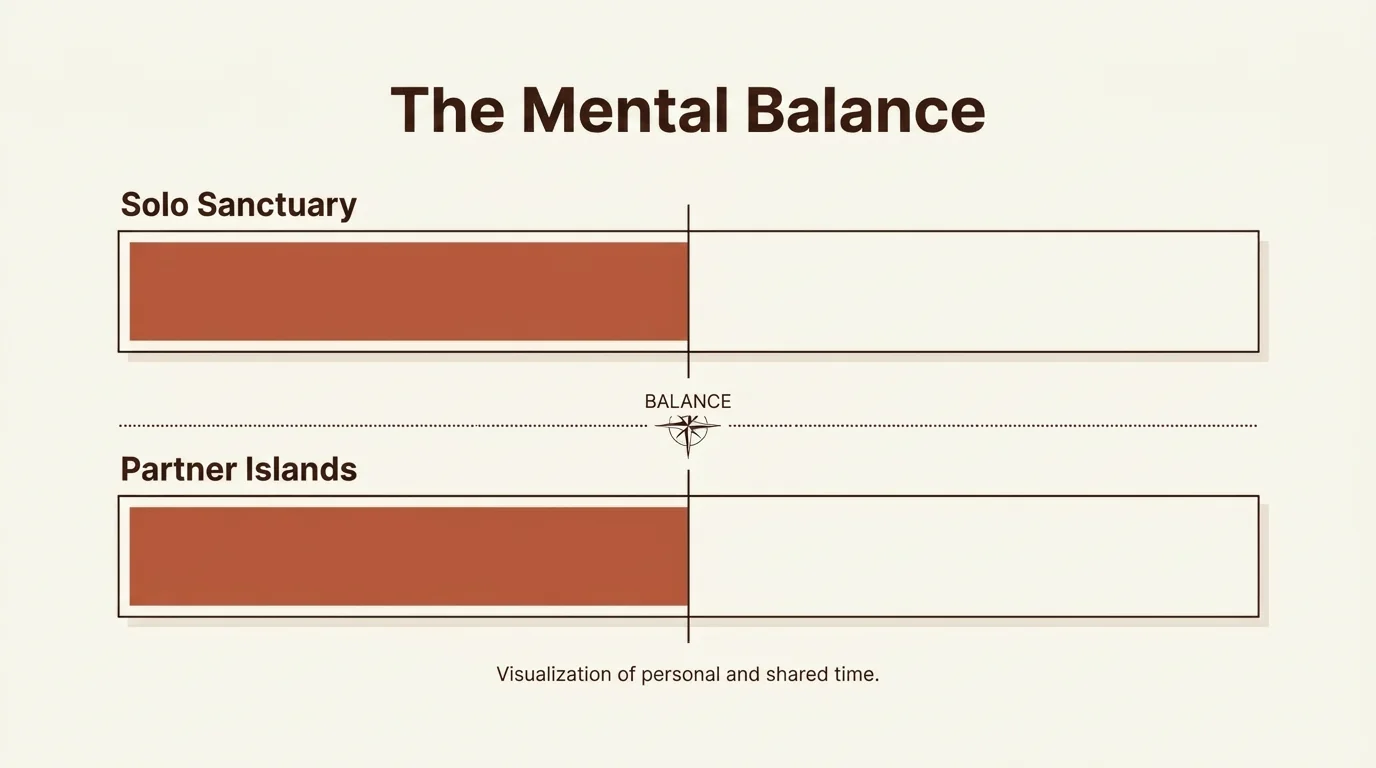
Without these islands of time together, you risk drifting apart. Without your personal sanctuary, you risk losing yourself in the relationship, slowly letting go of your own interests.

An illustration showing two bars, labelled 'Solo Sanctuary' and 'Partner Islands', held in perfect balance. Successful relationships often need both: time together and time for yourself.
Talk about this with your partner early on. An honest sentence like, “I really need Thursday evenings to myself,” is far more likely to strengthen your relationship than to threaten it.

5. The first 100 days: A guide

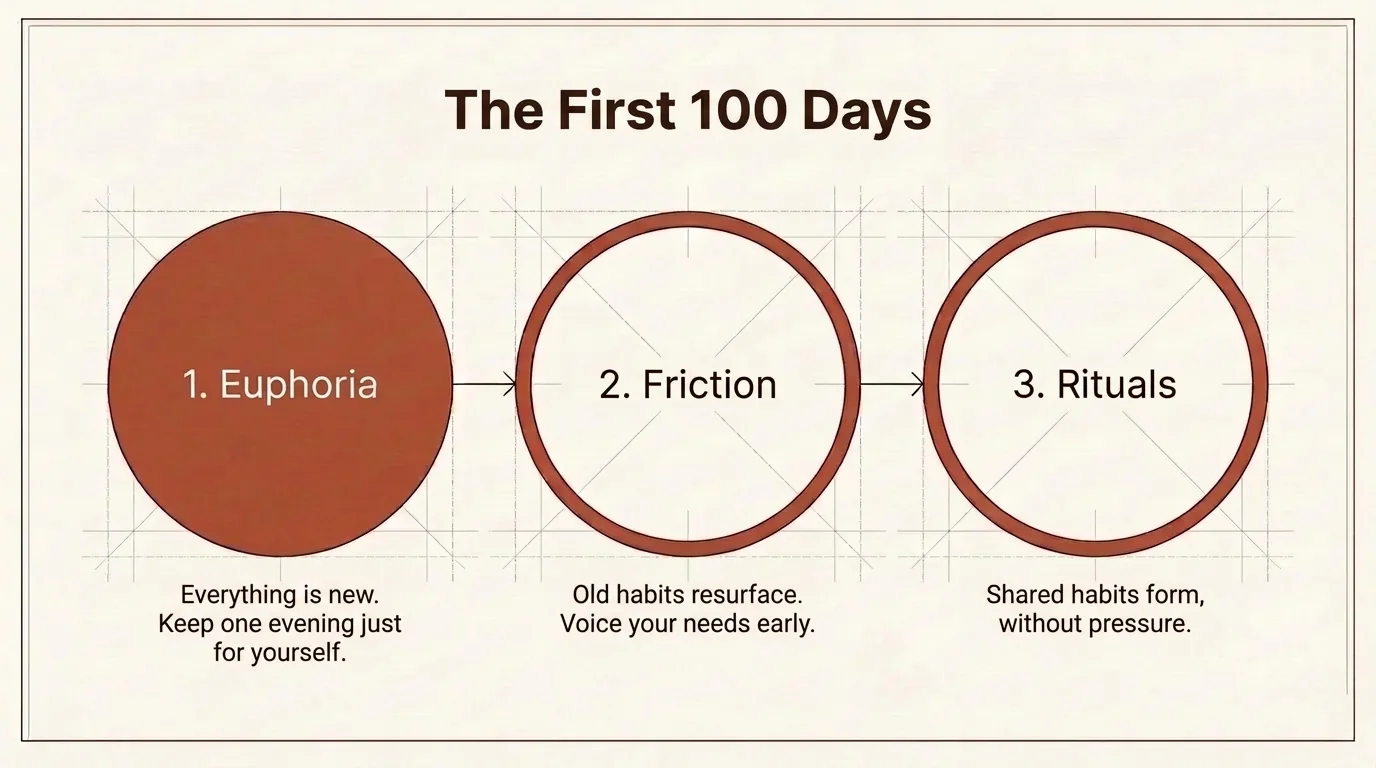
The first 100 days of a relationship are rarely a straightforward journey. Things often unfold in three phases, though every couple moves at their own pace. Think of these phases as a guide, not a rigid timetable.

Phase 1: Euphoria and the risk of losing yourself

Everything is new, everything is exciting. Typically, you might find yourself cancelling on friends and changing your own life to fit perfectly around your new partner.

Your anchor: Carve out at least one regular slot in your week that's just for you. One evening is all it takes.

Phase 2: Your old 'single' self reappears

After a few weeks, old habits start to creep back in. You might want some peace and quiet, while they want closeness. The first bit of friction emerges.

This isn't a sign that you're not a good match. This is the point where infatuation can deepen into a real relationship. It's a different story if you feel disrespected or pressured: that's not friction, that's a red flag.

Your anchor: Talk about your needs before they build up into resentment. A quick weekly check-in can help: What went well this week? What did I find challenging? What do I need going forward?

Phase 3: Finding your rhythm as a couple

This is when you start creating routines that work for both of you: a trip to the Saturday market, a phone call every evening, cooking a meal together.

Your anchor: Routines are allowed to change. Check in with each other regularly to see if they still bring you joy or if they've started to feel like a chore.

Infographic showing the first 100 days of a relationship in three phases: Euphoria, Friction, Rituals The first 100 days often unfold in three phases: euphoria, friction, and rituals.

6. Finding 'the one': where to begin

When you're looking for a serious relationship, it’s about quality, not quantity. That's why some dating sites are designed to focus on what really matters: personality and compatibility.

Swipe-based dating apps like Tinder, Bumble or Hinge are all about instant decisions, and that’s not for everyone. If you're hoping to find a committed relationship, you might prefer a platform that prioritises personality and finding a genuine match.

For singles in their 40s, 50s and beyond, popular dating sites include eHarmony, Match.com, Ourtime and EliteSingles. There are also niche services that cater specifically to mature singles. The right dating site for you will depend on what you’re looking for, the pace you’re comfortable with and your gut feeling. Of course, no platform can guarantee success.

Wherever you choose to look, three things can help:

  • Perfect your profile: AskAlva's Profile Check reviews your photos and bio, giving you concrete tips on how to improve them. The check assesses photo quality, never the person.
  • Master the chat: The Chat Coach helps you make sense of messages and find the right replies.
  • Date safely: The Scam & Safety Check flags potential warning signs in profiles and chats. It’s no substitute for your own judgement.

Take your time. A good relationship rarely starts in a hurry.

7. FAQs: Am I ready for a relationship?

How do you know when you’re ready for love again?

You’ll know you’re ready for love again when you can get excited about meeting someone new, rather than needing them to fill a void. You can think about the past without it weighing you down, and you have genuine room in your life for a partner. There's no such thing as absolute certainty – curiosity and openness are often all you need to start.

How can you overcome a fear of getting close?

You can overcome a fear of getting close step by step. Notice when you feel the need for space, and talk about it instead of just pulling away. Small, positive experiences of letting someone in will help to build your trust. If the fear feels particularly strong, counselling can provide extra support.

What's the biggest change when you're no longer single?

When you're no longer single, the biggest changes are to the pace of your decisions and how you plan your daily life. You start making plans with someone else, sharing your time and opening up more about your inner world. In return, you gain support, companionship and shared experiences.

I've been single for a long time. Does that make me incapable of being in a relationship?

No, being single for a long time doesn't make you incapable of being in a relationship. A long spell of being single says very little about your ability to form a partnership. You've likely developed your own routines, but these can always be adapted. With patience and openness, you'll learn to share your life again.

Do I have to be completely over my ex?

No, you don't have to be completely over your ex to start a new relationship. The crucial thing is that your past relationship isn't dictating your behaviour in the new one. If you can talk about it without getting overwhelmed, you're probably ready.

How can I protect myself from scams when I'm dating?

You can protect yourself from scams by watching out for red flags. These include someone declaring intense feelings very quickly, always making excuses to avoid a video call, or asking for money early on. If you’re in any doubt about a profile or chat, proceed with caution. Being aware of the tactics scammers use helps you stay safe without becoming mistrustful.

How long does it take to adjust to being in a relationship again?

The time it takes to adjust to being in a relationship again is different for everyone. The first 100 days can offer a useful framework, but there's no need to reach a specific milestone in that time. More important than the pace is staying true to yourself along the way.

Your next step

Take another look at the quick checklist and choose a couple of things you'd like to focus on. Then, make sure you book your first 'solo sanctuary' into your diary.

When you feel ready to start connecting with people again, AskAlva is here to help with your chats, your profile, and staying safe. Simply upload a screenshot and you’ll get clear, no-nonsense advice.

🧭 Dating coach by AskAlva

Not sure how to go about it? Upload a screenshot. AskAlva gives you a clear read in under a minute.

Try it free →

Screenshots are never stored.

More from “Strategy & mindset”